Part 1
A seven-year-old girl told me she slept in a car because her family had no room for her. Then I noticed the library book beside her pillow—and realized someone had been lying.
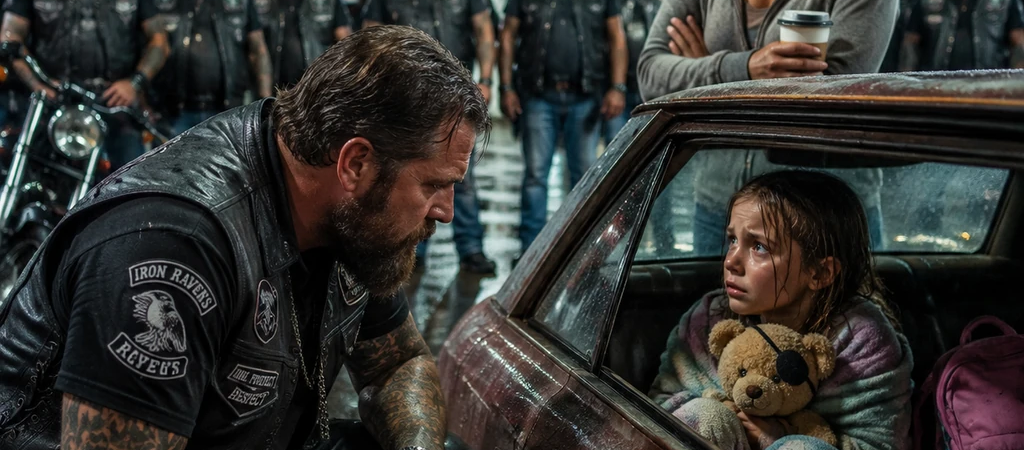
My name is Caleb Mercer, and that night I was parked outside a closed gas station in Mill Creek, Ohio, with rain ticking against my helmet.
I belonged to the Iron Ridge Riders, a motorcycle club with 450 members spread across three states. We were not a gang, and we were not looking for trouble. Most weekends, we collected donated coats, repaired veterans’ porches, and delivered meals to people who could not drive.
That evening, I had been riding home alone after helping fix a wheelchair ramp at a church on the east side.
The gas station lights buzzed above a row of empty pumps. My old black motorcycle leaned beside the curb, its chrome dulled by road salt. I was reaching for my gloves when I saw the rusted sedan parked behind the building.
Its windows were fogged from the inside.
At first, I thought someone had left a dog in there. Then I saw a small hand move beneath a faded blanket.
I walked closer and tapped lightly on the glass.
The girl sat up.
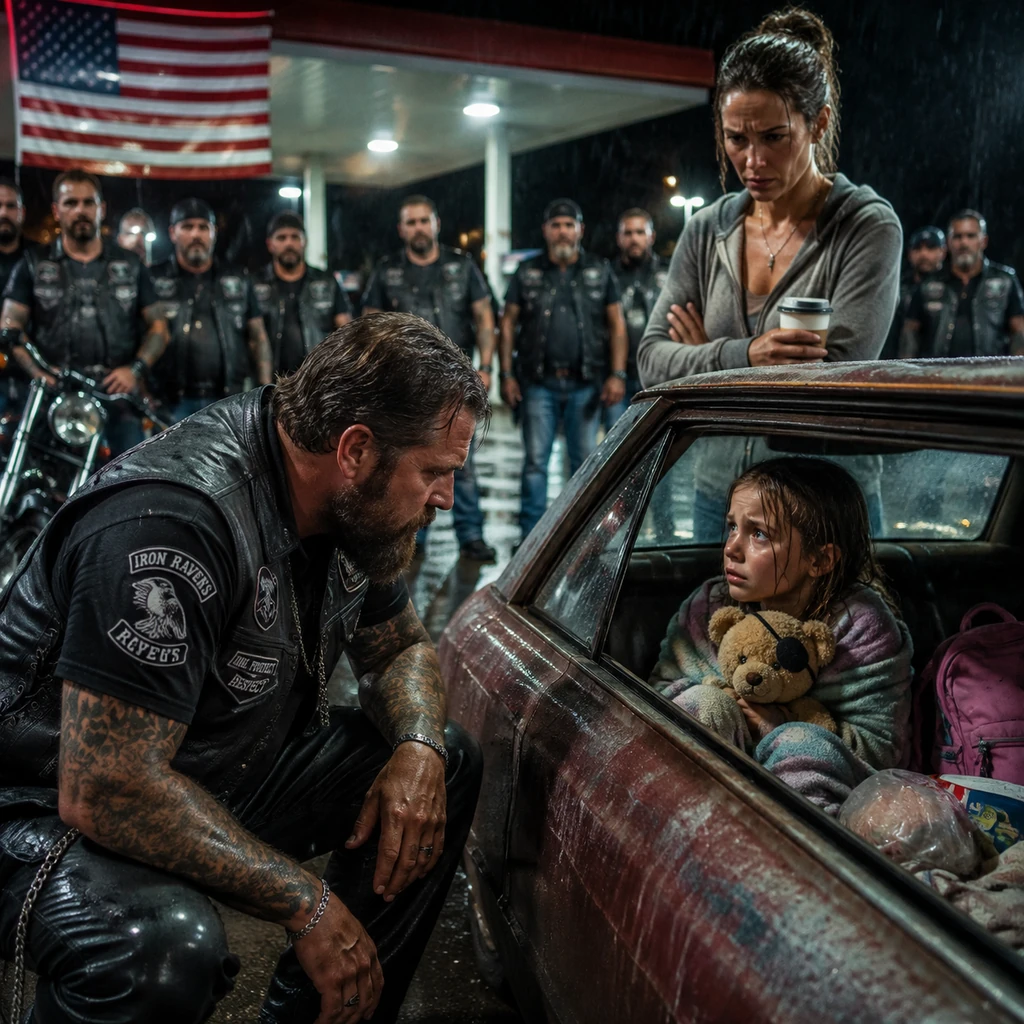
She had tangled brown hair, a purple sweatshirt, and a stuffed bear missing one eye. A library book rested against her knees. Its title was stamped in yellow letters: The Secret Garden.
She did not scream. She did not reach for the door.
She only watched me through the fogged window.
I lifted both hands so she could see I was not trying to scare her.
“Hey,” I said. “Are you okay in there?”
The girl looked toward the gas station office, even though the building had been closed for an hour.
Then she whispered, “Please don’t tell my mom I’m awake.”
That answer made the rain feel colder.
I crouched beside the window.
“What’s your name?”
“Ruby.”
“Ruby what?”
“Ruby Carter.”
I glanced at the front seat. There was no adult inside. No coat large enough for a grown person. No food, except for an empty paper cup and a crushed packet of crackers.
“Where’s your mom, Ruby?”
“She’s at the apartment.”
“Why are you sleeping here?”
Ruby pulled the blanket tighter beneath her chin. The stuffed bear’s loose button eye pointed toward me.
“There’s no room for me,” she said.
The sentence sounded practiced.
Not like a child explaining something. Like a child repeating something she had been told to say.
I stood and looked around the lot. The sedan had a flat rear tire and a paper notice tucked beneath one windshield wiper. The date was three days old.
“Does your mom know you’re here?”
Ruby nodded.
“She said I could stay in the car until she made space.”
“Made space for what?”
Ruby stared at the library book.
“For the baby.”
That was when I noticed her fingers. They were pale and stiff from the cold.
I removed my riding jacket and wrapped it around my arm before opening the rear door.
“Ruby, I’m going to get you somewhere warm. Is that okay?”
She shook her head quickly.
“If I leave, she’ll be mad.”
“Your mom?”
“Denise.”
I waited.
Ruby looked down at the book again.
“Denise is my mom’s sister. My mom said Denise was helping us.”
The rain ran off the edge of the car roof and dripped onto my sleeve.
“Where is your mother tonight?”
Ruby pressed her lips together.
“She went to find work.”
“When?”
“Yesterday.”
A seven-year-old should not have to measure time by whether her mother came back.
I called the number on the gas station sign, but no one answered. Then I called the county’s non-emergency child welfare line and explained what I had found. The dispatcher asked if Ruby was injured.
“No,” I said. “But she’s cold, alone, and sleeping in a car.”
Ruby heard me and shook her head harder.
“Don’t call them.”
“Why not?”
“They’ll take me away.”
“Who told you that?”
“Denise.”
Her voice cracked on the name.
I kept my tone calm. “Ruby, I’m not going anywhere. But I need to know what happened.”
She looked through the windshield toward the dark road.
“Denise said if anyone asked, I had a home. She said if I told the truth, they’d put me with strangers.”
The dispatcher stayed on the line while I found a clean blanket in my saddlebag. I placed it around Ruby’s shoulders and left the door open so she could breathe without fogging the glass.
Then Ruby reached beneath the seat and pulled out a red plastic folder.
“I’m not supposed to show this,” she said.
“What is it?”
She held it against her chest.
“My school papers.”
Inside was a folded attendance notice from Mill Creek Elementary. Ruby had missed eleven days. There was also a handwritten note from the school counselor asking Denise Carter to schedule a meeting.
At the bottom of the note, someone had written in blue ink:
Please call Ruby’s mother directly.
I read it twice.
“Does your mom have a phone?”
Ruby shook her head.
“Denise does.”
“Do you know the number?”
Ruby pointed to a child’s drawing taped beside the back window. It showed three stick figures standing beneath a yellow house. A phone number was written across the top in careful, uneven numbers.
I called it.
A woman answered on the fourth ring.
“Who is this?”
“My name is Caleb Mercer. I found Ruby in the back of a car behind the QuickStop on Harlan Road.”
There was silence.
Then the woman said, “She’s fine. She knows where she belongs.”
“Are you Denise Carter?”
“You need to leave my niece alone.”
“Ruby is seven years old and has been sleeping in a car.”
“She has a bed.”
“Where?”
“With us.”
“Then why is she outside?”
The woman’s voice sharpened.
“Because she wouldn’t listen. She knows the rules.”
Ruby had curled into the corner. She was listening to every word.
I moved a few steps away from the car.
“What rules?”
“You’re making this worse.”
“I’m asking a simple question.”
“Take her to the police station if you want. They’ll send her right back.”
Then Denise hung up.
The dispatcher asked me not to move Ruby until an officer arrived. I sat on the wet curb beside the sedan and kept talking to her about school, books, and the stuffed bear she had named Captain.
She told me Captain had protected her since she was four.
“From what?” I asked.
“Bad dreams. Loud doors. When Mom cries.”
She said it without drama. That was the part I could not forget.
At 9:18 p.m., a county deputy arrived with a child-welfare investigator named Marissa Bell. Marissa wore a navy county jacket and carried a clipboard under one arm.
She did not rush Ruby. She crouched near the open door and introduced herself.
“Hi, Ruby. I’m Marissa. Can I sit here?”
Ruby nodded.
Marissa asked gentle questions. Ruby answered most of them, but each time her aunt’s name came up, she went quiet.
The deputy checked the car and found a small suitcase under the front passenger seat. Ruby’s clothes were folded inside. There were two pairs of socks, a toothbrush, a school picture, and a paper bag with three granola bars.
This was not a child who had accidentally fallen asleep in a car.
Someone had prepared the car for her.
Marissa looked at me.
“Does the club have a family shelter or emergency lodging?”
“We have a community house,” I said. “It’s owned by one of our members. Families can stay there while county services arrange something permanent.”
“Is it licensed?”
“It’s a temporary volunteer residence. We would follow whatever placement rules you require.”
Marissa nodded, but she did not promise anything.
Ruby reached for my sleeve.
“Are you going to leave?”
“No.”
“You have to go home.”
“I know.”
“Then why are you still here?”
I looked at that one-eyed bear, the folded school papers, and the little suitcase packed beneath a stranger’s seat.
Because somebody had decided Ruby could be hidden until she became inconvenient.
But I could not simply take her. I could not make a promise the law would not allow me to keep. And I could not pretend that a warm blanket solved the reason she had been left there.
Marissa stood and called Denise again. This time, no one answered.
The deputy wrote down the address of Denise’s apartment. It was only six miles away.
Ruby gripped my sleeve tighter.
“Please don’t make me go there.”
“What happened there?” Marissa asked.
Ruby looked at the dark sedan window.
“My mom left something for me.”
“What did she leave?”
Ruby reached into the pocket of her purple sweatshirt and pulled out a brass key.
“She said if Denise tried to send me away, I should give this to the biker who asked questions.”
I stared at the key.
It was stamped with a number: 417.
Ruby looked up at me.
“Are you the biker she meant?”
I had no idea who Ruby’s mother was, or what door that key opened. But I knew I could not hand Ruby back to the same silence that had put her in that car.
I took out my phone and called our club president, Marcus Hale.
“Wake everyone you can,” I said. “We have a child who needs a safe place, and her mother may be in danger. I want every legal resource we have ready before midnight.”
Marcus did not ask for details.
He only said, “Send me the address.”
I looked at Ruby, then at the key in her small hand.
And I decided I would find out what door her mother had tried to open before she disappeared.
Whose side are you on so far? Leave a comment, tap Like, or share this post—the full story continues in the comments.