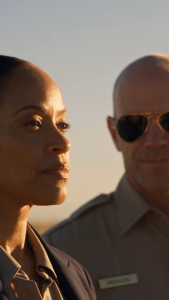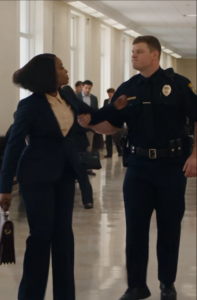
Cop Struck a Black Woman He Mistook for a Defendant—Then the Bailiff Called Her “Your Honor,” and the Courthouse Had to Face What It Had Ignored
Part I — The Hallway
The first thing Officer Bradley Miller took from me was not my dignity.
It was the assumption that the courthouse would protect me simply because I belonged there.
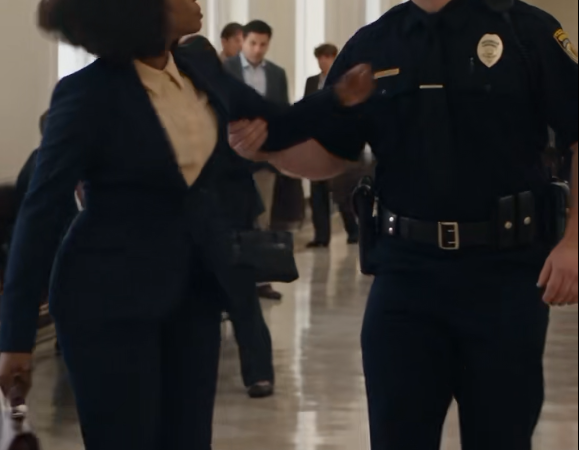
His palm struck the left side of my face hard enough to turn my head and send my briefcase to the floor. Papers slid across the polished hallway tile, some stopping beneath benches, others catching against the shoes of people who had been pretending not to watch.
For one second, the world narrowed to three things: the metallic taste of blood, the ringing in my left ear, and Miller reaching for his handcuffs.
“Assaulting an officer,” he said.
His fingers closed around my arm again.
“Turn around.”
I looked at him.
He was close enough that I could see the pale line beneath his patrol cap where the sun normally reached his forehead. Close enough that I could smell coffee on his breath. Close enough to understand that he was not afraid of me.
That mattered.
People later asked whether I had been frightened.
Not then.
Fear came later, when I understood how casually it had happened.
At that moment, I was furious.
“You have absolutely no idea what you’ve just done.”
Miller gave me a thin, dismissive smile.
“I know exactly what I did.”
Heavy footsteps sounded behind him.
“Get your hands off her!”
Senior Bailiff Thomas Gallagher came around the corner at a speed I would not have believed possible for a man in his late sixties.
Thomas had worked in the Monroe County courthouse longer than some judges had practiced law. His gray hair was thinning, his shoulders had rounded over the years, and one knee made him descend stairs sideways when he thought nobody was looking.
None of that slowed him now.
He pushed between us.
Miller’s free hand moved instinctively toward his Taser.
“Back off, Tommy.”
Thomas ignored him.
He turned toward me.
His face changed.
“Your Honor…”
Miller stopped moving.
Thomas looked at my swelling cheek, then at the blood along my lower lip.
“Oh, dear God.”
The corridor went quiet in a way it had not been quiet when Miller struck me.
That was the part I remembered most.
Not the slap.
Not the handcuffs.
The silence after Thomas identified me.
Before those two words, people had watched a police officer grab a Black woman, accuse her of lying, and hit her.
After those two words, they understood something serious had happened.
I was the same woman in both moments.
Thomas turned slowly toward Miller.
“What did you do?”
Miller released my arm.
“I—”
“She told me she was—”
“A judge?” Thomas said.
Miller swallowed.
“She said she was Judge Caldwell.”
Thomas stared at him.
“And then?”
Miller looked at me.
His expression had already begun changing shape, certainty turning into calculation.
“She resisted.”
A young attorney near the elevator spoke before I could.
“No, she didn’t.”
Miller looked toward him.
Another voice came from farther down the corridor.
“He grabbed her first.”
Then another.
“She told him to let go.”
A courthouse clerk stepped out from beside the wall.
“He hit her.”
Miller’s gaze moved through the crowd.
Minutes earlier, he had seemed strengthened by an audience.
Now he appeared to be counting witnesses.
I bent and picked up one of my papers.
Thomas immediately crouched beside me.
“Leave it, Judge.”
“I can pick up paper, Thomas.”
“Your face—”
“My face can wait.”
I gathered another page.
My hand was steady until I saw a small red drop appear on the white margin.
Blood from my lip.
That made my fingers tremble.
Not much.
Enough.
Thomas saw it.
He stopped collecting papers.
“Judge Caldwell.”
“I’m fine.”
“No, ma’am.”
His eyes were wet.
That nearly undid me.
Thomas had spent decades around crime scenes, grieving families, handcuffed teenagers, furious attorneys, frightened witnesses, and judges who believed volume was a substitute for authority. I had never seen him close to tears.
“I’m all right,” I said more quietly.
He stood.
“No. You’re standing. That’s different.”
Miller shifted behind him.
“Judge, I apologize. There was obviously a misunderstanding.”
I straightened.
The side of my face was beginning to throb.
“A misunderstanding?”
“I was given a description of a defendant who failed to report to 4B.”
“Maya Reynolds.”
“Yes.”
“And what was the description?”
Miller hesitated.
I waited.
Thomas looked at him too.
Finally Miller said, “Black female. Mid-forties. Dark coat.”
I glanced down at my charcoal suit jacket.
“No height?”
“I don’t remember.”
“No photograph?”
“I was told—”
“You called me Maya Reynolds before asking my name.”
He said nothing.
“You accused me of lying when I gave you my name.”
“Judge—”
“You demanded identification. I challenged your basis for detaining me. You grabbed me. When I tried to remove your hand, you called it resistance.”
Miller’s face reddened.
“That’s not exactly how—”
“And then you struck me.”
His jaw moved.
“Your Honor, I believed you had assaulted—”
“No.”
I did not raise my voice.
That made him stop.
“You believed you could define whatever happened after the fact because you were the one wearing the badge.”
The hallway remained silent.
I became aware of how many people were there.
Defendants.
Attorneys.
Clerks.
Two deputies.
People with cases waiting.
People who had likely spent their lives adjusting their behavior around authority.
This was no longer just my humiliation.
I suddenly felt exposed in a different way.
Every word I spoke would matter because I was a judge.
Every angry gesture could become a headline.
Every accusation could later be characterized as an abuse of my position.
I had spent fifteen years telling clients not to give angry people with authority anything extra to use against them.
Now the advice belonged to me.
I turned to Thomas.
“Is there a supervisor on this floor?”
“Yes, Your Honor.”
“Get one.”
Miller spoke.
“Judge Caldwell, can we talk privately?”
His mouth closed.
“I want this handled exactly the way it would be handled if I were Maya Reynolds.”
Something shifted in the faces around me.
Miller understood it too.
“Do not call me that because you’re scared now.”
He flinched.
“I told you who I was before you hit me.”
Thomas left to find a supervisor.
I crouched again and finished collecting my papers.
A woman in the hallway handed me the last page.
She looked about thirty. She wore a county-issued visitor badge and held a folder against her chest.
“You okay?” she asked.
It was not the careful question of someone speaking to a judge.
It was the ordinary question one stranger asks another after witnessing something ugly.
“Yes,” I said automatically.
Her gaze moved to my face.
Then back to my eyes.
“No, you’re not.”
She walked away before I could answer.
I stood there holding my scattered papers.
For the first time that morning, I wondered where Maya Reynolds was.
Twenty minutes later, I sat in my chambers with an ice pack wrapped in a white courthouse towel pressed against my cheek.
The county medical nurse had examined me.
No broken jaw. No serious injury. Swelling, bruising, a split lip, mild ringing in my ear.
She recommended further evaluation if the ringing continued.
The chief administrative judge stood near my desk while a command officer from the police department occupied the chair opposite me.
Miller was no longer on the sixth floor.
He had been relieved of courthouse duty pending review.
The command officer had said that quickly, as though speed itself demonstrated seriousness.
I knew better than to confuse procedural movement with accountability.
“We will conduct a full investigation,” he said.
“I expect you will.”
“Body camera footage will be preserved.”
“Was his camera recording?”
A pause.
“We’re determining that.”
I lowered the ice pack.
“What does that mean?”
“We haven’t reviewed the device yet.”
“Was it activated?”
“I don’t want to speculate.”
Neither did I.
But I had spent enough time in courtrooms to recognize careful language.
The chief judge rested both hands on the back of a chair.
“Josephine, your calendar can be reassigned today.”
“I have arraignments at ten.”
“You were assaulted less than an hour ago.”
“I’m aware.”
“You have a visible injury.”
“I’m aware of that too.”
He looked at me for several seconds.
“This isn’t about proving something.”
“Then go home.”
I turned toward the window.
November rain moved in slanted sheets against the glass.
Below us, people hurried across the courthouse plaza beneath umbrellas, shoulders hunched, heads lowered.
Some of them were coming here because the government had accused them of crimes.
Some were here because they had been harmed.
Some were here to testify.
Some hoped to leave with custody of their children, restraining orders, probation terms, dismissed cases, convictions, second chances, or answers.
The building required all of them to believe that procedure meant something.
“I’m taking twenty minutes,” I said.
“Josephine.”
“Then I’m going to court.”
The command officer looked surprised.
The chief judge did not.
He knew me better.
“Why?”
I put the ice pack down.
“Because if I disappear for the day, the only thing people in that hallway will remember is that once someone important got hit, the entire building stopped.”
“And if you go out there looking like that?”
“They’ll remember the judge still had a docket.”
He watched me.
Then he nodded once.
“Twenty minutes.”
When they left, Thomas remained by the door.
“You can say it,” I told him.
“I’m not saying anything.”
“You’re thinking loudly.”
He looked offended.
“I have never thought loudly in my life.”
Despite myself, I smiled.
Pain pulled at my split lip.
I stopped.
Thomas’s expression softened.
“I should’ve been there.”
“You were.”
“Earlier.”
“You were doing your job.”
“So was he, apparently.”
I looked up.
Thomas immediately regretted the words.
“Sorry.”
“No. Don’t be.”
He lowered himself into the chair across from me.
For a moment, neither of us spoke.
Then he said, “You know what scares me?”
“What?”
“If he’d realized you were a judge five seconds earlier, none of this would’ve happened.”
“That scares me too.”
“No.” Thomas shook his head. “Not what I mean.”
He rubbed his palm over one knee.
“What scares me is that he didn’t become a different man when I called you ‘Your Honor.’ He just realized he’d picked the wrong person.”
The ringing in my ear seemed louder.
Thomas looked toward the closed door.
“I’ve been in this building thirty-two years. You see enough people come through, you learn who changes depending on who’s watching.”
“Did you know something about Miller?”
He did not answer immediately.
That was answer enough.
“I knew he was rough.”
“Rough how?”
“Short temper. Likes compliance.”
“Have you seen him hit someone?”
“Threaten someone?”
“I’ve heard him talk.”
Thomas rubbed his jaw.
“He talks different to defendants than lawyers. Different to young guys than old ones. Different when supervisors are around.”
“Did you report it?”
His eyes met mine.
The honesty stung more than an excuse would have.
“Because I never had anything concrete.”
“You just said you heard him.”
“I heard attitude. Sarcasm. Things you can explain away one by one.”
“And together?”
Thomas looked down.
“Together, maybe they were something.”
I leaned back.
A knock sounded.
My courtroom clerk stepped inside.
“Judge?”
“Yes?”
“There’s a problem with your docket.”
“What problem?”
She held up a file.
“The Reynolds matter.”
I looked at the label.
STATE v. MAYA REYNOLDS.
For several seconds, no one spoke.
My clerk continued carefully.
“It was transferred from 4B this morning. The assigned judge had an emergency. It was supposed to come before you after arraignments.”
I stared at the folder.
Maya Reynolds.
The woman Miller believed I was.
“What’s the hearing?”
“Motion to suppress.”
“Basis?”
She hesitated.
“Alleged unlawful detention and excessive force during arrest.”
Thomas closed his eyes.
I held out my hand.
“Give me the file.”
Part II — Pressure
Maya Reynolds was not waiting in my courtroom.
She was in a consultation room with her public defender when I came downstairs in my robe.
The robe covered the suit Miller had mistaken for a defendant’s clothes.
It did not cover my face.
People noticed.
I saw them looking when I entered from the side door and climbed the two steps to the bench.
Nobody spoke about it.
That was appropriate.
For forty-seven minutes, I handled arraignments.
A shoplifting case.
A probation violation.
A man charged with breaking a car window during an argument.
A woman accused of possessing a controlled substance.
The work forced me into its familiar rhythm.
Names.
Rights.
Conditions.
Dates.
Arguments.
Records.
Every person before me deserved a judge who was listening, not replaying a hallway confrontation.
So I listened.
But details landed differently.
When an assistant prosecutor described one defendant as “uncooperative during contact,” I asked what that meant.
When an officer’s report stated a suspect had “pulled away,” I asked whether the officer had been holding him first.
The prosecutor noticed.
So did I.
I had asked those questions before.
Now I heard the language differently.
At eleven fifteen, my clerk handed me the Reynolds file.
I opened it.
Maya Reynolds was forty-one, not forty-three.
Five foot six.
Black.
Dark hair.
No violent criminal history.
She had been arrested three weeks earlier on a charge involving alleged theft from an employer. She maintained that the disputed money had been authorized reimbursement and that internal records would prove it.
That question was not before me.
The motion concerned her arrest.
According to Officer Bradley Miller’s report, he had approached Reynolds outside her apartment building after receiving confirmation of a warrant. Reynolds had “become argumentative,” “attempted to walk away,” and “physically resisted lawful detention.”
According to Reynolds, Miller had not identified himself before grabbing her arm. She had pulled away instinctively. He had twisted her against a vehicle and threatened to add charges if she did not stop “acting like a lawyer.”
I read that phrase twice.
Acting like a lawyer.
My clerk stood silently beside the bench.
“Bring counsel in,” I said.
Both attorneys entered.
Maya came with her public defender.
I knew her immediately.
Not because she resembled me.
She barely did.
She was shorter, wore her hair differently, and had a narrow face that did not resemble mine except in the broadest description.
Black woman.
Adult.
Dark clothing.
That had apparently been enough.
Maya saw my cheek.
Her step slowed.
Her eyes moved from me to the bailiff, then back.
I knew from her expression that she had already heard.
Courthouse news traveled faster than any official announcement.
“All rise.”
Everyone stood.
I sat.
“Please be seated.”
Maya lowered herself beside her attorney.
I looked at the lawyers.
“There is a matter I need to address before we proceed.”
The prosecutor stood.
“Your Honor, if this concerns this morning—”
“It does.”
Maya’s public defender looked at her.
I continued.
“Officer Bradley Miller is a material witness in the pending suppression motion. This morning, I had an encounter with Officer Miller that makes it inappropriate for me to hear any contested matter involving his credibility or conduct.”
The prosecutor nodded immediately.
“We agree, Your Honor.”
Maya’s lawyer rose more slowly.
“We understand.”
“I’m recusing myself from this case. It will be reassigned.”
Maya looked at me.
Not angry.
Not relieved.
Studying.
I closed the file.
“Anything further?”
Her attorney glanced at her.
Maya whispered something.
The lawyer shook her head slightly.
Maya whispered again.
Then the attorney faced me.
“My client is asking permission to speak.”
The prosecutor began to rise.
I lifted one hand.
“Not about the merits of the case.”
Maya stood.
She kept both hands on the table.
“Did he really think you were me?”
The courtroom became motionless.
Her lawyer touched her arm.
“Maya.”
“It’s all right,” I said.
I looked at her.
She glanced at my bruised cheek.
“Did you tell him who you were?”
“And he didn’t believe you?”
She gave a short breath that contained no humor.
Then she looked down.
“Okay.”
One word.
Nothing else.
But I understood what had happened.
She had not asked because she needed information.
She had asked because part of her wanted to know whether my title had protected me.
It had not.
Not until someone else confirmed it.
Maya sat.
I transferred the case.
That should have been the end of my connection to her.
It was not.
By noon, someone had posted a twelve-second cellphone video online.
It began too late to show Miller’s initial approach.
It showed me saying, “Take your hand off me.”
It showed him gripping my arm.
It showed me pulling away.
Then the camera jerked as several people moved.
The slap itself occurred partly outside the frame.
The sound did not.
The video ended seconds after Thomas said, “Your Honor.”
Twelve seconds.
That was enough.
By two o’clock, reporters stood outside the courthouse.
By three, the police department issued a statement describing “an incident involving an officer and a member of the judiciary.”
The statement said Miller had been placed on administrative leave pending an internal investigation.
It did not say he hit me.
It did not say he had mistaken me for a defendant.
It did not say I told him my name.
It did not say Maya Reynolds was Black.
At four thirteen, my phone rang in chambers.
Police internal affairs.
I had expected the call.
The investigator asked whether I could give a statement that afternoon.
“Would you prefer we come to you?”
“No. I’ll come there.”
Thomas, who had been standing near my office door, frowned.
After I hung up, he said, “You sure about that?”
“You don’t owe them convenience.”
“That’s not why.”
“Then why?”
I picked up my coat.
“Because I want to walk into the same building everybody else does.”
He shook his head.
“You judges get strange ideas about symbolism.”
“You’ve worked for judges thirty-two years.”
“That’s how I know.”
The interview room at internal affairs had beige walls, a metal table, and fluorescent lights that made everyone look tired.
Two investigators sat across from me.
A recording device rested between us.
I had brought counsel.
Not because I believed I was in danger of prosecution, but because I had spent fifteen years telling clients never to assume an interview was informal simply because everyone was polite.
The lead investigator explained the process.
I listened.
Then she asked me to describe what happened.
I did.
From the elevator to Thomas’s arrival.
Slowly.
Precisely.
Without adjectives I could not prove.
When I finished, she asked, “Did Officer Miller tell you why he believed you were Ms. Reynolds?”
“He said she was supposed to report to Courtroom 4B.”
“Did he describe her?”
“Not before stopping me.”
“Did you show identification?”
“Why not?”
My attorney shifted slightly.
I answered.
“Because I was not legally required to prove my identity merely because he had made an unsupported assumption.”
The investigator nodded.
“Do you believe showing identification might have prevented the physical confrontation?”
There it was.
A question I had heard in different forms for fifteen years.
Why didn’t you just comply?
Why didn’t you make it easier?
Why didn’t you solve the officer’s mistake for him?
I kept my voice level.
“It might have.”
She waited.
“That does not make his actions lawful.”
“I understand.”
“Do you?”
She looked up.
I regretted the sharpness almost immediately.
But I did not withdraw it.
She folded her hands.
“I understand the distinction you’re making.”
“Good.”
She continued.
“When Officer Miller grabbed your arm, you attempted to pull free?”
“Did you strike his wrist?”
“I moved his hand away when he reached for me again.”
“Could that have appeared aggressive?”
“To whom?”
“To Officer Miller.”
“He had already decided I was lying about my identity. I can’t testify to what he imagined after that.”
My attorney glanced at me.
A warning.
Stay factual.
I exhaled.
The investigator asked, “Did you tell him you were a former public defender?”
“What was his response?”
“He asked whether I wanted to ‘play lawyer.’”
She wrote something.
Then: “Did he make any statement you interpreted as racial?”
“He said, ‘You people always think you can argue your way out of everything.’”
“Did he specify what he meant by ‘you people’?”
“Could he have meant defendants?”
“He believed I was a Black female defendant.”
The investigator paused.
“I am not asking you to record my interpretation as fact. Record the words.”
She nodded.
“We will.”
When the interview ended, she turned off the recorder.
Then she remained seated.
“One more thing.”
“My attorney is still here.”
“I know.”
She looked uncomfortable.
“We reviewed Officer Miller’s body camera.”
“It was not recording during your encounter.”
My attorney leaned forward.
“Malfunction?”
“Battery?”
The investigator’s jaw tightened.
“It had been manually deactivated approximately fourteen minutes earlier.”
I stared at her.
“We don’t know yet.”
“Was he required to have it activated?”
“In public enforcement contacts, yes.”
“How long had it been off?”
“Fourteen minutes before the incident through three minutes after.”
My attorney asked, “When did it resume?”
The investigator looked at me.
“Shortly after Senior Bailiff Gallagher identified Judge Caldwell.”
The room seemed smaller.
I sat back.
“Are you saying Miller turned his camera on after he learned who I was?”
“We are still establishing the exact sequence.”
“Do you have activation timestamps?”
“Then you have the sequence.”
She did not argue.
For the first time since the hallway, I felt something colder than anger.
Miller had not merely lost control.
At some point before meeting me, he had made a choice to turn off the device intended to document what he did.
And once he discovered I was a judge, he made another choice.
He turned it back on.
Thomas was waiting outside.
He stood when I emerged.
“Well?”
“The camera was off.”
His expression barely changed.
“How convenient.”
“Manually.”
That changed it.
He looked down the corridor.
“I need to tell you something.”
“Not here.”
We went downstairs and sat in an empty courthouse cafeteria after closing.
Rain tapped against the windows.
Thomas placed his coffee on the table but did not drink it.
“You remember a guy named Leon Price?”
“Disorderly conduct case. Maybe six months ago. Young Black guy. Delivery driver.”
I shook my head.
“You probably never had the case. Happened downstairs. Miller brought him in.”
“What happened?”
“Price had a warrant for missing court on a traffic matter. Miller arrested him near security. Kid kept saying the warrant had been recalled. Miller told him to shut up. Price said he wanted someone to check.”
Thomas rubbed his thumb against the paper cup.
“Miller shoved him against the wall.”
“You saw it?”
“Part of it.”
“Did Price resist?”
“Not that I saw.”
“What happened afterward?”
“He filed a complaint.”
“And?”
“Nothing.”
“How do you know?”
“He came back a month later asking whether anyone had talked to me. Nobody had.”
I stared at Thomas.
“Did you report what you saw?”
“I told myself I hadn’t seen the beginning.”
“That didn’t stop you from seeing the end.”
His voice had gone quiet.
I looked away.
The cafeteria lights reflected off the dark windows.
Thomas continued.
“There was another woman last year. Older. Miller accused her of ignoring an order at security. Grabbed her bag, dumped everything on the floor.”
“Complaint?”
“Don’t know.”
“You never told anyone?”
“I complained to another bailiff. He said Miller was an ass.”
“That was it?”
“That was it.”
I wanted to be angry at him.
Part of me was.
But another part recognized the system he was describing.
Not conspiracy.
Not secret meetings.
Not people agreeing to protect misconduct.
Something more ordinary.
Each person saw one small piece.
Each piece seemed insufficient on its own.
Everyone assumed someone else had a better view.
The absence of certainty became permission to do nothing.
Miller did not need everyone to approve of him.
He only needed them to doubt themselves.
Thomas stared at his coffee.
“I keep thinking about what I said in your office.”
“Which part?”
“That he picked the wrong person.”
“That’s not right.”
He looked at me.
“He picked the same kind of person he always picks. He just happened to be wrong about what would happen afterward.”
Part III — Reversal
The bruise darkened overnight.
By Wednesday morning, makeup could not hide it.
I did not try.
My first hearing involved a plea agreement.
The second involved a landlord dispute.
The third was postponed because a witness had not appeared.
Life inside the courthouse continued.
That bothered some people.
They seemed to expect the building to become entirely about what had happened to me.
It did not.
People still needed restraining orders.
Juries still deliberated.
Parents still fought over children.
Defendants still sat beside lawyers and waited to learn whether they were going home.
The institution continued because institutions always do.
That is both their strength and their danger.
At eleven, the chief judge came to my chambers.
“The department wants you to avoid commenting publicly until the investigation is complete.”
“I haven’t commented.”
“They’re concerned about appearances.”
“Whose?”
He sighed.
“I’m asking.”
“The entire courthouse is under a microscope.”
“That microscope includes us.”
“Also good.”
He sat.
“There are already questions about whether defendants can get fair hearings involving city officers.”
“They’re entitled to ask.”
“And questions about whether judges here are too close to law enforcement.”
“They’re entitled to ask that too.”
He studied me.
“You’ve changed.”
“Since Tuesday?”
“Since you came to the bench.”
“How?”
“You were more patient with imperfect systems as a lawyer.”
“That is a remarkable sentence.”
“You know what I mean.”
“I really don’t.”
“You understood constraints.”
“I still do.”
“You understood that sometimes the record in front of the court is incomplete.”
I looked at him for several seconds.
“Are we talking about Miller?”
“We’re talking about the courthouse.”
“No. You came here because you’re worried my experience will affect my judging.”
“I came here because I’m worried you think seeing one ugly thing means everything around it is rotten.”
I stood.
“Get out.”
He blinked.
“I said get out.”
He stood too.
“This is exactly what I’m talking about.”
“No. What you’re talking about is whether being struck in a courthouse hallway has made me unreasonable.”
“That’s not what I said.”
“It’s what you came to ask without asking.”
His face tightened.
“I’m trying to protect the institution.”
I walked to the door and opened it.
“The institution did not get slapped.”
He stopped beside me.
Then he said, “Neither did every officer in this county.”
I looked directly at him.
“That’s why Miller’s individual history matters.”
He frowned.
“What history?”
I said nothing.
His expression changed.
“You should go.”
After he left, I closed the door.
My hands were shaking.
I hated that.
Anger had always made my hands cold.
As a young lawyer, I had learned to hide them beneath counsel tables.
As a judge, I usually folded them above the bench.
I sat at my desk until they steadied.
Then my clerk called.
“Maya Reynolds’s attorney is asking whether you have a minute.”
I nearly said no.
Instead, I said, “What for?”
“She says it’s not about the pending motion.”
I thought about recusal.
About appearances.
About boundaries.
“Five minutes.”
The public defender entered alone.
She closed the door.
“Maya asked me to give you something.”
“If it concerns her case, I can’t receive it.”
“It doesn’t.”
She placed a photocopy on my desk.
A complaint form.
Officer involved: Bradley Miller.
Complainant: Maya Reynolds.
Date: three weeks earlier.
I did not touch it.
“What is this?”
“She filed it the morning after her arrest.”
“I can’t review evidence related to her motion.”
“This complaint isn’t part of the motion.”
“It could become part of it.”
“That’s why I’m not asking you to act on it as a judge.”
“Then why are you here?”
“Because internal affairs told her yesterday they had no record of a prior complaint.”
I looked at the paper.
Maya’s attorney continued.
“She has her copy.”
“Stamped?”
There was a received stamp at the bottom.
MONROE COUNTY POLICE — PROFESSIONAL STANDARDS.
Three weeks earlier.
I felt the room tighten around me.
“Where was it filed?”
“Department headquarters.”
“With whom?”
“She dropped it at the desk. They stamped her copy.”
“And internal affairs says it doesn’t exist?”
“They said they could not locate it.”
I did not touch the page.
“Take this to the investigator.”
“We are.”
“Then why bring it here?”
The attorney hesitated.
“Maya wanted you to know she wasn’t waiting for a judge to get hit before she complained.”
The words landed cleanly.
No accusation in the lawyer’s voice.
None was necessary.
I stared at the complaint.
“Take it.”
She picked it up.
At the door, I said, “Counsel.”
She turned.
“Tell Ms. Reynolds…”
What?
That I believed her?
I had not heard the evidence.
That I was sorry?
For what exactly?
For a system larger than me?
For not knowing?
For being protected by a title she did not possess?
“Tell her I understand why she wanted me to know.”
The attorney nodded.
“That’s enough.”
After she left, I sat alone.
Then I did something I had warned myself not to do.
I searched my memory for every case in which Bradley Miller’s name had appeared before me.
Not because I intended to reopen them.
Because I needed to know whether I had missed something.
Three cases came immediately.
A drug possession matter.
A warrant arrest.
A resisting charge dismissed by the prosecutor.
In none had Miller’s credibility been directly litigated.
Then I remembered a fourth.
A young man accused of obstruction.
His lawyer had argued at sentencing that Miller escalated the arrest unnecessarily.
I had said something from the bench.
I could almost hear myself.
An allegation without corroboration cannot become a finding.
Legally correct.
Still correct.
But suddenly incomplete in a way that troubled me.
How many uncorroborated allegations remained uncorroborated because each one was sealed inside a separate file?
I called my clerk.
“Can you ask records for a list of public cases in which Officer Bradley Miller testified before this court over the last two years?”
She paused.
“For what purpose?”
“A conflict review.”
That was true.
“And only public docket information. Nothing sealed.”
“Got it.”
An hour later, she returned with eleven case numbers.
I did not read transcripts.
I did not investigate.
I did not have that authority.
But the number itself bothered me.
Eleven appearances in my courtroom.
How often had I seen his name and registered nothing?
That afternoon, internal affairs called again.
They had found Maya’s complaint.
It had been misclassified.
“Misclassified as what?” I asked.
“General correspondence.”
“Who classified it?”
“We’re reviewing that.”
“Was Miller notified?”
Another pause.
“When?”
“Two days after it was filed.”
“And when did his body-camera activation begin showing irregularities?”
The investigator became careful.
“I can’t discuss the broader review yet.”
“That means there is a broader review.”
“I didn’t say that.”
“You didn’t have to.”
She exhaled.
“Judge Caldwell, I need you to let us do our job.”
I looked through my office window at the courthouse plaza below.
“That is exactly what I’m doing.”
Friday morning, a second video surfaced.
Not of me.
Of Leon Price.
The delivery driver Thomas had mentioned.
Someone had recorded his courthouse arrest six months earlier.
The video began with Price pressed against a wall near the security checkpoint.
Miller had one hand between Price’s shoulder blades.
Price kept saying, “Check the warrant. Just check it.”
Miller told him to stop resisting.
Price’s hands were visible.
He was not resisting.
At least not in the portion recorded.
Miller pushed him harder.
Price turned his head.
“I’m not fighting you.”
Miller replied, “Then stop acting like you run this place.”
The video ended.
By noon, a local reporter had identified two other complaints involving Miller.
By afternoon, the police union released a statement urging the public not to “rush to judgment based on edited video fragments.”
That statement was factually reasonable.
Video fragments can mislead.
I had made that argument myself in court.
But fragments accumulate.
So do choices.
Internal affairs found that Miller’s body camera had been manually deactivated during seven enforcement contacts in the previous four months.
Not every deactivation involved a complaint.
Not every complaint alleged force.
But three did.
My incident made four.
The department did not release that information immediately.
It leaked.
When I read the report that night, I felt no satisfaction.
I was at home, standing barefoot in my kitchen.
The bruise on my face had turned yellow at the edges.
My phone lay beside the sink.
I switched it off.
For the first time all week, I cried.
Not dramatically.
No collapse.
No sobbing.
I stood at the sink while tears ran down my face, and I hated how ordinary the kitchen looked.
A cup on the counter.
A dish towel hanging crookedly.
Rainwater drying on the window.
I thought of Maya asking, Did you tell him who you were?
I thought of Leon Price saying, Just check the warrant.
I thought of Thomas saying he had never had anything concrete.
I thought of myself telling a defendant that allegations without corroboration could not become findings.
All those statements could be true at once.
That was the problem.
The law demanded proof.
Justice required attention before proof became catastrophe.
I had always understood the first.
I was only beginning to understand the second.
Part IV — Reckoning
By the following Monday, Officer Bradley Miller had an attorney.
The attorney issued a statement saying Miller had been placed in “an impossible, rapidly developing situation involving mistaken identity, noncompliance, and physical resistance.”
The statement described the slap as a “defensive open-hand technique.”
Then I laughed.
Not because it was funny.
Because I recognized the language.
Every profession develops vocabulary that can turn human events into abstractions.
Judges did it too.
We said disposition instead of outcome.
Custodial status instead of jail.
Collateral consequence instead of a person losing work, housing, or custody because of a conviction.
Language could clarify.
It could also create distance.
A slap became a technique.
A frightened person became noncompliant.
A mistake became rapidly developing.
My own title appeared only once.
Judge Caldwell was later identified as a member of the judiciary.
Later identified.
As though my identity had not been offered directly and rejected.
Thomas entered my chambers carrying coffee.
He set one cup on my desk.
“I assume you’ve seen it.”
“Defensive open-hand technique.”
“Back in my day, we called that slapping somebody.”
I took the coffee.
“You are becoming reckless in old age.”
“I’ve been waiting thirty-two years.”
My smile faded.
“What happens to you?”
“For what?”
“You’re a witness.”
“So?”
“So you still work with city officers every day.”
Thomas shrugged.
“I’m retiring in eight months.”
“That wasn’t my question.”
“I’ll be fine.”
“Thomas.”
“A couple officers stopped talking to me.”
“Because you intervened?”
“Because I told investigators what I’d seen before.”
“What did you tell them?”
“Everything.”
I set the coffee down.
“The Price incident?”
“The woman at security?”
“Anything else?”
“Things I heard. Things I didn’t report. I told them that too.”
I studied him.
“How did that feel?”
“Bad.”
“Because I kept waiting for the investigator to ask why I hadn’t said something sooner.”
“Did she?”
“Eventually.”
“What did you say?”
Thomas looked at the floor.
“I said because nothing seemed serious enough until it happened to somebody I knew.”
He raised his eyes.
“That answer has been bothering me ever since.”
He leaned back.
“You know, people think cowardice feels like fear.”
“What does it feel like?”
“Most of the time?”
He picked at the cardboard sleeve around his cup.
“Reasonableness.”
The county prosecutor appointed an outside prosecutor to review Miller’s conduct in my case.
That was necessary.
The local office appeared before me regularly.
No decision could look compromised.
The outside prosecutor requested an interview.
I gave one.
Miller’s attorney requested preservation of courthouse surveillance video.
It was preserved.
The western hallway camera had captured most of the encounter.
No audio.
But enough.
Miller approaching.
Me stopping.
His hand on my arm.
Me pulling back.
Him reaching again.
Me knocking his wrist aside.
The slap.
The handcuffs coming out.
Thomas arriving.
Video does not eliminate interpretation.
But it can limit imagination.
Miller’s claim that I had “lunged” toward him did not survive the footage.
His attorney changed language.
Now I had made “sudden physical contact.”
True.
I had moved his wrist.
After he grabbed me.
The department investigation widened.
Seven body-camera deactivations became nine after technicians reviewed device logs.
Three occurred shortly before complaints.
In two others, Miller had issued resisting-arrest citations later dismissed.
Maya’s complaint was no longer misplaced.
It had become central.
Her suppression hearing was assigned to another judge from outside the county to avoid the appearance of institutional conflict.
I did not attend.
I did not read media reports while it was pending.
That required discipline.
I wanted to know everything.
I forced myself not to.
My role mattered precisely when curiosity made restraint difficult.
Two weeks after the hallway incident, Maya’s attorney came to my chambers again.
I almost refused the meeting.
“She wants to thank you,” the lawyer said.
“For recusing.”
“That’s not something she needs to thank me for.”
“She knows.”
I paused.
“The court granted the suppression motion.”
The lawyer continued.
“The judge found the initial detention lawful because of the warrant. But he found Miller’s description of the physical encounter inconsistent with video from a building security camera.”
There had been video.
Maya’s apartment building.
Another camera.
Another angle.
The lawyer placed no documents on my desk this time.
“The resisting-related evidence is out.”
“And the underlying theft case?”
“Still pending.”
I nodded.
“That’s all I can discuss.”
She turned to leave.
“Counsel.”
She looked back.
“How is Ms. Reynolds?”
The lawyer considered the question.
“Less surprised than everyone else.”
Then she left.
Miller was suspended without pay before Christmas.
Not because I was a judge.
The department emphasized that point publicly.
The suspension concerned multiple policy violations, including improper force, failure to activate his body camera, inaccurate reporting, and conduct unbecoming.
His attorney appealed.
The union defended him.
Some officers privately told Thomas the department was sacrificing Miller because I was powerful.
Others argued that any officer could make a mistaken identification.
Both statements contained pieces of truth.
Mistakes happen.
Institutions protect themselves.
But neither explained the nine camera deactivations.
Neither explained Maya’s complaint.
Neither explained Leon Price.
Neither explained why Miller treated my identity as a joke until another man authenticated it for him.
Those facts remained.
By January, the outside prosecutor announced charges stemming from my assault.
Simple battery.
Official misconduct.
Falsification related to his initial incident report.
The last charge mattered most to me.
Miller’s first written account stated that I had “refused repeated lawful commands, initiated physical resistance, and struck the officer’s arm immediately before a proportional defensive response.”
He filed it forty-eight minutes after learning I was a judge.
Forty-eight minutes.
He had time to calm down.
Time to review what had happened.
Time to understand who I was.
Time to know there were witnesses.
And he still wrote that version.
That changed the case.
A mistake can happen quickly.
A lie written slowly is something else.
The summons requiring me to testify arrived in February.
I stared at it for a long time.
I had issued thousands of subpoenas and orders.
Receiving one felt strangely invasive.
Thomas found me holding it.
“You knew it was coming.”
“You nervous?”
“That means yes.”
I put it down.
“I don’t like being the witness.”
“Judges are terrible witnesses.”
“You’re used to interrupting people.”
“I do not interrupt people.”
Thomas raised one eyebrow.
He reached the door.
He turned.
“Are you testifying?”
“Day before you.”
He opened the door.
Then paused.
“You know what Miller’s lawyer will do.”
“He’ll say you escalated.”
“He’ll say you wanted special treatment.”
“He’ll say you could’ve just shown ID.”
Thomas waited.
“You practicing being calm?”
“Could’ve fooled me.”
The door closed behind him.
I looked again at the subpoena.
In fifteen years as a public defender, I had prepared hundreds of clients for cross-examination.
Answer only what is asked.
Do not argue.
Do not guess.
Do not fill silence.
Do not try to win every point.
Tell the truth and let it be enough.
It was easier advice to give than follow.
Part V — The Witness Chair
Miller waived a jury trial.
His lawyer said the case had become too publicly charged for an impartial jury.
The outside prosecutor did not object.
A visiting judge was assigned.
The courtroom chosen for the trial was not mine.
I was grateful for that.
On the morning I testified, I entered through the public doors.
The judicial elevator had been repaired months earlier.
I could have used it.
I did not.
Thomas noticed.
He was sitting near the courtroom entrance after finishing his own testimony the previous day.
“You’re stubborn,” he said.
“Good morning to you too.”
“You could’ve gone upstairs.”
He looked at my charcoal suit.
The same one.
I had not planned it consciously.
At least that was what I told myself.
Thomas noticed anyway.
“Seriously?”
“That suit?”
“It’s a suit.”
“You own others.”
“This one survived.”
“You judges are dramatic.”
“You’re still here.”
“I’m old. Drama is free entertainment.”
My name was called.
Inside, Miller sat beside his attorney.
I had not seen him in person since the hallway.
He looked smaller.
Not physically.
Authority had once filled the space around him.
Now he was a man in a dark suit at a defense table.
No uniform.
No badge.
No duty belt.
I reminded myself that this did not make him less entitled to fairness.
That was not generosity.
It was the point.
I took the oath.
Sat.
The prosecutor began simply.
“State your name.”
“Josephine Caldwell.”
“Occupation?”
“Superior Court judge.”
“How long?”
“Just over three years.”
“And before that?”
“Public defender for fifteen years.”
He walked me through the morning.
The elevator.
The hallway.
Miller calling after me.
His accusation.
My name.
His disbelief.
The grip.
My attempt to remove his hand.
The prosecutor did not ask how I felt.
I was grateful.
Then he played the hallway surveillance video.
Watching myself get hit was different from remembering it.
Memory contains sensation.
Video contains distance.
I watched a woman in a charcoal suit step around a uniformed officer.
I watched him seize her arm.
I watched her turn.
I watched the hand move.
Fast.
Efficient.
Almost casual.
The prosecutor paused the video.
“What happened there?”
“He slapped me.”
“Did you strike Officer Miller before that?”
“Did you threaten him?”
“Did you tell him your identity?”
“How many times?”
“Once by name and once by explaining where my chambers were.”
“Did he believe you?”
The prosecutor returned to his table.
“No further questions.”
Miller’s attorney rose.
He was experienced.
Calm.
That made him more dangerous than someone theatrical.
“You were a criminal defense attorney for fifteen years?”
“A public defender.”
“So you are familiar with police-citizen encounters.”
“You’re familiar with the fact that officers sometimes have to make rapid decisions.”
“And citizens sometimes disagree with those decisions.”
He walked toward the screen.
“When Officer Miller asked for identification, you refused.”
“Even though you had identification available.”
“So there was a simple method by which you could have corrected the misunderstanding.”
“There were several.”
He stopped.
“Please answer my question.”
“I did.”
The visiting judge looked at me.
I knew that look.
The same one I gave argumentative witnesses.
I almost smiled.
Miller’s attorney continued.
“Showing identification would have established your identity, correct?”
“Most likely.”
“But you chose not to.”
“Correct.”
“Because he had no lawful basis to require it.”
“Yes, it was.”
The visiting judge said, “Judge Caldwell.”
Miller’s attorney let the silence work.
Then he said, “You were offended.”
“I was concerned about the legality of the detention.”
“You were offended.”
“I was also offended.”
“Thank you.”
He walked a few steps.
“You believed Officer Miller was treating you like a criminal.”
“He told me I was a defendant.”
“And that angered you.”
“So when he attempted to control the situation physically, you pulled away.”
“When he grabbed me, I pulled my arm back.”
“You resisted.”
“I withdrew my arm.”
“Those are different words for the same physical action, aren’t they?”
He glanced toward the judge.
“Your Honor—”
The judge said, “Move on.”
Miller’s attorney turned back.
“You then knocked Officer Miller’s wrist away.”
“So you did make physical contact.”
“Before the slap.”
He let that sit.
“Judge Caldwell, you testified that Officer Miller said, ‘You people always think you can argue your way out of everything.’”
“You interpreted that racially.”
“I testified to the words he used.”
“Did you interpret them racially?”
“Relevance.”
“Goes to perception and bias of the witness.”
The judge considered.
“Limited. You may answer.”
I looked at Miller’s attorney.
“At the time, I understood him to be referring either to defendants or to people he believed belonged in that category. Since he had specifically identified me as a Black female defendant, race was part of the context whether he intended the phrase racially or not.”
His attorney nodded.
“Very carefully phrased.”
“I’m under oath.”
A faint stir moved through the gallery.
The judge looked up.
Silence returned.
The attorney changed direction.
“You said Officer Miller laughed when you identified yourself as a judge.”
“Is it possible he believed you were trying to deceive him?”
“He apparently did.”
“So his disbelief was not necessarily about your race.”
“I cannot testify to his private motive.”
“Exactly.”
For the first time, he seemed mildly annoyed.
He moved closer.
“When Senior Bailiff Gallagher called you ‘Your Honor,’ Officer Miller immediately stopped using force.”
“So when your identity was confirmed, he responded appropriately.”
He paused.
“No?”
“He stopped committing the act.”
“Stopping after learning the person you hit has institutional power is not the same as having acted appropriately.”
The defense attorney said, “Nonresponsive.”
“Judge Caldwell, answer only the question.”
Miller’s attorney waited.
He had gotten what he wanted.
A flash of anger.
Enough to show I had one.
Good lawyers do not need to destroy a witness.
They need only make the witness human.
He continued.
“You have since become publicly associated with criticism of Officer Miller.”
“I have not made public statements about his guilt.”
“You cooperated with internal affairs.”
“With prosecutors.”
“You provided information leading to review of his previous cases.”
“I did not provide information about his previous cases.”
“Did you request a list of his appearances in your courtroom?”
“To determine potential conflicts.”
“Did that occur before the department expanded its investigation?”
“I don’t know.”
“Were you concerned about his prior conduct?”
“After learning he was the officer involved in Ms. Reynolds’s pending suppression motion, yes.”
“So you began looking backward.”
“I identified cases in which I might need to consider recusal.”
“Eleven cases.”
“That sounds like an investigation.”
“It was not.”
“Because you call it something else?”
“Because I did not review evidence, interview witnesses, make findings, or provide the list to investigators.”
He looked at his notes.
“Did you feel responsible for not recognizing Officer Miller’s alleged pattern sooner?”
The question hit harder than I expected.
The prosecutor objected.
The defense attorney said, “Bias.”
The judge thought.
“Overruled, within limits.”
Miller’s attorney faced me.
“Did you feel responsible?”
I could have answered no.
It would have been defensible.
I had not supervised Miller.
I had not received complaints about him as an administrator.
I had not been presented with evidence establishing misconduct.
But the oath mattered.
His expression changed slightly.
I looked at Miller.
For the first time all morning, he looked directly back.
“I wondered whether there had been things I failed to notice.”
The attorney stepped closer.
“And that guilt affected how you viewed what happened to you.”
“How can you know?”
“Because what happened to me was recorded.”
I continued before he could object.
“And because I was there.”
The judge said, “The answer may stand.”
Miller’s attorney returned to his table.
“One final question.”
He picked up a document.
“You told internal affairs you wanted your incident handled exactly as it would have been if you were Maya Reynolds.”
“But that’s impossible, isn’t it?”
“You’re a judge. She is a criminal defendant. You have status she does not. Institutional relationships she does not. Public credibility she does not.”
The words were harsh.
But accurate in ways he perhaps did not intend.
“So when you demanded equal treatment, what you really meant was that you wanted the system to treat her complaint with the seriousness it would give yours.”
He seemed surprised by the immediate answer.
I leaned slightly toward the microphone.
“That is exactly what I meant.”
Silence.
The attorney looked down at his notes.
The trial lasted four days.
I did not attend after testifying.
Thomas did.
He called me when the verdict came.
The visiting judge found Miller guilty of simple battery and falsifying an official report.
Not guilty of official misconduct under the narrower statutory definition charged.
I listened without speaking.
Thomas said, “You there?”
“How do you feel?”
“I don’t know yet.”
“Fair.”
“What did the judge say?”
“That the initial misidentification could have been an honest mistake.”
I closed my eyes.
“That what happened after you identified yourself was not.”
I sat on the edge of my desk.
“He said the most significant evidence wasn’t that Miller was wrong about who you were. It was what he did after he was given information contradicting his assumption.”
That sounded right.
“The report?” I asked.
“Judge said the report was deliberately misleading.”
I looked at the hallway outside my chambers.
People passed.
Ordinary day.
“What about sentencing?”
“Next month.”
“That’s it?”
“What do you want me to say?”
“I don’t know. Something profound. You’re the judge.”
“Wrong judge.”
Thomas laughed softly.
Then he said, “Maya was here.”
I sat straighter.
“Her own case.”
“You haven’t heard?”
He hesitated.
“The state dismissed it.”
“Employer records came in. Reimbursements were authorized. Accounting problem, not theft.”
I stared at the wall.
“So she was never—”
Never a thief.
Never someone trying to escape court.
Never the person Miller imagined when he saw me walking toward the stairs.
“She asked whether you were around.”
“You didn’t send her up.”
“Figured you’d yell at me about boundaries.”
“Good judgment.”
“I have moments.”
We were both quiet.
Then Thomas said, “She left something with your clerk.”
After the call, I opened my office door.
My clerk handed me a small envelope.
Inside was a card.
No legal argument.
No accusation.
Six handwritten words.
He believed you when someone important spoke.
I turned the card over.
On the back, Maya had written five more.
Now make that part matter.
Part VI — The Harder Choice
Miller’s conviction did not fix the courthouse.
That should be obvious.
But institutions are often tempted by clean endings.
One officer punished.
One press conference.
One revised policy.
A training seminar.
A statement about restoring trust.
Then everyone returns to work.
Three weeks after the verdict, I was asked to join a courthouse “community confidence task force.”
The title alone made me suspicious.
The chief judge chaired it.
Police representatives attended.
Public defenders.
Prosecutors.
Bailiffs.
Community advocates.
The first meeting lasted ninety minutes.
For sixty of them, people discussed body-camera compliance.
Useful.
Necessary.
Incomplete.
Then they discussed identification procedures for plainclothes judges.
I listened for ten minutes.
Finally I said, “No.”
The room stopped.
The chief judge looked at me.
“No what?”
“No special credential system for judges.”
A police commander frowned.
“Judge Caldwell, with respect, that could have prevented what happened.”
“So could Miller believing me when I gave him my name.”
“A visible judicial credential would reduce confusion.”
“For judges.”
“What about everyone else?”
“If the primary lesson from my assault is that judges need better ways to prove they’re important, then we have learned the wrong lesson.”
The chief judge leaned forward.
“That’s not what anyone is saying.”
“It’s exactly what the proposal does.”
The commander said, “We have to address practical risks.”
“Then address the risk that an officer makes a conclusion before asking a question.”
“We’re doing bias training.”
“I’m not talking about a seminar.”
“What are you proposing?”
I had thought about that question for weeks.
Not a grand solution.
Grand solutions usually collapse under their own certainty.
Something narrower.
Structural.
“Centralize courthouse complaints involving law enforcement contacts.”
The room quieted.
A prosecutor asked, “Meaning?”
“Right now complaints live in separate systems. Police complaints go to the department. Courthouse complaints may go to administration. Defense allegations appear inside individual case files. Bailiff concerns remain supervisory. Nobody sees patterns unless a formal investigation is already underway.”
The public defender across the table nodded slowly.
“I’m not proposing automatic findings. I’m proposing a record that shows repeated allegations involving the same officer, location, or type of contact.”
The police commander’s expression hardened.
“That risks creating a database of unsubstantiated accusations.”
He looked surprised that I agreed.
“Then you understand the problem.”
“I understand there must be protections.”
“An officer could have ten false complaints and suddenly look like a problem.”
“Then the system should also record outcomes.”
“What if there are no findings?”
“Then it says no findings.”
“But judges could see those complaints and become biased.”
“Judges should not receive raw allegations in pending cases unless disclosure rules require it.”
“Then who sees the pattern?”
“An independent courthouse review officer. Not a sitting judge deciding individual cases.”
The chief judge studied me.
“You’ve been working on this.”
“For how long?”
“Since I realized nine body-camera deactivations looked different when someone finally put them on the same page.”
Nobody answered.
Thomas, sitting near the end of the table as the bailiff representative, lifted one hand.
Everyone looked at him.
“I have a question.”
The chief judge nodded.
Thomas said, “Would courthouse employees be required to report things they personally witness?”
The question was for me.
“What counts?”
“Use of force. Threats. discriminatory language. Material deviations from security procedures. Anything that would matter if a supervisor were standing there.”
Thomas nodded.
“And if we’re not sure?”
“Report what you saw. Don’t characterize what you didn’t.”
He looked down.
“Should’ve had that thirty years ago.”
The commander said, “We already have internal affairs.”
Thomas turned toward him.
“With respect, Captain, internal affairs didn’t know what I knew because I never called internal affairs.”
“That’s on you.”
Thomas did not defend himself.
“That’s the point.”
The room became quiet again.
The proposal was not adopted that day.
Nor the next month.
There were objections.
Union concerns.
Privacy questions.
Disclosure rules.
Due-process protections.
Questions about who controlled the information.
Questions about how long reports were retained.
Good questions.
Necessary questions.
For once, I did not resent procedure.
Procedure was not the enemy.
Procedure without attention was.
We revised the proposal.
Limited access.
Auditable searches.
Clear categories distinguishing allegations from sustained findings.
Mandatory notification when repeated similar complaints met defined thresholds.
Independent review.
No automatic discipline.
No secret judicial access.
No shortcut around evidence.
Six months after Miller struck me, the county approved a pilot program.
Not because I demanded it.
Because enough people finally accepted that information existing in separate rooms was not the same as an institution knowing it.
Miller was sentenced to probation, community service, and anger-management requirements. His law-enforcement certification later became the subject of a separate administrative process.
He appealed his convictions.
That was his right.
I made no public comment.
Maya Reynolds’s record relating to the dismissed theft charge was cleared through the appropriate process.
Leon Price received a written acknowledgment that his complaint had not been adequately reviewed.
Thomas began counting the weeks until retirement.
The bruise disappeared.
The ringing in my ear stopped.
Life became ordinary again.
Then, almost nine months after the hallway incident, I received a sealed internal review summary concerning the courthouse reporting pilot.
Not details from criminal cases.
Aggregate information.
Three officers had generated repeat alerts.
Two involved procedural issues resolved through supervision.
The third involved a deputy from another agency who had received multiple complaints about unnecessarily aggressive searches.
The complaints had occurred over fourteen months.
Before the pilot, they had existed in three separate places.
Now they appeared together.
An independent review began.
No conclusion yet.
No assumption of guilt.
Just attention.
I read the report twice.
Then folded it closed.
Thomas entered without waiting.
His final day.
He wore a navy suit instead of his bailiff uniform.
I had never seen him without the uniform inside the courthouse.
He looked uncomfortable.
“You clean up terribly,” I said.
“Respect your elders.”
“You’re retired in twenty-two minutes.”
“Then I can finally tell you what I think of your rulings.”
“You’ve been doing that for three years.”
“Quietly.”
He placed his old courthouse identification badge on my desk.
“I’m supposed to turn this in downstairs.”
“Then why are you giving it to me?”
“Wanted you to see something.”
The badge was worn around the edges.
Thomas Gallagher.
Senior Bailiff.
Thirty-two years.
He turned it over.
On the back was a handwritten list of numbers.
“Times I should’ve said something.”
He shrugged.
“Not all Miller. Different things. Some small. Some probably nothing. Started writing them down after your incident.”
“So I wouldn’t turn forgetting into forgiveness.”
I looked again at the dates.
“You reported these?”
“Every one that needed reporting.”
“And the others?”
“Things I handled. Things I realized weren’t what I thought. Couple times I was wrong.”
He took the badge back.
“That’s important too.”
He slipped it into his pocket.
“I used to think the job was knowing who the good guys were.”
“And now?”
“Now I think the job is building a place where it matters less.”
I smiled.
“That is annoyingly profound.”
“Been saving it.”
We walked downstairs together.
At the fourth-floor hallway, Thomas slowed.
The same corridor.
The same western stairwell.
New paint had covered a scuff near the wall.
People moved around us carrying files, coffee, umbrellas.
No one stopped.
Thomas looked toward the place where he had found me with blood on my lip.
“You ever avoid this hallway?”
“Never?”
“First few weeks.”
He nodded.
“Me too.”
“You weren’t the one who got hit.”
His voice softened.
“But I was the one who finally saw how much I’d trained myself not to see.”
We stood there for a moment.
Then a uniformed officer approached from the elevator.
Young.
I did not know him.
He looked at me, then at Thomas.
“Excuse me, ma’am.”
For the briefest instant, my body reacted before my mind did.
Shoulders tightening.
Breath shortening.
Memory arriving faster than reason.
The officer stopped several feet away.
“Are you Judge Caldwell?”
He held up a folder.
“Clerk downstairs asked me to bring this to your courtroom. I wanted to make sure I had the right person.”
I looked at the folder.
Then at him.
“Yes. You do.”
He handed it over.
“Thank you, Your Honor.”
He walked away.
Thomas watched him go.
“That feel weird?”
“A little.”
“Progress?”
“Don’t ruin it.”
He smiled.
We reached the main lobby.
People had gathered near security to say goodbye.
Lawyers.
A few judges.
Thomas immediately became embarrassed.
“I specifically told them not to do this.”
“Nobody listens to you.”
“Apparently.”
He received handshakes.
A framed photograph.
A cheap cake.
A speech he pretended not to enjoy.
When it was over, he stood beside the courthouse doors holding a cardboard box containing thirty-two years reduced to a coffee mug, two photographs, an old flashlight, and a retirement card everyone had signed.
“You need help?” I asked.
“I carried drunk defendants up these stairs before you passed the bar.”
“So no?”
He pushed open the door.
Sunlight entered the lobby.
After months of winter and rain, spring had finally reached the city.
Thomas stepped outside.
Then stopped.
“Judge.”
He looked back at me.
“That morning.”
“When I called you ‘Your Honor’…”
“I’ve wished a hundred times I’d said your name instead.”
I frowned.
“Because Miller needed to hear your title.”
He adjusted the box in his arms.
“But everybody else should’ve only needed to hear you say who you were.”
Then he walked down the courthouse steps.
I stood there long after he disappeared into the crowd.
That afternoon, my last case involved a twenty-two-year-old man charged with obstruction during a traffic stop.
The prosecutor called the arresting officer.
The young man sat beside his public defender.
The officer testified that the defendant had become argumentative and pulled away when instructed to place his hands behind his back.
The defense attorney rose.
“Was your body camera operating?”
“Entire encounter?”
The footage played.
It did not show brutality.
It did not show innocence.
It showed something more complicated.
The officer gave an instruction.
The young man asked why he was being detained.
The officer repeated the instruction.
The young man stepped backward.
The officer reached for him.
The young man pulled away.
Both sides had described true pieces.
Neither description alone captured the whole event.
I watched it twice.
Then heard argument.
Then ruled.
The detention had been lawful.
The young man’s movement met the statutory standard for obstruction.
But I also found that some language in the police report overstated his physical aggression.
That did not erase the offense.
It mattered anyway.
I said so.
The defendant looked disappointed.
His lawyer whispered to him.
The officer gathered his papers.
Before he stepped down, I addressed him.
“Officer.”
“Yes, Your Honor?”
“Your report says the defendant ‘violently jerked away.’”
“The video shows him pulling his arm backward once.”
The officer shifted.
“Words matter.”
I looked at the defendant.
“So do actions.”
He nodded too.
No speeches.
No dramatic reversal.
No easy heroes.
Just a record made more accurate than it had been before.
When court ended, I returned to chambers.
Maya’s card remained in the top drawer of my desk.
I took it out.
For months, I had thought the second sentence was a demand.
That day, I finally understood it differently.
It was not asking me to use my importance.
It was asking me to build something that depended on it less.
I placed the card inside a small wooden box with a handful of things I intended to keep long after I left the bench.
Then I removed my robe.
The charcoal suit underneath had been repaired where a button loosened during Miller’s grip.
I had almost thrown it away.
Instead, I kept wearing it.
Not as armor.
Not as a symbol.
Because it was mine.
I picked up my briefcase and walked toward the public elevator.
The doors opened.
Inside stood defendants, lawyers, two courthouse employees, and a mother holding the hand of a teenage boy.
Nobody moved to make special room for me.
Good.
I stepped inside.
The doors closed.
On the fourth floor, a Black woman in a dark coat entered.
For an instant, I saw Miller’s hallway again.
Then the woman pressed the button for the lobby and looked at her phone.
Nothing happened.
No one stopped her.
No one demanded that she explain where she was going.
No one asked her to prove she belonged.
The elevator descended.
And for once, inside that courthouse, a stranger was allowed to remain exactly what she was until she told us otherwise.