Part 2
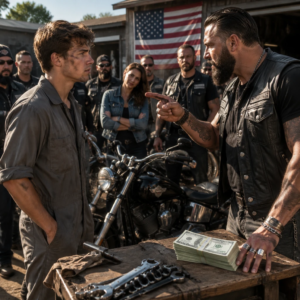
I tightened my grip on the wrench and looked back at the Harley.
Then I pulled the loose wire bundle free.
The crowd reacted before I did. A few men leaned forward, expecting sparks or smoke. Garrett’s boot stayed planted beside my hand, close enough to remind me that the five-minute bet had never really been about the motorcycle. It was about whether he could make me work while everybody watched me shake.
I ignored him and traced the wires with my fingers. The insulation was cracked in two places, but that wasn’t what had killed the bike. The real problem sat behind the ignition housing, where someone had forced a thin copper jumper into the connector and wrapped it with black electrical tape.
It looked temporary.
It also looked deliberate.
I glanced at the timer. Four minutes and twenty-six seconds remained.
“Move your boot,” I said.
Garrett’s eyes narrowed. “You giving orders now?”
“If you want the bike fixed, yes.”
The yard went quiet again. Not completely. I could still hear a motorcycle ticking as its engine cooled, a dog barking somewhere beyond the fence, and the faint rattle of a flag rope against the clubhouse pole. But every person close enough to hear me had stopped pretending this was funny.
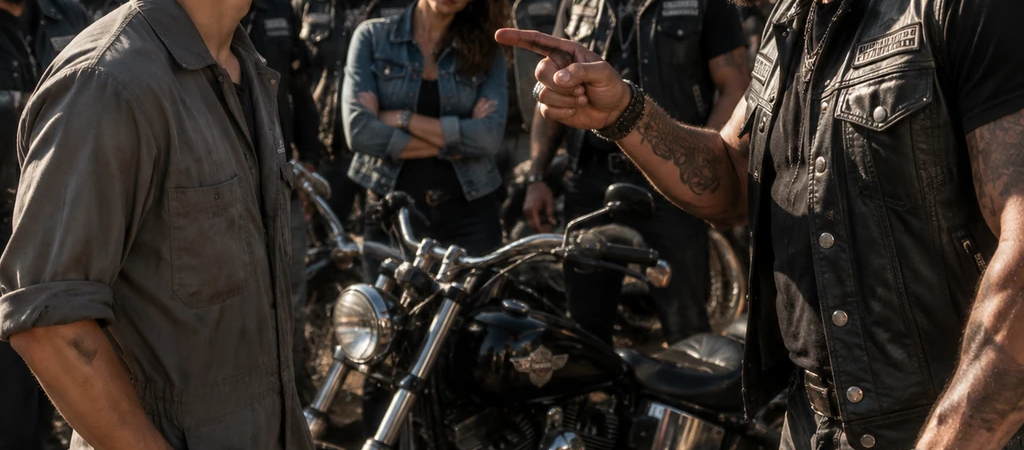
Garrett leaned down until his beard was only inches from my face. “Careful, kid.”
“I’m being careful,” I said. “That’s why I’m asking you to move.”
For a second, I thought he might kick the tools away. His hand tightened at his side, and the muscles in his jaw jumped. Then the woman in the denim jacket spoke from behind him.
“Garrett. Let him work.”
He turned his head. “You worried about the kid?”
“I’m worried about your father’s bike getting damaged because you’re standing over him like a bouncer.”
Her name was Claire, I realized. I had heard one of the men call her that earlier, before the bet began. She wasn’t wearing a vest like the others, but she carried herself as if nobody in the yard could order her anywhere. A silver wrench hung from a loop on her belt, clean enough to be decoration or important enough that she didn’t trust anyone else to touch it.
Garrett looked back at me, then moved his boot.
I took the opening.
The connector had been shoved into the wrong slot. Whoever did it had forced the metal tab down so hard that it had bent around the contact instead of seating inside it. That explained the dead ignition, but it didn’t explain the fresh fuel near the injector line. I pulled the tape away and found another wire underneath, newer than the rest and tied into the circuit with a small black knot.
The wire was clean.
Too clean.
Everything else in that compartment was dull with dust and age. This piece looked like it had been installed yesterday.
“Who worked on this last?” I asked.
Garrett didn’t answer.
I looked over my shoulder. “I need to know what was touched.”
“Just fix it.”
“That’s not an answer.”
His friend with the timer snorted. “You’ve got three minutes, genius.”
I turned back to the motorcycle. The pressure in my chest had changed. A moment earlier, I had been trying to prove I could repair a machine in front of a crowd. Now I was trying to understand why someone had hidden a second wire inside a failed ignition circuit.
The first wire was a mistake.
The second one was a message.
I cut the black wire and the fuel pump clicked once.
That sound hit the yard like a gunshot.
The crowd shifted. Someone muttered, “No way.” Another man said, “It’s getting power.” Garrett stepped closer, but Claire caught his arm before he could reach over me.
“Don’t touch anything,” she said.
His eyes stayed on me. “What did you do?”
“Removed the part that didn’t belong.”
I stripped the damaged connector, bent the contact back into place, and used a short length of clean wire from my kit to bridge the break. It wasn’t a permanent repair. It didn’t need to be. I needed the circuit to hold long enough to confirm the fault, and I needed to see whether the engine had been starved of power or whether someone had created a second problem to hide the first.
The timer beeped.
Three minutes left.
I tightened the terminal, turned the ignition, and pressed the starter.
The engine coughed once, then died.
Laughter broke out behind me.
It wasn’t the same laughter as before. This time it sounded relieved. They had been waiting for the moment when the kid’s confidence ran out and the room could return to normal.
Garrett’s voice came from above me. “Looks like you’ve got two minutes to explain yourself.”
I reached for the throttle and smelled the fuel again.
The bike had power. The pump was working. The starter was turning the engine. But the fuel smell was wrong. It was sharp and heavy, pooling around the intake instead of burning cleanly. Someone had adjusted the mixture until the engine was drowning every time it tried to start.
I opened the air cleaner.
A folded piece of gray cloth had been stuffed behind the filter.
At first, I thought it was just a rag somebody had left there. Then I saw the dark stain on one corner. Oil, maybe. Or something older that had dried almost black. The cloth had been wrapped around a small brass key, and tied to the key was a narrow metal tag stamped with three numbers.
214.
My hand stopped.
“What is it?” Claire asked.
I didn’t answer. The key itself was ordinary, but the tag wasn’t. It had been cut from a thicker piece of brass, with one edge filed smooth by hand. The numbers were deep and uneven, as if someone had stamped them in a hurry.
Garrett saw it over my shoulder.
The color drained from his face.
Only for a second.
Then the expression was gone, replaced by the same hard stare he had worn when he put the money on the bench. But I had seen the change. So had Claire.
“Give me that,” Garrett said.
I closed my fingers around the key.
The crowd stopped laughing.
“Why?” I asked.
“Because it’s not part of the bike.”
“Then why was it hidden inside the air cleaner?”
His mouth tightened. “Probably somebody’s trash.”
“Trash with a number stamped on it?”
The man holding the timer glanced at Garrett. “You know what that is?”
Garrett didn’t look at him. “I said give it to me.”
The Harley gave a faint click beneath my hand. I turned the key in the ignition again, but this time I did not press the starter. The fuel pump hummed, and the smell grew stronger.
The engine had been flooded on purpose.
That was the moment I understood the bet had been arranged around a failure. Garrett hadn’t dragged the bike into the yard to see whether it could be repaired. He had brought it there because he already knew it wouldn’t start, and he wanted someone else standing beside it when it refused.
He wanted a witness.
Maybe more than one.
I pulled the spark plug wire and checked the plug. Wet. Blackened. The engine was getting fuel, but no clean ignition. I dried the plug against the rag, adjusted the mixture screw by feel, and checked the timing connection. My fingers moved faster now, not because I was calm, but because fear had finally become useful.
Garrett crouched beside me.
“You have one minute,” he said quietly.
“You knew this bike was tampered with.”
His eyes hardened. “Watch your mouth.”
“Someone added that jumper wire, flooded the intake, and hid this key inside the filter. That wasn’t a failed repair. That was a setup.”
The yard seemed to contract around us. I could feel the men listening without turning their heads. Claire’s hand remained near the wrench at her belt.
Garrett lowered his voice. “You’re eighteen years old. You don’t know what you’re talking about.”
“I know machines. Machines don’t hide keys.”
For the first time, he looked at the brass tag instead of me.
That told me enough to keep going.
I reconnected the plug wire and leaned over the tank. The Harley’s paint was scratched near the gas cap, with a narrow line of fresh silver showing beneath the black. Someone had dragged a hard object across it recently. When I rubbed the mark with my thumb, a tiny piece of red paint flaked away.
Red paint.
The same color as the old pickup parked beside the clubhouse.
I looked at the truck, then at Garrett.
He followed my eyes.
“Don’t,” he said.
That single word carried more fear than his threat had.
The timer beeped again.
Forty seconds.
I climbed onto the bike, turned the ignition, and pressed the starter. The engine coughed hard enough to jerk the handlebars, then caught for half a second before dying in a cloud of dark smoke.
The crowd erupted.
Somebody shouted that I had blown it. Another man laughed and called for the mop bucket. Garrett stood up, holding one hand toward the room as if he had already won.
But the sound had told me what I needed.
The engine wasn’t dead. It was choking.
I reached down, opened the throttle a fraction, and adjusted the mixture screw one final turn. Then I pressed the starter again.
The Harley roared to life.
The noise rolled through the yard and bounced off the clubhouse walls. Chrome shook. Dust lifted from the gravel. The old engine settled into a rough, uneven idle, but it was running. For three seconds, nobody moved.
Then the timer went off.
Five minutes.
The man holding it stared at the display. “He made it.”
No one answered him.
I kept one hand on the throttle until the engine steadied. The bike smelled of fuel and hot metal, and smoke drifted past my face. It wasn’t a beautiful repair. It wasn’t something I would have sent out of a real shop. But it was alive, and every person in that yard had heard it come back.
Garrett stared at the motorcycle as if it had betrayed him.
Claire stepped forward. “Pay him.”
The five-thousand-dollar roll still sat on the workbench. Garrett didn’t move toward it.
“That wasn’t a full repair,” he said.
The engine sputtered.
I eased the throttle and listened. “You said fix it. You didn’t say restore it.”
“You bypassed a damaged connector.”
“I repaired the connection enough to confirm the ignition fault.”
“You pulled a wire out of my father’s bike.”
“The wire was added after the original wiring was already damaged.”
Garrett’s eyes flicked toward the brass key in my hand. “You’re making accusations because you got lucky.”
“Luck doesn’t explain the key.”
The engine suddenly dropped in pitch.
I turned the throttle, but the response came late. The bike coughed twice and shut off.
The yard filled with murmurs again.
Garrett smiled.
It was small, but it was the first genuine expression I had seen on his face all afternoon.
“There,” he said. “It died.”
I climbed off the Harley and placed the brass key on the workbench between us. “After running for almost a minute.”
“Still died.”
“Because it’s still being starved.”
“Then you didn’t fix it.”
He reached for the roll of cash.
Claire stepped between him and the bench. “The bet is settled.”
Garrett looked at her. “You taking his side now?”
“I’m taking the side of the timer.”
The men around us shifted uneasily. A few looked at the motorcycle. A few looked at the key. Nobody looked at Garrett for long. The public dare had turned into something nobody had agreed to witness, and the money on the table no longer seemed like the most important thing in the yard.
Garrett picked up the cash and tossed it toward me.
I caught it against my chest.
The bills were wrapped in a rubber band, thick enough to feel heavy even before I counted them. I looked down at the money, then back at the Harley.
“I don’t want this,” I said.
That surprised him. “What?”
“I want to know why someone tried to make your father’s bike fail.”
Garrett’s face changed again.
This time he couldn’t hide it.
A man near the red pickup whispered, “Garrett, maybe you should tell him.”
Garrett turned so fast the man took a step backward. “Stay out of it.”
The man lifted both hands. “I didn’t do anything.”
“No,” Garrett said. “You just talk too much.”
The threat landed hard. It wasn’t loud, but it stopped the room. I looked from Garrett to the pickup and noticed something I hadn’t seen before: a clean rectangular patch on the truck’s rear bumper where a club decal had recently been peeled away.
Under the remaining adhesive, a few red paint chips clung to the metal.
The same red as the mark on the Harley.
The key sat between us, dull and silent.
I picked it up again and turned the tag over. On the back, beneath the number 214, there was a line scratched into the brass. I had missed it because the light was facing the wrong way.
The letters were uneven, but clear.
G.M.
My initials were not G.M.
Garrett Mercer’s were.
He saw me read them.
“You said this belonged to your father,” I said.
Garrett’s hand closed into a fist. “It does.”
“Then why is your name on the key?”
He didn’t answer.
Behind him, one of the older bikers quietly stepped away from the red pickup. Claire watched that movement, then looked toward the clubhouse door. Her expression had lost all its amusement.
I held the key up between two fingers. “What does 214 open?”
Garrett looked at the locked clubhouse.
For one long second, nobody in the yard breathed.
Then the clubhouse door swung inward from the other side, and a woman I had never seen before stood in the opening wearing my shop’s gray uniform.
She looked directly at the key in my hand.
And said, “You were never supposed to find that.”