Part 2
Bear held my stare for another beat, then lifted two fingers off the handlebars and killed his engine. The rest of the line followed one by one until the highway went so quiet I could hear the heat ticking off the metal. That silence made everything feel worse, not better. It meant they were listening now, and once people like that started listening, they were going to expect me to prove every word.
He looked at the bald rider first. “Reed, take Vince and circle wide. No lights. No heroics. If she’s feeding us a lie, I want to know before we roll into it.”
Reed gave me one hard look, then swung back onto his bike without a word. Vince was younger than the others, all sharp elbows and a hooked nose, and he didn’t hide the fact that he thought I was trouble. A second later the two of them dropped off the shoulder and disappeared into the wash with their headlights dark, their tires whispering through the sand instead of roaring.
Bear turned back to me. “You said you heard them count our bikes. Start there.”
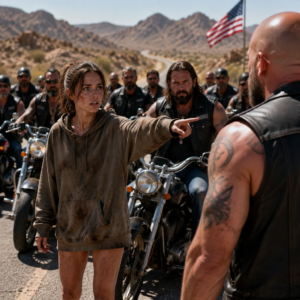
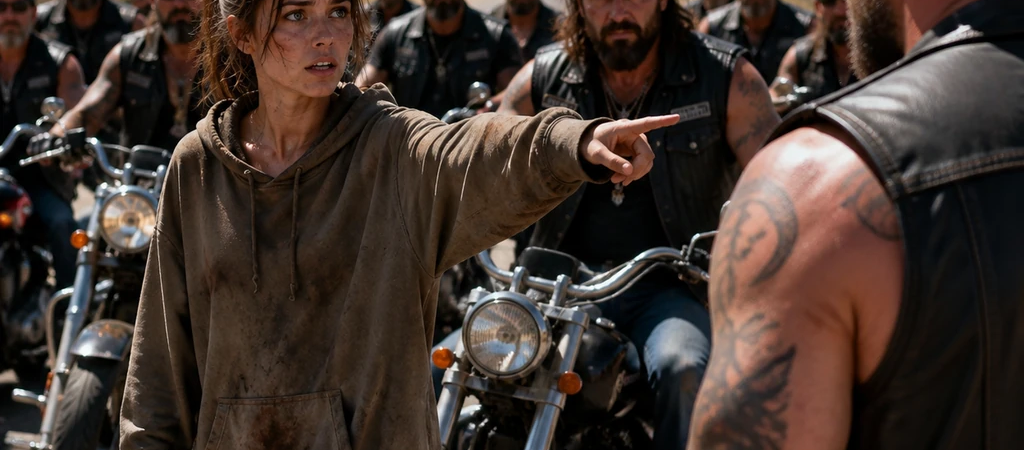
My mouth was dry enough to hurt. I could feel every eye on me, and that old familiar urge to shrink down and disappear tried to crawl over my skin again. I pushed it away and pointed with one shaking hand toward the ridge line beyond the next bend.
“There’s a cut in the rock about half a mile up,” I said. “If you’re on foot, you can stand above the road without being seen from here. I was trying to get water at the gas station in Ludlow when I saw a truck pull off and heard men talking from the radio.”
Bear’s expression didn’t change, but the group behind him tightened in a way I could feel. “What kind of truck?” he asked.
“White. No company marks. One of the taillights was busted and taped over.”
That got a reaction from one of the men near the back. Not much, just a shift in his shoulders, but it was enough to tell me somebody had seen that truck before. Bear noticed it too. He tipped his chin at the rider. “You know it?”
The rider hesitated. “I saw a white Ford idling near the quarry road this morning. Same busted light.”
The first real crack opened in the club’s doubt, and I hated that I needed it. I hated that the only way to be believed was to have my fear lined up against somebody else’s memory. Bear rubbed a hand over his beard and looked past me at the bend in the highway.
“Any other details?” he asked.
I swallowed. “One of them had a red bandana tied around his wrist. Not around his neck. Around his wrist.”
Bear’s jaw set. “That means something to you?”
“It means he wasn’t trying to hide who he was from the others.” I forced myself to breathe. “It means the men up there knew each other. This wasn’t some random road crew or a couple of thieves. They were set up like they were waiting for a signal.”
The words hung there in the dry air. Nobody interrupted me, and that was worse than if they had. I could feel them measuring how much of me to believe, and I knew exactly how little my size and my clothes were helping my case. My dirty hoodie and bare feet made me look like somebody who had crawled out of the wrong part of town and gotten lucky with a warning. Nobody wanted to stake their life on luck.
Bear finally said, “What kind of signal?”
I opened my mouth, then shut it again when I heard something shift in the rocks above the highway. Not a voice. Not yet. Just a scrape that made every biker on the shoulder turn their heads at once. A second later Reed came back over the rise on foot, moving fast and low with Vince right behind him.
Reed didn’t waste words. He stopped in front of Bear and said, “She’s right. There’s a hard turn in the road ahead, and someone’s built a blind on the inside slope. Fresh tire tracks in the dirt below it. At least three rifles. Maybe four.”
The line of men went still. Vince wiped dust off his face with the back of his hand and stared at me like I had just become a different species.
Bear didn’t look at me. He looked at the road. “Anything else?”
Reed hesitated just long enough to make my stomach drop. “Yeah. There’s a medevac reflector panel hanging off a post near the shoulder. Bright orange. New enough that it still looks clean.”
That was the abnormal detail that made my skin go cold, because it didn’t belong there. Emergency reflector panels didn’t get hung on a dead stretch of desert highway unless somebody wanted to mark something for a driver who already knew where to look. It was too precise to be a warning and too visible to be an accident. It was a marker.
Bear heard the same thing I did. “A marker for what?”
Reed looked at the ridge again, then back at Bear. “For a stop point. Or a target. Hard to tell from here.”
The older rider’s eyes narrowed, and for the first time I saw something in his face besides suspicion. I saw calculation. He was already mapping every turn, every line of sight, every place a truck could box in twenty-two bikes on a narrow highway. He knew what I knew now, which was that whoever had planned this didn’t need to win a firefight. They only needed to funnel the club into a pocket where the road would do the killing for them.
One of the riders behind him spat into the dust. “Who the hell wants us dead?”
Bear didn’t answer that. He looked at me instead. “You said you heard them talking. What exactly did they say?”
I should have lied then, because the next part sounded insane even to me. But there was no clean way to say it. If I softened it, they’d think I was guessing. If I made it sound too neat, they’d think I was trying to steer them.
“They weren’t talking about the club,” I said. “Not at first. They kept saying ‘the package’ and ‘the handoff.’ Then one of them said the wrong rider was coming through tonight, and another one told him to shut up because ‘the girl on the road might hear.’”
Bear’s head snapped up. “They knew about you?”
I hated the answer before I said it. “I don’t think they knew me. I think they knew someone might warn you.”
That landed harder than anything else I’d said. Reed glanced at Vince. Vince glanced at the ridge. Even Bear looked a little less certain for half a second, and I understood why. If the ambush team had been counting on a warning reaching them, then I wasn’t an accident in the road. I was part of the problem they’d already planned for.
Bear stepped down off his bike, boots crunching in the dust. Up close, he was even bigger than he looked from the saddle, broad enough to block the sun when he faced me. But his voice was lower now, steadier, and somehow that made it more dangerous.
“Why would a setup team care if a homeless kid heard anything?” he asked.
I flinched at the word homeless, though I knew he hadn’t meant it as an insult. It was just the truth he could see. The ugly truth was easier for strangers to hold onto than the rest of me.
“Because I wasn’t supposed to be there,” I said. “And because I’ve been at the quarry road before.”
Bear’s eyes narrowed. “Doing what?”
The question dragged the answer up from a place I had been trying not to touch. I had been hiding out behind an abandoned service shack outside Barstow for three nights, sleeping in turns, stealing light from the gas station sink, listening to trucks come and go from the ridge road. I had seen men unloading cases after dark. I had seen a cooler carried by two people who moved like they were afraid to drop it. And yesterday, while I was trying to stay out of sight near the quarry, I had seen a woman shoved into the back of one of those white trucks.
I had not told anyone that yet.
Because if I said it out loud, then I had to explain why I hadn’t gone for help sooner, and I didn’t have a good answer for that. The truth was that people had looked through me for so long that I had learned not to expect rescue, even when I was standing right in front of it.
“I was watching,” I said finally. “I saw them move something into the trucks. I didn’t know what it was.”
“You think there’s a person in there?” Reed asked.
I nodded once. “I think there was. I think that’s why the road marker matters. They were waiting for your group to come through so they could hide whatever else they were doing behind the chaos.”
The riders traded looks, and this time nobody laughed. The threat had stopped being abstract. It had shape now. A body. A road. A truck with one broken taillight. A marker hung exactly where a driver would need to see it at speed.
Bear rubbed his mouth with the back of his hand. “Show me the marker.”
“What?” I said.
He pointed at the ridge. “You’re the only one who spotted the ambush from a distance and lived long enough to talk about it. I want to see the spot you were on.”
Reed cut in before I could answer. “If we go up there, we’re exposed.”
“We’re already exposed,” Bear said.
That was when the sound came again, faint this time but sharp enough to freeze everyone in place. A single crack from somewhere beyond the bend. Not a bike. Not an engine. A rifle report carried thin through the heat.
Dust kicked up off the edge of the road half a second later where a round hit the shoulder where Bear had been standing just seconds before.
Nobody moved.
Then Bear grabbed my arm and hauled me down behind the engine block of the lead bike as a second shot snapped over the highway, and from the ridge above us a voice finally shouted the one thing I had been hoping never to hear.
“Now! They’re on the road!”