Part 2
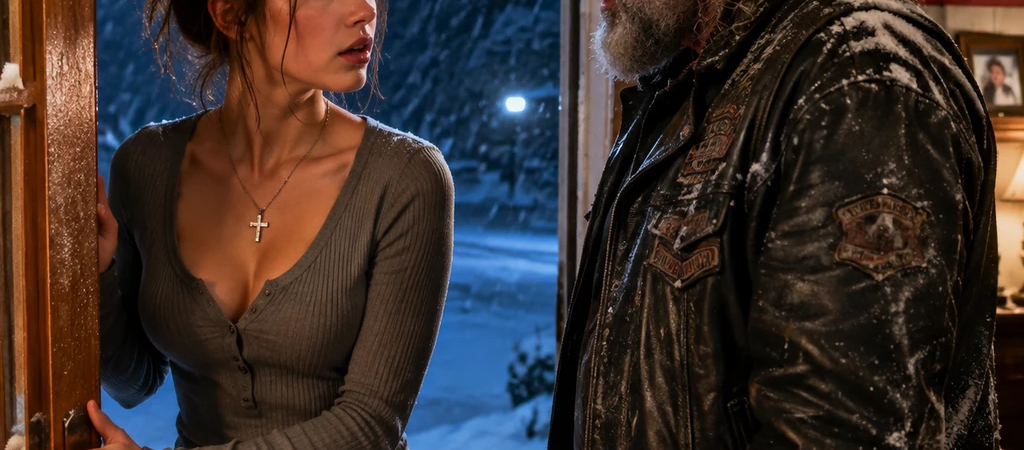
The second his boots hit my kitchen floor, the man folded forward like the last of his strength had finally given up. I grabbed his arm before he could go down, and the heat of him shocked me through the sleeve of my sweater. He was burning up under all that ice, which somehow scared me more than if he’d been cold through and through.
“Sit,” I said, though my voice came out smaller than I meant it to.
He made it to the chair by the table, sank into it, and kept one hand braced on the wood like he was afraid the room might tilt. Up close, the smell of him changed too. Not just wet leather and snow, but smoke, blood, and something sharp and medicinal, like he’d already spent time in a place with fluorescent lights and rubber gloves.
I shut the door and slid the bolt home. The sound felt final. My house had always been a quiet place, the kind where even the clock on the wall seemed to whisper. Now the silence had teeth in it.
“Do you need an ambulance?” I asked.
He gave a short, humorless laugh. “No. Just water. And maybe a minute where nobody’s yelling at me.”
I almost smiled at that, then saw the dark stain spreading under the cuff of his right sleeve. He must have seen me look, because he pulled his hand back fast, like he was hiding the injury from me out of habit.
“You’re bleeding,” I said.
“It’s not as bad as it looks.”
“That’s what people say right before it gets worse.”
He glanced up at me then, and there was a tired kind of respect in his face. “You sound like someone who’s had to learn things the hard way.”
I didn’t answer. I went to the sink, filled a glass from the tap, and brought it back with my hands shaking so hard the water trembled against the rim. When he took it, I noticed his fingers were thick-knuckled and nicked all over, the hands of somebody who had fixed engines, fought weather, and maybe fought people too. He drank half the glass in one swallow and shut his eyes for a second like it hurt to be alive.
A louder crack split across the roof, making us both look up. The storm had shifted again. Ice tapped against the window in hard little bursts, and somewhere outside, the wind found a loose corner of siding and made it bang like a fist.
I should have asked him to leave as soon as he could stand. That was the sensible thing. That was the thing Grandma would’ve told me to do if she could have seen what I’d done.
But he wasn’t looking at me the way strangers usually did. He wasn’t scanning the room, measuring what he could take, or asking where the phone was, or making me feel small in my own house. He was looking at the mantel.
At Grandma’s photograph.
His face changed so fast it scared me. The hardness drained out of it, leaving only shock and something so raw I didn’t know what to call it.
He lowered the glass slowly. “No,” he said under his breath.
I turned to the photo and back to him. “What?”
He stared at the framed picture like he’d been punched. Then he reached into the inside pocket of his leather jacket with a hand that wasn’t quite steady anymore. For one ugly second I thought he was pulling a weapon, and every warning I’d ever heard about men like him flashed hot and bright in my head.
Instead, he took out a folded piece of paper.
The paper was wrapped in plastic, then wrapped again in an old blue handkerchief that had been tied shut with string. It had been protected carefully, like it mattered more than money. He set it on the table and didn’t touch it again.
“Your grandmother gave this to me,” he said.
My throat closed. “That’s impossible.”
He looked at me hard, like he was trying to decide whether I could bear the truth or not. “Her name was Margaret Whitmore, right?”
I could only nod.
“She handed me that envelope three weeks ago.”
The room seemed to lean sideways.
“No,” I said again, but this time it sounded weak even to me. Grandma had been in the hospital for the last ten days of her life. By the time the ambulance took her, she could barely keep her eyes open. She had not been handing anything to anybody. She had been too tired to lift her head.
He saw the look on my face and took a slow breath. “Listen to me before you decide I’m lying.”
I didn’t trust my own voice, so I stayed quiet.
“She made me promise I’d bring it here if anything happened to her. She said if the girl was still living in the farmhouse, I’d know where to find her.”
The word girl hit me strange. Like he knew exactly how little I still felt most days.
I stared at the envelope. My name was written across the front in Grandma’s hand, the same slanted letters she’d used on birthday cards and grocery lists and the note she’d pinned to the fridge the day she forgot where she’d put the sugar. Seeing it there made my chest tighten so fast I had to grip the edge of the counter.
“How do you know my grandmother?” I asked.
He gave a tired little shake of his head. “I knew her before you were born.”
That should have sounded insane. It did sound insane. But there was something in the way he said it, something old and careful, that kept me from calling him a liar right then.
He leaned back in the chair and winced, and only then did I see the torn seam along the inside of his jacket. Something hard was pressing against his shirt from beneath the leather. Not a gun. A thick rectangle, wrapped in cloth and taped down so it wouldn’t rattle.
“What is that?” I asked.
His eyes flicked to my face, then to the door I’d bolted, then back to me. “That’s why I’m here.”
“Then say it.”
He rubbed a hand over his beard and dragged in a breath that sounded like it hurt. “I can’t say all of it yet. Not until I know whether anybody followed me.”
My skin went cold all over again. “Followed you?”
He looked toward the front window, where the storm had erased everything past the porch light. “I was supposed to meet someone at the church turnout north of town. Instead I found a truck in the ditch and a man waiting in the dark who wasn’t supposed to know I was coming. He knew your grandmother’s name.”
The kitchen went even quieter after that. I could hear the stove ticking as the iron cooled. I could hear my own breathing. Outside, the wind changed pitch, and for one sharp moment I thought I heard an engine somewhere beyond the white curtain of snow.
“You’re scaring me,” I said.
He gave me a look that wasn’t defensive, just tired. “Good. You should be scared. I was scared too, which is how I know this isn’t normal.”
I didn’t like the way he said that, but I liked even less that he sounded honest.
He reached for the envelope, then stopped with his fingers hovering over it. “Margaret said if anything happened to her, you’d try to carry it alone. She said you’d think being brave meant not asking questions.”
That landed so hard I had to turn away.
Grandma used to say almost the same thing when I was little, only gentler. She’d tell me that silence was useful in bad weather, but not when your life depended on hearing the truth. After she got sick, I learned how to keep my face still, how to fold grief down small enough to fit inside a school day, how to smile when neighbors asked if I was all right and say yes when I wasn’t.
The man watched me with a strange kind of patience. He didn’t fill the silence. He let it sit there between us until I hated it enough to break first.
“What was in the truck?” I asked.
He hesitated. “Nothing good.”
“That’s not an answer.”
“No,” he said. “It’s all you get until I know whether you’re in danger.”
The way he said you’re made the back of my neck tighten.
I looked at the envelope again. My name. Grandma’s handwriting. The blue handkerchief wrapped around it like a secret someone had tried to keep alive after the person who owned it was gone.
“What did she want me to know?” I asked.
He looked at the paper, then at the photo on the mantel, and when he spoke his voice had gone lower than before.
“She said if I ever found this house locked from the inside, I was to tell you the same thing she told me twenty years ago.”
My pulse started pounding in my ears.
“What thing?”
He opened his mouth to answer, but before he could, three hard knocks hit the front door.
Not the wind. Not a branch. A hand.
He was already on his feet when the fourth knock came, and the blood drained out of his face so completely that for one terrible second he looked like the dead had come back for him.
Then a man’s voice cut through the storm from the porch, low and certain and close enough to make my stomach drop.
“Open up, Jack. We know she’s in there.”
The biker reached across the table and pulled the envelope toward him like he was afraid they might see it through the walls.
And that was when I realized he had not come to my house looking for shelter.
He had come to finish something my grandmother started.