Part 3
STORY PART 3:
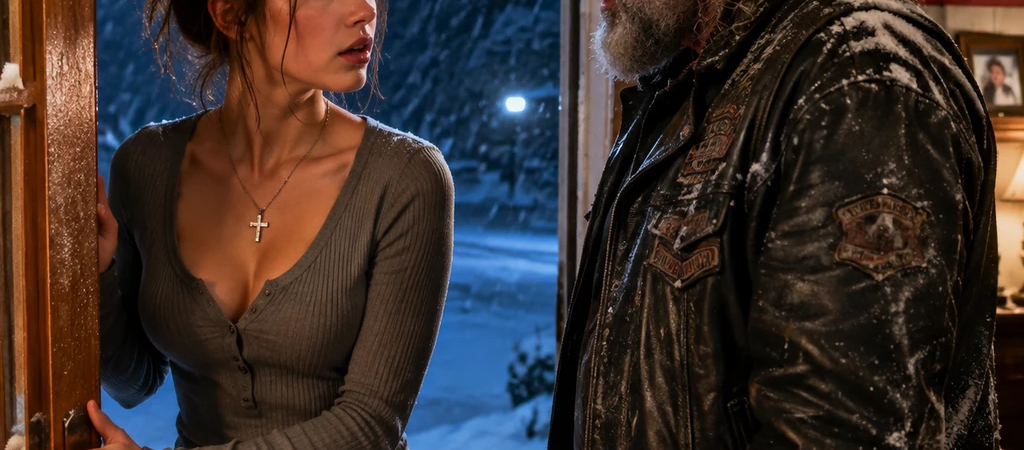
“Open up, Jack. We know she’s in there.”
The voice on the porch was calm enough to make it worse. Whoever stood outside wasn’t shouting into the storm or pounding in panic. He sounded certain the door would open eventually, as if my house were already his and the lock was only a temporary inconvenience.
Jack moved between me and the entrance. His injured arm hung stiffly at his side, but his good hand went inside his jacket and came out empty. He looked toward the kitchen window, then the back door, measuring every way in and every way out.
“Do you know him?” I whispered.
“I know his voice.”
“Who is he?”
“Someone who should not know your name.”
Another knock struck the door. The old frame groaned.
“Clara,” the man called. “You don’t want to get mixed up in this. Send Jack out, and nobody has to make tonight worse.”
My name sounded wrong in his mouth. Familiar enough to prove he knew who I was, cold enough to remind me that knowing and caring were two different things.
Jack turned his head slightly. “How many?”
“I don’t know.”
“Listen.”
I held my breath. Beneath the wind, I heard the low purr of an engine somewhere past the side of the house. Another engine answered from the road. Tires pressed into the snow, then stopped.
There was more than one vehicle outside.
Jack crossed the kitchen in three silent steps and killed the stove flame. Darkness swallowed the room except for the weak gray light coming through the windows. He took my wrist and pulled me away from the front hall.
His fingers were rough, but his grip was careful. “Where’s the root cellar?”
“Under the pantry.”
“Does it have another exit?”
“No. Just stairs and a vent.”
“Good. Stay away from the windows.”
The man outside gave a quiet laugh. “Jack, don’t make this difficult. You’ve got nowhere to go.”
Jack’s face tightened at the sound of his name. “He wants me to panic.”
“He knows you’re here.”
“He knows enough to be dangerous.”
I looked at the envelope in his hand. “Then give it to me.”
His eyes cut to mine.
“It has my name on it,” I said. “Whatever my grandmother left in there, it belongs to me.”
“It may be the reason they’re here.”
“It already is.”
For a moment, he looked as if he might argue. Then he placed the envelope in my palm.
The paper felt strangely warm from his hand. I tucked it beneath my sweater, against the cross at my throat, and the two objects pressed together through the fabric. One had been given to me by Grandma during the last week of her life. The other had supposedly been entrusted to a stranger twenty years ago.
The pieces felt connected, even though I had no idea how.
Jack leaned toward the front door without touching it. “You need to understand something. The men outside may not be after the envelope alone.”
“What else would they want?”
“You.”
My mouth went dry.
The voice on the porch changed. “Clara, your grandmother left behind property, records, and a lot of questions. You’re a minor, and you’re alone in that house. Let us help you before somebody gets hurt.”
The words sounded official, almost reasonable. That frightened me more than a threat would have.
“Is he police?” I whispered.
“No.”
“How do you know?”
“Because real police don’t announce they’re coming for a girl through a locked door while covering their license plates.”
I glanced toward the front window. Through the curtain, the porch light reflected in a dark shape parked near the road. I could not see the plate.
Jack had noticed details I had missed because I had been too busy being afraid.
A soft scrape came from the back of the house.
He looked at me. “They’re testing the doors.”
The next sound was the faint metallic rattle of the rear doorknob.
I backed toward the pantry. My knees felt weak, but some stubborn part of me refused to collapse. “What do we do?”
“Stay quiet until they leave.”
“You said they have nowhere to go.”
“I said I don’t.”
He pointed toward the narrow hallway that led to the pantry. “Cellar. Now.”
I shook my head. “You’re coming with me.”
“If I go down there, they’ll search the house until they find us. If I stay here, I can draw them away from the pantry.”
“You’re injured.”
“I’m still harder to explain than a sixteen-year-old girl.”
The rear doorknob stopped rattling.
Then someone tapped three times against the kitchen window.
I flinched so hard the cross struck my collarbone.
Jack’s eyes went to the necklace. “Where did you get that?”
“Grandma gave it to me.”
“When?”
“The day the ambulance took her away.”
His expression changed. “Did she say anything?”
“She told me not to lose it.”
“Only that?”
I remembered the hospital room with its pale walls and humming machines. Grandma’s hand had been cold around mine. She had pushed the cross into my palm and closed my fingers over it with what little strength she had left.
There had been something else. A sentence I had assumed was part of the confusion caused by pain medication.
“Her exact words were, ‘The key is never where they expect the door to be.’”
Jack stared at the cross.
Outside the kitchen window, the tapping came again. Three slow knocks.
“What does that mean?” I asked.
“It means your grandmother knew they might come looking.”
He reached for the necklace, then stopped before touching it. “Can I see the cross?”
I pulled it over my head and placed it in his hand. He turned it over, rubbed his thumb along the dark metal, and pressed one fingernail against the center of the back.
A tiny seam appeared.
I had owned that cross for years and never noticed it.
Jack twisted the lower edge. The back plate loosened, revealing a narrow hollow inside. Something thin and silver glinted in the darkness.
My breath caught.
He tipped the cross into his palm. A small key slid out.
It was no longer than my thumbnail, with a jagged tooth pattern and a strip of faded red thread tied through its loop.
“The red thread,” I whispered.
Jack looked up. “What?”
“Grandma used to tie red thread around things she didn’t want me touching. The old filing cabinet in her bedroom had one around the lock. I thought she was just trying to scare me away from her papers.”
“Where is the cabinet?”
“Upstairs.”
The front door shook under a heavy blow.
Dust fell from the ceiling.
“Then that’s where they’ll go first,” Jack said.
A second blow struck the door. The deadbolt held, but the hinges screamed.
He gave the key back to me. “Put the cross on.”
“Why?”
“Because if they see you without it, they may realize something changed.”
I threaded it over my head with shaking hands. The key disappeared against my sweater.
“What’s in the cabinet?”
“I don’t know. Grandma never let me open it.”
“Then she expected you to open it after she was gone.”
The front door cracked.
Jack grabbed the envelope from beneath my sweater before I could stop him. “We need to make them think this is still with me.”
“No.”
“Clara—”
“It has my name on it.”
“And that’s exactly why they’ll tear this place apart to get it.”
He pulled the blue handkerchief from the envelope and folded the paper inside it. Then he shoved the bundle beneath his jacket, making it visible enough to notice if someone looked quickly.
I hated that the plan made sense.
A splinter of wood flew across the entryway as the door gave another inch. Jack took the cast-iron poker from beside the stove and positioned himself in the darkest corner near the hall.
“Cellar,” he mouthed.
I moved toward the pantry, but stopped when I saw the old coffee mug beside the sink. Grandma’s dented mug. The same one she had left there on the day the ambulance came.
I remembered Mrs. Harlan’s warning from that afternoon: If one of those men comes up your road, you keep that door shut. They don’t ride through a storm for nothing.
At the time, I had thought she was talking about bikers in general. But Mrs. Harlan had not been looking at the road when she said it. She had been looking at the coffee mug.
She had known Grandma.
And she had known someone might come.
The realization hit me so sharply that I almost missed the small paper tucked beneath the mug. It had been there for weeks, maybe months, flattened by the ceramic base. Grandma used to leave grocery reminders in that spot, so I had never bothered to read it.
I lifted the mug and unfolded the paper.
The handwriting was Grandma’s.
Not a grocery list. Not a note to me.
Three letters and a number were written across the page: H-17.
Below them was a sentence.
Trust the one who asks what happened, not the one who tells you what happened.
My hands went cold.
Jack saw the note and came toward me. “What is it?”
I showed him.
He read it once, then again. His jaw tightened.
“Who tells you what happened?” I asked.
“The man outside.”
“And who asks?”
He looked toward the front door. “Your grandmother was warning you not to accept their version of anything.”
The door burst inward.
Wind exploded through the entryway, carrying snow across the floor. A broad man in a dark winter coat stepped over the broken threshold, one hand raised against the cold. Two others appeared behind him, their faces half-covered with scarves.
The first man was clean-shaven, with a narrow scar beside his left eye. He looked less like a criminal than a county administrator. That seemed deliberate.
His gaze landed on Jack, then moved to me.
“Clara Whitmore,” he said. “I’m Evan Rourke. I work with the estate office handling your grandmother’s property.”
“You’re not an estate attorney,” Jack said.
Rourke smiled without warmth. “You’re in no position to question my credentials.”
“Neither are you in any position to enter a private home.”
Rourke’s eyes flicked to the poker in Jack’s hand. “You brought a weapon into a child’s house, Jack. That’s not going to look good when the sheriff arrives.”
“Call him.”
“I already did.”
The lie came too quickly.
I stared at Rourke. He had expected me to believe him because he used the sheriff’s name. He wanted the room to feel official before anyone official arrived.
The man behind him stepped fully inside. Snow melted from his boots onto Grandma’s rug.
Rourke kept his attention on me. “Your grandmother’s death left several matters unresolved. There are documents in this house that belong to other people. We’re here to recover them.”
“Then show me a warrant.”
His expression shifted for the first time.
Jack looked at me sharply, almost surprised.
I had never asked for a warrant in my life. The word had simply appeared in my mind, pulled from television shows and the warnings posted at school. But it felt right the moment I said it.
Rourke’s smile vanished. “You’re a minor. You don’t understand what you’re holding.”
“I understand you broke my door.”
“You opened it for him.”
“That doesn’t give you permission to come in.”
One of the men near the threshold moved toward me. Jack stepped into his path.
“Take one more step,” Jack said, “and you’ll have a problem you can’t explain away.”
The man stopped.
Rourke sighed as if we were wasting his time. “Jack, you’ve made this worse for her. Your club has been circling this county for years, frightening people, threatening witnesses, leaving messages at businesses. Now you’ve dragged a teenager into whatever revenge game you’re playing.”
The words struck something inside me. I looked at Jack.
“Is that true?”
His eyes stayed on Rourke. “Not the way he means it.”
“That’s not an answer.”
“No,” Jack said quietly. “It isn’t.”
Rourke seized the silence. “Your grandmother was frightened of these men. She knew they were coming back. She left papers proving they were involved in illegal dealings, and Jack wants those papers buried.”
The bundle beneath Jack’s jacket suddenly felt like a beacon.
“What illegal dealings?” I asked.
Rourke took another step. “You don’t need to know. You need to give me the documents and let adults handle this.”
“Then why did you come during a blizzard?”
“Because Jack stole them.”
Jack’s face hardened. “I didn’t steal anything.”
“You were at the church turnout.”
“I went there because Margaret called me.”
“She was dead.”
“She called me three weeks ago.”
Rourke glanced at me. “Your grandmother was heavily medicated by then. She wasn’t capable of making reliable decisions.”
That sentence sounded polished. Practiced. It sounded like something he had already told other people.
I thought of Grandma in the hospital, her eyes open and alert when everyone else assumed she was sleeping. I remembered her gripping my wrist and asking me whether I had seen anyone near the farmhouse. I remembered thinking the question was just another sign that the illness had made her suspicious.
Maybe I had been wrong.
Rourke held out his hand. “Give me the envelope, Clara.”
Jack moved before I could answer. He swung the poker into the wooden floor between us, hard enough to split one of the old boards.
The men behind Rourke reached inside their coats.
“Back up,” Jack ordered.
Nobody moved.
Then the lights came on.
The sudden brightness blinded me. The storm had not restored the power. Someone had switched on a flashlight from the hallway, its beam aimed directly at our faces.
A fourth man stood there.
He wore a county sheriff’s jacket.
My heart lurched with relief, but Jack did not lower the poker.
The sheriff looked at Rourke first. “You said the girl was in immediate danger.”
“She is,” Rourke replied.
“From him?”
“From all of us, apparently.”
The sheriff’s eyes settled on Jack. “Put the weapon down.”
Jack’s hand tightened around the poker.
“Jack,” I said.
He turned his head slightly.
I could see the decision moving across his face. Fight the men in my house and give them the story they wanted, or surrender the weapon and trust a lawman who had arrived with the person trying to force his way inside.
His eyes went to the sheriff’s badge.
Then to the sheriff’s boots.
There was mud on them.
Not snow. Mud.
And a dark smear along the heel that looked like red clay.
The road had been frozen for two days. No vehicle could have reached my house without sinking into the snow, and there was no red clay anywhere near the farmhouse. The only place in the county with that color soil was the church turnout north of town.
The place where Jack had found the truck.
The place where someone had been waiting.
The sheriff had not come from the station.
He had come from the turnout.
Jack saw me looking at the boots. His gaze followed mine, and the last trace of uncertainty left his face.
“Clara,” he said, “go upstairs.”
Rourke’s head snapped toward him. “Don’t.”
That single word told me more than anything else could have.
Rourke had been pretending to protect me. The sheriff had been pretending to restore order. But both of them were afraid of what might happen if I reached the bedroom.
The filing cabinet.
The key.
H-17.
I ran.
The stairwell was narrow, and my socks slipped against the wood as I climbed. Behind me, someone shouted. A heavy object struck the wall. Jack yelled for me to keep going, followed by the sheriff ordering everyone to stop.
I did not stop.
At the top of the stairs, I sprinted down the hall toward Grandma’s room. The door stood half-open, and the old red thread still hung around the filing cabinet lock.
I pulled the cross from my neck and took out the tiny key.
The lock turned with a soft click.
Inside were folders tied with string, a stack of bank statements, several photographs, and a small metal box stamped with the same mark I had seen stitched beneath Jack’s jacket: a black circle crossed by a white line.
My fingers shook as I opened the top folder.
The first photograph showed Grandma standing beside a younger Jack outside a roadside diner. Jack’s hair was dark then, and his beard was only beginning to gray. Between them stood a third person.
I knew him.
Everyone in town knew him.
Sheriff Daniel Voss.
The date on the back was twenty years old.
Under the photograph lay a typed report with names, license numbers, and dates. Most of the names had been blacked out, but one appeared again and again in Grandma’s handwriting.
Evan Rourke.
I heard footsteps on the stairs.
I grabbed the metal box, the folder, and the photograph. Then I saw the last item at the bottom of the cabinet.
A cassette tape.
Grandma had written one sentence on its label.
Play this only when Jack is present.
The footsteps reached the hallway.
I shoved everything under my sweater and turned toward the window. It was too high to climb from, and the drop outside would have broken my legs. The bedroom door began to open.
“Clara,” Sheriff Voss called. “Step away from the cabinet.”
I held the cassette against my ribs.
He entered alone, but his hand rested on the gun at his hip. Behind him, Rourke appeared at the end of the hallway, his face no longer pretending to be patient.
“You don’t understand what you found,” Voss said.
“No,” I answered. “But I understand you lied about where you came from.”
His eyes hardened.
Rourke came closer. “Give us the folder.”
“Why?”
“Because your grandmother stole it.”
“She kept it.”
“She destroyed lives with it.”
“Whose?”
Neither man answered.
The silence confirmed the answer better than words.
Downstairs, something crashed. Jack shouted my name, and the sound carried panic I had not heard in his voice before.
Voss extended his hand. “Clara, I don’t want to hurt you. But if you force this, Jack will not walk out of here.”
I looked past him at the stairwell.
Jack had come to my house carrying Grandma’s final message. He had warned me not to trust anyone who gave me answers too easily. He had also lied by omission, kept the truth from me, and tried to use the envelope as bait without asking what I wanted.
Rourke and Voss had broken into my house.
Jack had entered because Grandma sent him.
None of that made him safe.
But the cassette had been meant for him.
That was the clue I could not ignore.
Voss took one step toward me. “Hand over the evidence.”
The bedroom window rattled from the force of the wind. Somewhere below, a chair scraped across the floor. Jack cried out, followed by a sharp thud.
I pressed the cross into my palm and felt the tiny key dig into my skin.
Then I made my decision.
I pulled the cassette from beneath my sweater and held it up where all three men could see.
Rourke’s face went white.
Voss drew his gun.
And from the stairs, Jack shouted, “Clara, whatever you do, don’t let them hear that tape!”
I looked at the cassette, at the gun, and at the dark hallway separating me from the only person who knew why my grandmother had trusted him.
Then I reached for the old tape recorder on her nightstand.