Part 2
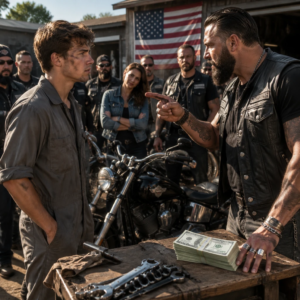
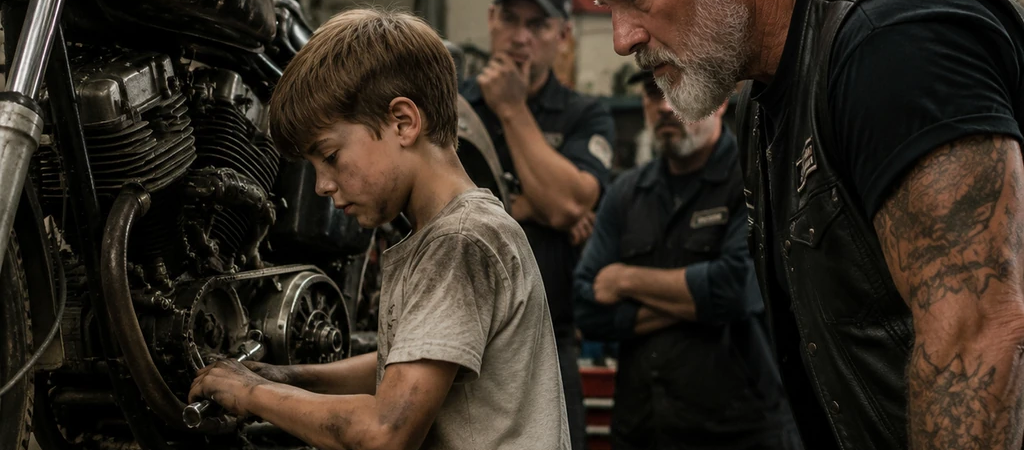
I reached the bike with every pair of eyes in the garage on my back, and that was when I understood what it felt like to walk into a room already deciding your future. The air around the Harley was warmer than the rest of the shop, thick with old oil and metal dust, and the tank looked so worn I could see where hands had gripped it for years. Frank Mercer stood beside me without saying a word, which somehow made the whole thing feel even heavier.
I crouched down and looked at the left side cover first, because that was where the sound in my head kept pointing. The mechanics had been treating the bike like it had a dead engine, but the problem was smaller than that and meaner. It was the kind of mistake that only showed itself when someone got impatient and forced the next step before the last one was lined up right.
One of the older mechanics crossed his arms. “Kid better be right,” he muttered, not even trying to hide the edge in his voice.
Mr. Alvarez rubbed his palms together and kept glancing between Frank and me like he was already regretting letting this go any farther. I could feel his fear, and I could feel the mechanics waiting for the part where I embarrassed myself. That should have made me freeze. Instead, it made me focus.
“Hand me a flashlight,” I said.
For a second nobody moved. Then Frank reached into the open toolbox and tossed one across the bay. I caught it with both hands, because if I dropped it I would never hear the end of it. The beam hit the engine case, and the first thing I saw was not the cam timing mark at all. It was a fresh, bright line in the grime, almost hidden under the edge of the cover.
That line did not belong there.
I leaned closer and my stomach tightened. Somebody had been inside this motor recently, and not a long time ago. The screws holding the cover on were scuffed in a way that looked wrong for a bike that had supposedly been sitting untouched. One head was rounded just enough to show a sloppy hand had slipped on it. The gasket edge had a thin tear like it had been pried open and closed fast, with nobody caring whether it sealed clean.
Frank saw where I was looking. “What is it?”
I ran my thumb over the case and showed him the smear of fresh aluminum dust caught in the grease. “This wasn’t just breaking down. Somebody opened it after it started giving trouble.”
The whole shop shifted at once. That was the first real consequence, because every man in that room understood what I was saying. A bad bike was one thing. A bike with someone else’s hands already inside it was another. Frank’s jaw tightened, and for the first time his face stopped looking calm.
“Who touched it?” he asked, not loud, but sharp enough to cut through the room.
Nobody answered. That silence had a different shape than before. Before, they were waiting for me to fail. Now they were waiting to see whether Frank was angry at them.
I took the cover off carefully, working the screws out one by one while the room held its breath. The gears behind it were clean, too clean in places, and one of the cam marks had been painted over with a bright dab of orange grease pencil that did not match the age of the rest of the engine. I knew right then that somebody had tried to make the timing look right instead of actually making it right.
“There,” I said, pointing with the flashlight. “See that? The mark’s been moved. Not fixed. Moved.”
The older mechanic took a step closer despite himself. He bent forward, frowned, and then stopped as if the engine had just insulted him back. Mr. Alvarez let out a low, unhappy sound. Frank did not look at either of them. He kept staring at the spot I was pointing at, and his eyes changed in a way I did not like. It was the look of a man realizing the problem had a history.
He folded his arms. “You saying somebody tampered with my bike?”
“I’m saying somebody tried to hide that it was already hurt,” I said. “The timing chain didn’t fail all at once. It got forced out of alignment. Then someone marked it wrong so it would look normal until it ate itself alive.”
That got a few sharp looks from the mechanics. One of them muttered something under his breath that sounded like a protest, but he didn’t have the courage to say it out loud. I kept my hand steady on the flashlight and looked deeper into the case. Then I saw the abnormal thing, the detail that made my skin go cold.
There was a tiny brass washer lodged behind the cam plate.
Not a normal part. Not something that belonged in any engine I’d ever worked on.
It was thin, polished, and flattened on one side as if somebody had forced it into place on purpose. There was a bit of red thread wrapped around it, almost invisible against the grease. I reached in with the tip of a pick and lifted it free. The moment I did, a whisper of burnt paper smell drifted up from the cavity behind it.
Frank noticed my expression. “What is that?”
I held the washer up in the flashlight beam. “This is not supposed to be here.”
He took it from me, turned it once between his fingers, and frowned. Up close, the brass had a tiny set of scratches on one side, like somebody had used it as a spacer because they didn’t have the right part. But the red thread was what made my chest tighten. It looked too deliberate. Not a repair. A marker.
One of the mechanics behind us finally spoke. “People do all kinds of stupid things when they rush a job.”
Frank turned his head slowly. “Did you do this job?”
The mechanic shut his mouth.
The question hung there until even the fan in the corner sounded too loud. Mr. Alvarez opened his mouth as if to smooth things over, but Frank lifted one hand and stopped him. He crouched beside the bike and looked at the exposed engine the way men look at evidence when they do not want to believe what it says.
“How do you know all this?” he asked me again, but this time there was something else under the question. Not doubt. Interest.
I swallowed. “Because my dad used to make me take old engines apart just to learn how they lied when they were hurting.”
That was true, and saying it made my throat feel tight. For a second the garage disappeared, and I saw our old kitchen table with parts laid out on a towel, my father’s hands steady and black with grease, his voice telling me not to trust the easy answer. He had been gone long enough that most people stopped asking about him. Frank did not.
“What was his name?”
“Tom Carter.”
Frank repeated it once under his breath like he was checking whether the name meant anything. Then he looked back at the engine, and the way his face tightened told me it did not.
I should have kept looking at the bike. Instead, I glanced at Frank’s vest when he straightened up, and that was when I saw the patch on the inside seam near his ribs. It was hidden unless you were standing close and looking from the right angle. The leather had been stitched over an old tear, and beneath the stitching I caught a glimpse of letters burned into the lining.
M.C. REPAIR.
Not club colors. Not a name. Not a slogan. A repair tag.
That was odd enough on its own, but what stopped me cold was the thread. It was the same red thread I had just pulled from the washer.
I looked back at the tiny brass ring in Frank’s hand, then at the hidden stitch, and something in me clicked into place without fully understanding why. Those details belonged together. Somebody had been using the same kind of marker on the bike and on the vest, and neither one felt accidental.
Frank saw me staring. “What?”
I hesitated, then pointed at the seam. “That thread. It’s the same as the one inside the engine.”
The whole garage went quiet again, but this time it was not because they thought I was bluffing. It was because they could all see the connection and did not like what it suggested. Frank’s expression went hard, and he turned his vest slightly to hide the seam from the others, which only made it worse.
Mr. Alvarez took a careful step forward. “Frank, what exactly are we looking at here?”
Frank ignored him. His eyes were on me now, and I could feel him deciding something. “You didn’t get that from a book, did you?”
I shook my head. “No. My dad showed me what people hide when they think no one’s looking.”
That seemed to land. Frank stood there for a moment, breathing through his nose, then looked down at the engine again. When he spoke, his voice had changed. It was lower and flatter, the voice of a man who knew the room had just moved into dangerous ground.
“My brother rode a bike like this forty years ago,” he said.
Nobody in the shop moved. Even the mechanics who had been smirking earlier looked up now.
Frank’s hand rested on the tank, and the old paint gave off a dull shine under the fluorescent lights. “He had a habit of marking his repairs with red thread when he was on the road and didn’t have proper parts. Thought it was funny. Thought I’d forget.”
I looked at the washer again, and the burnt-paper smell in the engine cavity suddenly made sense in a way I did not want it to. Somebody had not just tampered with the bike. Somebody had rebuilt a piece of it using an old trick tied to Frank’s own family.
“Your brother’s name was on this bike?” I asked.
Frank did not answer right away. His face stayed still, but his eyes had gone distant. Then he reached past me and peeled back a strip of taped wiring near the frame rail, where the harness ran into the backbone of the bike. I expected old insulation, maybe a splice job. Instead, he found something thin and dark tucked under the tape.
A folded piece of paper.
It had been sealed in plastic, flattened against the frame, and protected from grease and heat. Frank did not open it. He just held it up to the light and stared at the shape inside. His hand went almost completely still.
The name written on the paper was not his brother’s.
It was my father’s.
And before anyone in the garage could say a word, the back door of the shop banged open so hard it rattled the tool cabinets, and a woman I had never seen before stepped inside with a look on her face like she had been running for her life. She pointed straight at Frank and said his name as if she had been looking for him for years.
Then she saw me holding the flashlight, looked at the paper in Frank’s hand, and went pale.
“You found it,” she whispered. “He knew you’d find it.”