Part 2
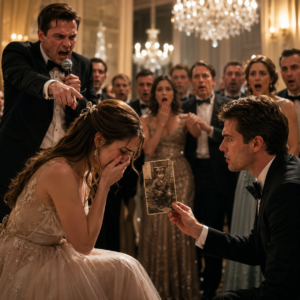
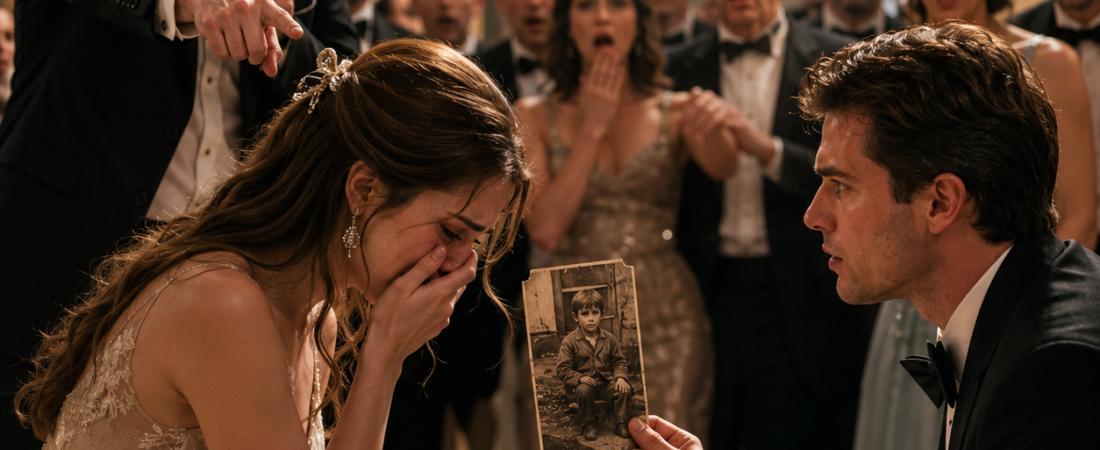
The photograph passed from hand to hand before it finally reached her.
Eleanor’s fingers trembled as she took it.
A ten-year-old boy stood in the frame, wearing a coat two sizes too big, sitting on the steps of a diner in the rain.
Behind him, barely visible at the edge of the shot, a younger version of herself crouched down, holding out a paper bag.
She didn’t remember the photograph being taken.
She remembered the boy.
“You used to come to that diner every Tuesday,” Julian Marsh said, his voice steady despite the hundreds of eyes locked on him. “You always ordered the same thing. Grilled cheese, two coffees. You never ate both meals.”
Eleanor’s mouth opened, but nothing came out.
“I was eight the first time you noticed me sitting outside,” he continued. “You didn’t ask why I was there. You just handed me the second meal like it was nothing. You did that every week for two years.”
Bradley Sinclair’s laugh had already died somewhere in his throat.
“This is absurd,” he said, forcing the words out. “Some sob story from a waitress’s tip jar doesn’t make her worth a million dollars.”
Julian turned to him slowly.
“She wasn’t a waitress. She was sixteen. She skipped her own lunch so a stranger’s kid wouldn’t go hungry.”
A murmur rippled across the room, the kind that spreads through a crowd right before it turns.
“I tracked her down two years ago,” Julian said. “Followed the trail from a diner that closed in 2009 to a marriage announcement in a society page. I’ve been waiting for the right moment to pay back a debt that’s been sitting on my ledger since I was eight years old.”
A murmur rippled across the room, the kind that spreads through a crowd right before it turns.
“I tracked her down two years ago,” Julian said. “Followed the trail from a diner that closed in 2009 to a marriage announcement in a society page. I’ve been waiting for the right moment to pay back a debt that’s been sitting on my ledger since I was eight years old.”
He’d rehearsed this moment more times than he wanted to admit, lying awake some nights running through exactly how he’d say it, worried he’d somehow get the words wrong and it would land as an insult rather than the gratitude he actually meant. Standing here now, watching Eleanor’s face shift from confusion into recognition, he understood that no rehearsal could have prepared either of them for how a single photograph could undo an entire evening.
He looked directly at Bradley.
“Tonight seemed like the right moment.”
Bradley’s face had gone the color of the tablecloth behind him.
“You don’t know anything about our marriage,” he snapped.
“I know enough,” Julian said. “I know a man doesn’t put a price tag of ten dollars on his wife in front of three hundred people unless he’s been doing it quietly for years first.”
The room had gone fully silent now, the kind of silence that costs a man his reputation in real time.
A caterer near the kitchen doors stopped mid-stride, tray balanced on one hand, unwilling to move and break whatever this was. A photographer hired for the gala’s official coverage had already lowered his camera, then quietly raised it again, sensing this shot mattered more than any of the ones on his call sheet.
Eleanor finally found her voice.
“Julian,” she said quietly, “you don’t have to do this.”
“I’m not doing it for you,” he said. “I’m doing it because somebody in this room needed to say the number out loud. One million dollars. That’s the bid. It stands whether he accepts it or not.”
Bradley’s hand tightened around the microphone.
“This is a joke,” he said, forcing a laugh that convinced no one. “A stunt. Some kid with money to burn trying to embarrass me at my own gala.”
“Your gala,” Julian repeated. “Funny. I heard the venue deposit bounced twice before the Whitfield Group covered it as a favor to your father-in-law.”
A gasp went through a cluster of guests near the bar.
Bradley’s jaw tightened.
“That’s a lie.”
“Ask your accountant,” Julian said. “Ask him about the loan against Eleanor’s trust that funded this party. Ask him whose name is actually on the deed to the house you keep calling yours.”
Eleanor’s grip on the photograph went white-knuckled.
She had signed papers eight months ago. Papers Bradley told her were “just formalities” for refinancing. She hadn’t read past the signature line.
She was starting to understand exactly what she’d signed.
Somewhere behind her, Bradley’s mother, Constance, had gone rigid in her seat, her champagne flute frozen halfway to her lips, the same woman who had spent nine years reminding Eleanor at every family dinner that she’d “married up” and ought to be grateful for it. Tonight, for the first time, Constance had nothing to say at all.
A man Eleanor recognized as one of Bradley’s golf partners leaned toward his wife and murmured something behind his hand. His wife’s eyes went wide, then flicked toward Eleanor with an expression that had shifted, in the space of thirty seconds, from polite disinterest into something closer to concern.
Eleanor realized, standing there under the chandelier light with her whole marriage dissolving in real time in front of three hundred witnesses, that she had spent nine years mistaking silence for peace.
It had never been peace. It had only ever been permission.
She thought back, standing frozen in that ballroom, to the first time Bradley had made a joke at her expense in front of colleagues, some offhand comment about her “decorating degree” being the closest thing she had to a real job. She’d laughed along with everyone else that night, telling herself it was harmless, that he loved her underneath it, that marriage meant absorbing a few sharp edges from the person you’d chosen. She hadn’t understood yet that the sharp edges were never going to stay a few.
She thought about the dinner parties where he’d introduced her simply as “my wife” without a name attached, as though Eleanor were a job title rather than a person. She thought about the vacation to Positano where he’d booked separate massage times so she “wouldn’t chatter through his relaxation.” She thought about a hundred small erosions that had, added together, worn her down into someone who apologized for taking up space at her own dinner table.
None of it had felt like abuse while it was happening. It had felt like marriage. That was, she was beginning to understand, exactly how it was designed to feel.
Julian watched her face change as the realization moved through her, and he didn’t rush her out of it. He simply stood beside her, steady, letting the silence stretch as long as she needed it to.