Part 2
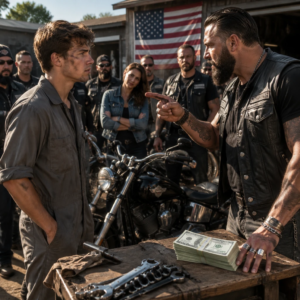
I sat down because Ray’s hand was still near my wrist, and because the man with the shaved head had closed the door behind him.
The bell above it gave a small metallic ring. Outside, the motorcycles remained parked beneath the pale October sun, but the riders who had been laughing beside them were no longer laughing. They stood in a loose line near the windows, pretending to watch the street.
Ray took the chair beside me. The shaved-head man sat across from us and kept his arms folded.
“His name is Cole Mercer,” Ray said. “Cole, this is Noah Bennett.”
Cole did not offer his hand.
“I know who he is.”
The words tightened something in my chest.
Ray turned toward him. “You know his name. That isn’t the same thing.”
Cole’s eyes stayed on me.
“His name was on the paper.”
“What paper?” I asked.
Ray reached into the inside pocket of his vest and pulled out a small folded square of white paper. He placed it on the table between us without opening it.
I recognized the color immediately.
It was the same pale blue paper I had seen inside the wallet.
I had assumed it was a receipt. When I opened the wallet beside the newspaper box, I had noticed something tucked behind the identification card, but the cash had taken all my attention. I had pulled the bills out, checked the name, and closed everything again.
Ray unfolded the paper.
A single line had been written across it in black ink.
NOAH BENNETT. BLUE STAR CAFE. 9:15 A.M.
My mouth went dry.
For a few seconds, the diner disappeared around me. The clatter of dishes, the hiss of the coffee machine, the low voices near the front window all seemed to move farther away.
“That was inside your wallet?” I asked.
Ray nodded.
“It wasn’t there when I found it,” I said. “I didn’t see this.”
“I know.”
“How?”
“Because the note wasn’t there when I lost the wallet.”
Cole leaned forward.
“Ray found the wallet in his office before he came into the diner. He put the money and his ID inside it himself.”
I looked at the brown leather wallet on the table.
The room seemed to tilt.
“You put the money in it?”
“All of it.”
“Why?”
Ray’s eyes hardened, but his voice stayed even.
“Because I wanted to know whether the person who picked it up would return it.”
I remembered his first question. You look like you could use what’s inside.
The count. The way he had watched my face while the bills spread across the counter. The suspicion in his voice when I said nothing was missing.
He had not been surprised to see four thousand dollars.
He had been waiting to see what I would do with it.
“That was a test,” I said.
“Yes.”
“You planted the wallet.”
“I placed it beside the newspaper box.”
“Why did you write my name on the note?”
Ray glanced at Cole.
“That part wasn’t mine.”
A cold line moved down my back.
I looked at the paper again. The letters were narrow and pressed hard into the page. The final stroke of the T in Bennett had torn the paper slightly.
“Where did you get this?”
“It was inside the wallet when I found it.”
“Then someone put it there before you planted it.”
“That’s what I’m telling you.”
I shook my head. “You were watching me?”
“I was watching the wallet.”
“That’s not an answer.”
Ray did not argue. He folded the paper once, carefully, and placed it beside the coffee mug.
“I put the wallet out because someone had been asking questions about the club’s emergency fund. I wanted to see whether the person looking for it would come back.”
“I wasn’t looking for your emergency fund.”
“I know that now.”
“Then why are you still treating me like I did something?”
“Because you’re the first person who touched it.”
Cole’s chair scraped against the floor.
“That’s not the whole reason.”
Ray raised a hand, and Cole stopped.
I looked from one man to the other. My plate was empty, but my stomach had turned over. The breakfast that had made my hands stop shaking now seemed like something I had accepted under false pretenses.
I reached for my backpack.
“I should leave.”
Ray caught the strap before I could lift it.
“Wait until you understand what you’re leaving.”
“I understand enough. You tested me, found out I passed, and now you’re acting like I’m involved in something.”
“You may be.”
“I’m not.”
“You don’t know that.”
The answer frightened me because it sounded reasonable.
Ray opened the wallet and took out his identification card. He turned it over and showed me the back.
There was a faint gray smear along the lower edge. It looked like dust, but when he rubbed it with his thumb, a dark red color appeared on his skin.
“Transfer ink,” he said.
I stared at the mark.
“What does that mean?”
“Someone pressed the card against a freshly marked surface.”
Cole reached into his jacket and set a clear plastic sleeve on the table. Inside was a photograph taken at an angle from across the street.
The image showed the newspaper box, the bus stop, and part of the Blue Star Cafe sign. My own figure stood near the curb, bent over the wallet.
My face was turned away, but my olive jacket and broken backpack strap were unmistakable.
The photograph had been taken before I entered the diner.
A second figure stood behind me near the laundromat entrance. The person’s face was hidden by the shadow of the awning, but one hand held a phone pointed directly at me.
My fingers went numb.
“When was this taken?” I asked.
“Eight forty-seven,” Cole said.
I looked at the cafe clock. It read 9:32.
“Who took it?”
“Not us.”
“Then how did you get it?”
“Someone left it under Ray’s office door this morning.”
My eyes returned to the photograph.
The shadowed figure had been there while I was deciding whether to keep the wallet. They had watched me open it. They had watched me read Ray’s name. They had watched me walk toward the diner.
Maybe they had watched me sleep outside the hardware store the night before.
A chair moved behind me.
June stood near the counter, holding a coffee pot. Her face had lost its usual impatience.
“Ray,” she said quietly, “the back door is locked.”
“Good.”
“It was open when I arrived.”
Cole stood.
Ray looked at him. “Check it.”
Cole moved toward the kitchen without another word.
I remained frozen beside the table.
The thought came before I could stop it. “Was someone in the diner?”
Ray’s expression changed.
“Why do you ask?”
“Because the person in the picture knew I would come here.”
“You didn’t tell anyone you were coming here.”
“I told the waitress.”
June’s hand tightened around the coffee pot.
“You didn’t know my name,” she said. “You asked for the wallet’s owner.”
I looked at Ray.
He had been the only person who knew my name before Cole arrived.
Ray slowly reached for the wallet again.
“Did anyone speak to you at the bus stop?”
“No.”
“Did anyone approach you?”
“No.”
“Did you notice a vehicle?”
“The gray sedan.”
Cole returned from the kitchen. “Back door was open. No damage.”
Ray did not look surprised.
“Was there anything outside?” he asked.
“A tire mark in the alley. Fresh.”
“What kind?”
“Passenger car.”
Cole sat down again, but his posture had changed. He was no longer watching me as if I were a suspect. He was watching the windows.
Ray lowered his voice.
“Tell me about the sedan.”
“It was across the street. I saw it when I found the wallet.”
“Make?”
“Gray. Older model.”
“Plate?”
“I didn’t see it.”
“Anyone inside?”
“Maybe. The windows were dark.”
“Did it move when you went into the diner?”
“I think so.”
“You think?”
“I wasn’t paying attention.”
Ray pressed his thumb against the edge of the wallet.
“Did it follow you before today?”
I wanted to say no. That would have been easier. But the question reached backward through the last week, touching details I had dismissed because noticing them had never helped me.
The same gray sedan had been parked near the church basement two nights earlier.
I had seen it outside the grocery store yesterday.
Once, near the bus station, a man had stood beside it with his hood pulled low. When I looked at him, he turned away.
“I’ve seen it before,” I said.
Cole’s face tightened.
“Where?”
“Near the church. The grocery store. Maybe the bus station.”
“Maybe?”
“I wasn’t keeping track.”
“You should have.”
“I didn’t know I was being followed.”
Nobody answered.
Through the front window, a motorcycle engine started. The sound rolled through the diner and faded down the street.
Ray looked at the photograph again.
“Why would anyone follow you?”
“I don’t know.”
“Think.”
“I’m thinking.”
“What happened before you lost your housing?”
The question struck too close to the center of me.
I folded my hands on the table.
“My stepfather sold the house.”
“Why?”
“Because he couldn’t keep up with the payments.”
“And your mother?”
“She died three years ago.”
Ray’s eyes lowered briefly.
“Did she leave you anything?”
“No.”
“Any paperwork? Accounts? A storage unit?”
“No.”
“Any reason someone would know your name?”
“Everyone knows my name.”
“That isn’t what I asked.”
I felt anger rise through the fear.
“My name is on my ID. I worked at an auto parts warehouse. I went to Cedar Grove High School. There are a lot of ways to find me.”
“Did you ever handle records at the warehouse?”
“I loaded shipments.”
“Did you see anything unusual?”
“Like what?”
“Missing inventory. False invoices. Cash being moved.”
I stared at him.
“I stacked brake pads and changed labels on boxes. I didn’t run the place.”
Cole looked toward the window.
“Did the warehouse close suddenly?”
“The owner said business was bad.”
“Was that true?”
“I don’t know.”
“Did anybody ask you to sign anything?”
“No.”
“Did you take anything when you left?”
“No.”
Ray watched my face.
“Are you sure?”
I pushed back from the table.
“I returned four thousand dollars that I could have used to eat for a month, and you’re asking whether I stole brake pads?”
“Nobody said you stole anything.”
“You keep asking questions like I did.”
Ray let go of my backpack strap.
“Because someone put your name in my wallet.”
“Someone put my name in your wallet, not me.”
“That’s why I’m asking.”
The words landed differently. He was not accusing me. He was trying to place me inside a story that had started before I knew there was one.
Cole pulled a folded document from the inside of his jacket and laid it beside the photograph.
It was a printed page with several lines blacked out. At the top was the name of a company I recognized.
Pine Ridge Auto Supply.
My former employer.
I looked at the page, then at him.
“What is that?”
“A shipment record.”
“Why do you have it?”
“Because our repair shop bought parts from Pine Ridge.”
“I thought you said the club owned the shop.”
“We do.”
I looked at Ray. “You knew where I worked?”
“I knew where you said you worked.”
“And you still hired me?”
“I offered you a conversation about work.”
“That’s not what this feels like.”
Cole tapped the document.
“Three months before Pine Ridge closed, a shipment disappeared. The paperwork said it was delivered to a storage facility outside Cedar Grove. The facility says it never received it.”
“I don’t know anything about that.”
“The employee who signed the receiving record was Noah Bennett.”
The room went completely still.
I read the line twice.
The signature at the bottom looked like mine.
It had the same tall N, the same narrow space between my first and last name, the same sharp final stroke. But I had never signed that document.
“I didn’t do this,” I said.
Ray’s eyes stayed on me.
“Do you recognize the signature?”
“It’s mine.”
“Did you sign it?”
“No.”
“Then who did?”
“I don’t know.”
Cole opened the clear sleeve and slid the paper toward me. A yellow highlighter mark circled a date.
The date was two days after I had been fired.
My throat tightened.
“That’s impossible.”
“Why?”
“Because I wasn’t there.”
“Where were you?”
“Sleeping behind the warehouse.”
Cole’s expression did not change. “You were fired on a Friday. The receiving record was signed Monday morning.”
“I told you, I wasn’t there.”
“Your employee number is on the page.”
I stared at the number.
I had memorized it from my time clock badge. It was printed beneath my name in small black digits.
The paper trembled under my fingers.
Ray leaned closer.
“Did you still have your badge after you were fired?”
“Yes.”
“Did you return it?”
“I left it in the supervisor’s office.”
“Who was the supervisor?”
“Derek Malloy.”
Cole and Ray exchanged a look.
“What?” I asked.
Ray took the document back.
“Derek Malloy disappeared two weeks ago.”
I felt the diner chair press into my back.
“Disappeared how?”
“He didn’t come home. His truck was found near the county line.”
“Is he dead?”
“We don’t know.”
“Why are you telling me this?”
“Because someone has been trying to find the missing shipment,” Cole said. “And because your name is attached to the paperwork.”
“I don’t have it.”
“We know.”
“I don’t know where it went.”
“We know that too.”
“Then what do you want from me?”
Cole’s answer came without hesitation.
“The truth.”
I laughed once, but there was no humor in it.
“I’ve been telling you the truth.”
“Not all of it.”
“I don’t know what else to tell you.”
Ray studied me for a long moment.
“When you left the warehouse, did Derek give you anything?”
“No.”
“Did he ask you to meet him somewhere?”
“No.”
“Did he mention a locker, a key, or a package?”
“No.”
“Did he ever call your mother?”
The question stopped me.
Ray noticed.
“My mother was dead,” I said.
“Before she died.”
I looked down at my hands.
I had not thought about the old voicemail in years. It had arrived on my mother’s phone during the last month she was alive. She had been too sick to answer, so I had listened to it for her.
Derek Malloy’s voice had come through the speaker.
He had asked her whether Noah had received the blue envelope.
At the time, I had assumed he meant a medical document. My mother had been dealing with insurance forms, hospital bills, and letters from people who wanted money she did not have.
When I asked her about it, she told me Derek had called the wrong number.
I had believed her because I needed to.
“I don’t know,” I said.
Ray’s gaze sharpened.
“Don’t know what?”
“Whether he called her.”
“You just said he did.”
“I remembered something.”
“What?”
I told them about the voicemail.
Cole’s attention moved from me to Ray.
“Blue envelope,” he said.
My skin prickled.
“What?”
Ray stood so suddenly that the table shook.
“Where is your mother’s phone?”
“She didn’t keep it. The hospital took it when she died.”
“Did you keep anything from her apartment?”
“Some clothes. A few photographs.”
“Letters?”
“No.”
“Check your backpack.”
“I don’t have a blue envelope.”
“Check it.”
The command carried enough force that I obeyed before I had time to resent it.
I pulled the backpack onto my lap. The surviving strap groaned. Inside were a blanket, two shirts, a cracked phone charger, a paperback novel, and a small plastic bag containing my birth certificate and the last photograph I had of my mother.
I emptied everything onto the seat.
No envelope.
Ray watched the items spread across the vinyl.
“Nothing,” I said.
Cole picked up the birth certificate. “This all you have?”
“Yes.”
“Where’s your wallet?”
I looked at the brown leather wallet on the table.
“I don’t have one.”
Ray frowned.
“You had identification.”
“In a plastic sleeve.”
“Why?”
“My old wallet was stolen at the bus station.”
“When?”
“Last month.”
“Did it have your mother’s address?”
“It had my ID and bus pass.”
“Anything else?”
“No.”
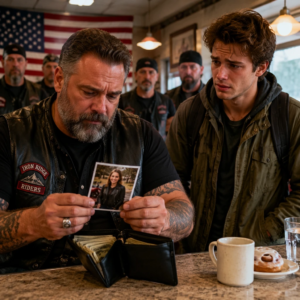
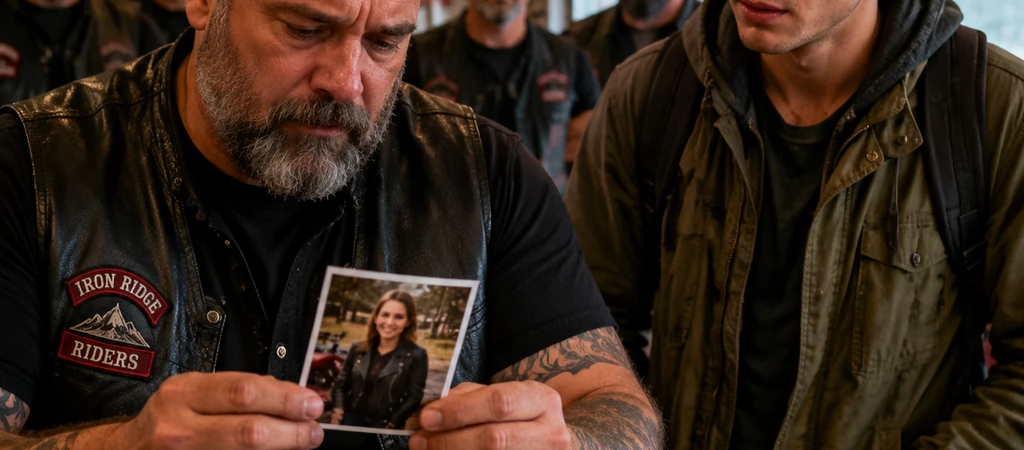
Ray took the photograph from the seat. It showed my mother standing beside me outside our old house. She was thinner than I remembered, but she was smiling. Behind us, the front porch railing had already begun to sag.
Cole turned the photograph over.
A pale blue strip of paper had been taped to the back.
I stopped breathing.
Ray peeled it away carefully.
The paper was folded twice. On the outside, in the same hard black handwriting as the note from the wallet, were four words.
ASK HIM ABOUT THE LOCKER.
My fingers closed around the edge of the seat.
“I never saw that before.”
Ray opened it.
Inside was a number.
Not a phone number. A locker number.
C-117.
Below it, someone had written a date from six months earlier, the week my mother died.
Cole took out his phone and searched something. His face changed before he spoke.
“C-117 is at the Cedar Grove bus station.”
I looked at him.
“How do you know?”
“Because the station lockers are numbered by row.”
Ray folded the paper again.
“Did your mother ever use the bus station?”
“She took the bus to the hospital sometimes.”
“Did she mention a locker?”
“No.”
“Did Derek?”
“No.”
“Did anyone else know about it?”
“I don’t know.”
Ray slipped the note into the clear sleeve with the photograph.
I stood, my knees unsteady.
“I’m going there.”
“Not alone,” Ray said.
“I don’t need an escort.”
“This stopped being about whether you need one.”
“I’ve been alone for months.”
“And someone has been watching you for at least a week.”
That silenced me.
June approached the table with a fresh pot of coffee. She looked at the photograph, then at my face.
“Ray,” she said, “the side window.”
Everyone turned.
A small black rectangle had been fixed to the outside of the glass near the bottom corner. It was no larger than a matchbox. A thin red light blinked once, then disappeared.
Cole moved first.
He crossed the diner, unlocked the front door, and stepped outside. Ray followed him. Through the glass, I watched them examine the sidewalk.
The device was gone.
A car engine started somewhere behind the building.
By the time Cole reached the alley, it had already faded into traffic.
Ray came back inside with his jaw set.
“Now you understand why you’re staying with us.”
I looked at the blue note inside the plastic sleeve.
“No,” I said. “Now I understand why someone wants me to think I’m part of this.”
Ray did not disagree.
That frightened me more than an accusation would have.
He took the plain business card from the table and turned it over. On the back, beneath the repair shop’s phone number, someone had written another message in the same black ink.
The letters were smaller this time.
HE DOESN’T KNOW WHAT HIS MOTHER LEFT HIM.
I read it once.
Then again.
Ray’s eyes moved to mine.
“Did your mother leave you anything else?”
I thought of the last photograph. The hospital bracelet in a drawer I had never opened. The locked cabinet in our old kitchen. The day Derek Malloy had stood on our porch and asked whether I had found the envelope.
I had told him no.
But he had looked past me, toward the hallway, as if he already knew where it was.
My stomach turned.
“I may have made a mistake,” I said.
“What kind?”
“When my stepfather sold the house, he told me everything inside had been cleared out.”
Ray waited.
“I believed him.”
Cole stepped closer. “What’s in the house now?”
“Nothing. A new family lives there.”
“Then what did you leave behind?”
I looked at the message on the card.
“I don’t know.”
Ray placed the wallet in his vest and picked up his keys.
“Then we start with the locker.”
I reached for my backpack, but before I could put the blanket back inside, a motorcycle pulled up outside the diner.
The rider did not remove his helmet.
He walked to the window, lifted one gloved hand, and held something against the glass.
A blue envelope.
The rider looked directly at me.
Then he tapped the envelope three times.
When Ray opened the door, the man stepped inside and placed it on the table.
“There was nobody at the bus station,” he said.
His voice was low and distorted by the helmet.
“So I brought it here.”
Ray stared at the envelope.
“Where did you find it?”
The rider turned toward me.
“Inside locker C-117.”
The envelope had my mother’s handwriting on the front.
Under my name, she had written one sentence.
DO NOT GIVE THIS TO RAY CALLAHAN.
Ray read it over my shoulder.
For the first time since I had met him, the color left his face.
Then he looked at me and said, “Noah, your mother knew my name.”