Part 4
I’m carrying the immediate 10:00–10:15 threat forward and keeping the resolution procedural: Noah will use the witnesses, the evidence trail, and the deputies’ presence to deny the trap its leverage. The part will deliver a temporary legal reversal while leaving the larger question of what his mother protected unresolved.STORY PART 4:
“Bring the key alone.”
I read the line again through the clear plastic bag. The red stain had spread along the lower corner of the envelope, but the paper itself was still dry. It was not blood. Someone had drawn the message with a red marker and pressed the ink against the inside edge so it would look fresh.
That realization changed the way I looked at the envelope.
“It’s bait,” I said.
Deputy Price held out his hand. “Give it to me.”
“No.”
His eyes narrowed. “Mr. Bennett, you are standing in the middle of an active search.”
“And someone wants me to leave this diner alone with a key connected to a missing shipment. The message is asking me to do exactly what a person trying to destroy evidence would want.”
Price glanced at the bag. “You don’t know that.”
“I know the envelope was thrown from a gray sedan after the first one disappeared. I know my mother’s handwriting was copied onto the front. I know the message inside was written to make me separate from every witness in this room.”
Ray looked at me with a new expression. It was not suspicion anymore. It was attention.
I pointed toward the evidence bag containing the business card.
“The same person wrote the message on that card. The same person knew my name before I entered this diner. They knew about the locker, the key, and the exact time. If I go to that locker alone, you lose the chance to see who is waiting for me.”
Price studied me for several seconds.
“You’ve been listening.”
“I’ve been trying to stay alive.”
The words came out quieter than I expected.
Deputy Alvarez stepped beside Price and looked at the clock. It read 10:02.
“We should preserve the envelope, photograph it, and notify the station before anyone touches the locker,” she said.
Price did not answer immediately. His radio crackled at his shoulder.
Alvarez continued. “And request the diner’s exterior footage. We have the sedan on scene twice. If this person is moving evidence, the footage matters.”
Price finally nodded.
“June, lock the front door,” he said. “Nobody leaves until we document everyone who was here.”
June moved toward the door, but Ray stopped her.
“Use the side entrance only for the deputies.”
Price gave him a sharp look. “You heard her. Nobody moves through any exit.”
Ray’s jaw tightened, but he stepped aside.
For the first time that morning, the room did not turn toward Ray for an answer. It turned toward me.
I was still frightened. The difference was that fear no longer felt like proof that I had to obey someone else.
Price placed the blue envelope on the table and photographed both sides with his phone. Alvarez photographed the stain, the tape, and the message through the plastic. She asked me to describe when I first saw it, who had touched it, and where it had been before the gray sedan appeared.
I answered carefully.
Hank told them about the locker. Cole described the surveillance device on the window. June explained that the first envelope had vanished while the deputies were entering and the club members were watching the search outside.
When June finished, she pointed at the empty coffee mug beside the counter.
“There was one more person in here,” she said.
Everyone looked at her.
“A man in a brown work jacket,” she continued. “He sat in the last booth. He ordered coffee and never drank it.”
“Why didn’t you mention him?” Price asked.
“Because I thought he was waiting for the rain to stop.”
“Where is he now?”
“He left right before the deputies came in.”
“Did you see which way he went?”
June looked toward the side window.
“He used the kitchen door.”
Cole’s face hardened. “The door that was open.”
June nodded.
I remembered that moment. The back door had been open when Cole checked it, but there had been no damage. Whoever entered or left had not forced anything.
“Do you know him?” Price asked.
“No. But I saw his car when he arrived.”
“What kind?”
“Gray sedan.”
The diner became silent again.
Price requested a description over the radio and asked dispatch to contact the bus station. Alvarez sealed the loose tape from beneath the table in a separate evidence bag. A few minutes later, the station manager confirmed that locker C-117 had been accessed earlier that morning, but the security camera covering the row had been pointed toward the wall.
“Convenient,” Cole muttered.
“It’s also evidence,” I said.
He looked at me.
“What?”
“The camera being moved. The open back door. The device on the window. The missing envelope. They’re all pieces of the same thing.”
Ray leaned against the table.
“You think the person wanted us looking at you.”
“I think they wanted you to believe I was the message.”
The statement made his expression go still.
Price looked from me to Ray. “Explain.”
“The wallet had my name inside it before Ray placed it by the newspaper box. Whoever wrote that note knew Ray was testing the wallet. They wanted him to see me as part of the problem. Then someone watched me find it and followed me here.”
Ray looked down at the brown leather wallet.
“Derek knew about my test.”
I turned toward him.
“You told him?”
“Not directly.”
“Then how?”
Ray’s eyes moved to the club members near the windows.
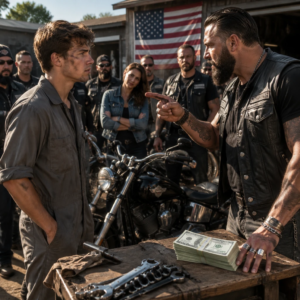
“Derek came to the repair shop three months ago. He said Pine Ridge was hiding inventory and using employee badges to falsify receiving records. He gave me a list of names, including yours.”
“You believed him?”
“I believed something was wrong.”
“But not enough to tell me.”
“You were homeless, frightened, and carrying a badge number somebody had already used. I didn’t know whether you were a victim or the person who helped them.”
My anger rose again, but this time it had somewhere to go.
“You could have asked me.”
Ray lowered his voice. “Would you have trusted me?”
“No.”
“Then we would have started exactly where we are now.”
That answer did not excuse him. It did make the room more complicated.
At 10:08, Price received word that the bus station manager had located a second camera. It showed the gray sedan entering the station parking lot at 9:34 and leaving at 9:43. The driver’s face was unclear, but the rear plate was visible.
Dispatch was running the plate.
Price looked at me.
“We’re going to the bus station.”
“I’m coming.”
“You’ll remain with me.”
“I want Ray there.”
Price shook his head. “He is connected to the evidence.”
“So am I.”
“That is why you’ll be with a deputy.”
I looked at Ray.
He understood what I was asking before I said it.
“Don’t let him handle anything,” I told Price. “Not the key. Not the locker. Not the envelope.”
Ray’s expression tightened.
I expected him to argue. Instead, he nodded.
“He’s right.”
The answer surprised all of us.
Price placed the key inside an evidence pouch and wrote the time across the label. He had me initial the chain-of-custody form as the person who found it. Alvarez did the same as the collecting deputy.
My name looked strange on the form.
For months, my name had appeared on documents as proof that I was unemployed, unwanted, or behind on something. This time, it was attached to an account of what I had seen and what I had refused to do.
The difference was small, but I felt it.
We left the diner through the front door in a line. Price and Alvarez went first. Ray followed with Cole and Hank. I walked beside June, who pressed a paper bag into my hands.
“Your toast,” she said.
“I thought Ray paid for breakfast.”
“He did. This is mine.”
Inside were two sandwiches and an apple.
I looked at her.
“Don’t make a speech,” she said. “I hate speeches.”
The bus station was three blocks away. The deputies parked near the entrance while Ray’s riders remained across the street. Price instructed them to stay outside the taped area.
The locker row smelled of dust, old carpet, and overheated metal. C-117 stood at the far end beneath a broken fluorescent light. Its outer door was closed now.
Price photographed it.
The station manager unlocked the master panel. Alvarez inspected the screws on the rear wall and found two freshly scratched marks around the lower hinge.
“Someone opened this recently,” she said.
Price looked at me. “The key.”
I watched him place it into the lock.
My hand was shaking, so I put it against the wall.
The key turned once.
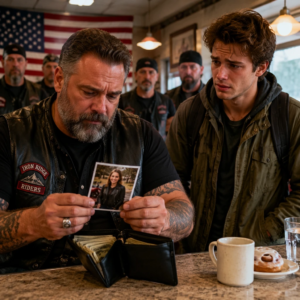
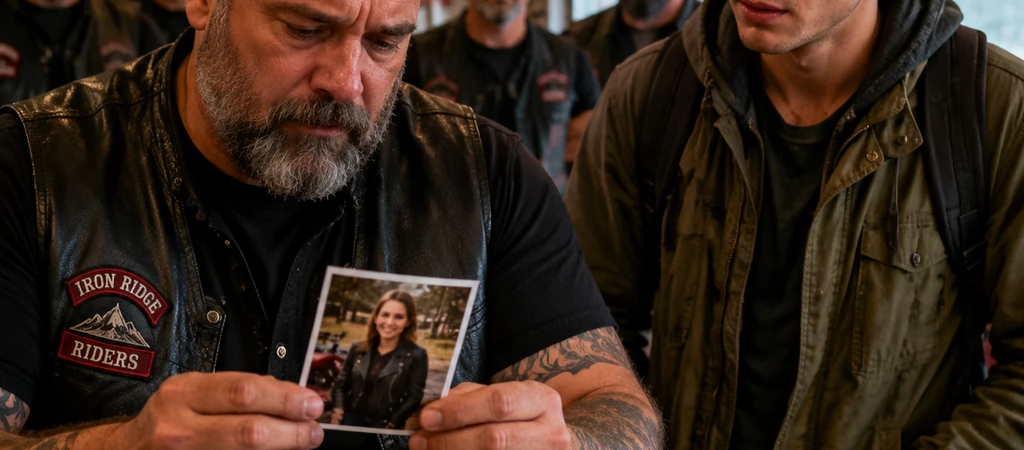
Inside the locker was a black metal box wrapped in a faded blue scarf. On top sat a folded photograph of my mother, younger than I had ever known her, standing beside a man in a leather vest.
I recognized the vest before I recognized the man.
Ray stepped closer.
The photograph showed him twenty-five years earlier. His beard was dark, his hair longer, and the Iron Valley Riders patch was already stitched across his shoulder.
My mother stood beside him with one hand resting on the seat of a motorcycle.
I looked at Ray.
“You knew her.”
He did not deny it.
“I knew her.”
“How?”
“Her name was Laura Bennett. She worked at a legal aid office near the county courthouse.”
“My mother was a receptionist at a clinic.”
“She worked there later.”
“Why didn’t you tell me?”
Ray stared at the photograph.
“Because she asked me not to.”
The answer made my chest hurt.
Price removed the box and set it on the evidence table the station manager had provided. Alvarez photographed the scarf, the photograph, and the box before opening it.
Inside were three folders, a small digital recorder, and a flash drive taped beneath the lid.
The top folder carried the Pine Ridge Auto Supply logo.
The second held copies of receiving records. Several pages contained signatures from employees who had never worked the dates listed. My own name appeared twice. The signatures were close enough to fool someone scanning quickly, but the final letters were wrong.
I had always crossed the t in Bennett with a short line.
The forged signatures used a long slash that cut through the entire word.
My mother had circled the difference in blue ink.
The digital recorder held one file.
Alvarez played it through her department phone.
A man’s voice filled the small locker room. It was Derek Malloy.
“I told you the badge belonged to Noah,” he said. “He never knew what it opened. You said the records would disappear before anyone checked.”
Another voice answered. Older. Angry.
“You were paid to keep the kid out of it.”
“I tried.”
“You put his name on the forms.”
“Because you told me to.”
The recording ended with a scrape and a sharp breath.
I looked at Ray.
“Who is the other man?”
He did not answer.
The station manager rushed in from the lobby.
“Deputy Price,” he called, “dispatch has the plate.”
Price stepped away to take the radio.
Alvarez continued cataloging the box. She found a handwritten note beneath the recorder.
The letters were my mother’s.
RAY CALLAHAN KNOWS WHERE THE FIRST FILE WENT. HE DOES NOT KNOW WHAT I KEPT.
My mouth went dry.
Ray closed his eyes for a brief moment.
“I knew about one file,” he said.
“The missing shipment?”
“No. A list of payments.”
“To whom?”
“People at Pine Ridge. A county inspector. Maybe someone at the bank. Your mother brought it to me because she believed the club could protect her.”
“Did you protect her?”
Ray’s face changed.
“She died before I could get the file back.”
“You said she asked you not to tell me.”
“She was afraid that if I told you, they would use you to find it.”
“So you let me sleep outside without telling me that my name was tied to a theft investigation?”
“I did not know where the file was.”
“Did you ever look?”
“Yes.”
“Where?”
“Her old house. Her storage unit. Derek’s office.”
“And you still didn’t tell me.”
Ray looked at the photograph in the evidence box.
“I thought the safest thing I could do for you was leave you out of it.”
I laughed once.
“You didn’t leave me out. You left me blind.”
Before he could answer, Price returned.
“The sedan is registered to Derek Malloy.”
Every person in the locker room went still.
The man listed as missing had been watching me, planting notes, and moving evidence. He had not disappeared from the county. He had been circling the story from the outside.
Price received another message through his radio.
“Derek Malloy is headed here,” he said. “A patrol unit spotted the sedan two blocks away.”
The station manager looked toward the glass doors.
“Can we secure the lobby?”
“Lock the rear exit,” Price ordered. “Nobody approaches the parking lot.”
I stepped closer to the evidence table.
“What will happen when he sees the box?”
“He won’t see it,” Price said.
“He already knows I have the key. The envelope told him to bring me here alone. He may think the trap worked.”
Price looked at me.
“What are you suggesting?”
“Let him think he still controls the meeting.”
Alvarez studied me. “You want to speak to him?”
“I want him to say why he did this.”
“That is not your decision.”
“No. But I can tell you what he expects. He expects me to be alone, frightened, and willing to trade the box for answers. If he sees the deputies immediately, he’ll run or stay silent.”
Price’s expression remained cautious.
“You’re not bait.”
“I’m the person he built the trap around.”
“That doesn’t make it safe.”
“It makes it predictable.”
Ray stepped forward. “Noah, you don’t owe anyone this.”
“I know.”
The words were important. I needed him to hear them.
“I’m doing it because he has used my name on records for months. He used my mother’s fear to move me from one place to another. He put me in front of you and let everyone decide I was guilty before I understood what was happening.”
I looked at the folder containing the forged signatures.
“I want him to hear me say that.”
Price spoke with Alvarez in a low voice. They arranged the deputies near the side corridor and kept the evidence sealed. The station manager agreed to remain at the desk as a witness.
I took the blue envelope from its bag only long enough to place it on the empty bench near the locker row. The camera remained on. The message stayed visible through the plastic.
Then I stood several feet away with my hands in sight.
Ray and the others moved behind the service wall.
At 10:14, the lobby doors opened.
Derek Malloy walked in wearing a brown work jacket.
He looked older than I remembered. His cheeks were hollow, and a cut ran along his forehead. He glanced toward the locker row, saw me, and stopped.
For a moment, neither of us spoke.
Then he smiled without warmth.
“You brought the key.”
“I brought witnesses.”
His eyes shifted toward the lobby.
“You were supposed to come alone.”
“That was the point.”
Derek took one step toward me.
“You don’t understand what you’re carrying.”
“I understand that you forged my signature.”
“I was trying to keep you alive.”
“You put my name on stolen shipment records.”
“Because Martin Voss told me to.”
The name meant nothing to me.
Derek looked toward the service wall, though he could not see Ray.
“The owner of Pine Ridge,” he said. “He moved parts through shell companies and used employee badges to make the paperwork look clean. When the auditors came, he needed someone disposable.”
“And you chose me.”
“I chose the name he already had access to.”
“You chose a homeless kid who couldn’t afford a lawyer.”
His face tightened.
“I didn’t know you were homeless.”
“You knew my mother.”
Derek’s eyes dropped.
“She found the payment list.”
“She trusted you.”
“She threatened to expose Voss.”
“And you gave him her name?”
“No.”
“Then why did you call her?”
“Because I wanted the file.”
“What file?”
“The one she hid from Ray.”
The words struck the air between us.
Derek glanced at the blue envelope on the bench.
“She kept a copy of the payment list. Ray had the original for one night, then it disappeared. Your mother gave the copy to you without telling you what it was.”
“I was eleven when she left me a photograph.”
“You were older when she hid the key.”
“Why did you send me to the locker?”
“Because I needed the key. The lock was changed after your mother died.”
“You could have asked me.”
“You would have gone to Ray.”
“You were already using Ray to test me.”
Derek’s face turned pale.
“I didn’t know about the wallet.”
That was the first answer that sounded true.
“The note was inside before Ray placed it,” I said. “You put it there.”
“Yes.”
“Why?”
“I needed him to think you were connected to the missing file. I needed him to keep you close.”
“Why would that help you?”
“Because I knew he would protect the evidence before he gave it to the police.”
He looked at the service wall again.
“But he didn’t know you had the locker key.”
“No,” I said. “My mother did.”
Derek swallowed.
“Your mother was smarter than all of us.”
“Where is the first envelope?”
His hand moved toward the inside of his jacket.
Price stepped from behind the wall.
“Keep your hands where I can see them.”
Derek froze.
Alvarez came from the opposite side. The station manager locked the lobby doors behind him.
Derek’s shoulders sagged.
“You recorded me,” he said.
“Your statement is being documented,” Price replied.
Derek looked at me.
“You think this fixes anything?”
“No.”
That answer seemed to unsettle him more than anger would have.
Price arrested him for the outstanding warrant related to the Pine Ridge investigation and for suspected evidence tampering. Alvarez recovered the first blue envelope from inside his jacket. It was empty except for a torn piece of paper bearing my mother’s handwriting.
The paper said only:
THE FIRST FILE IS WITH THE PERSON WHO CLAIMS HE LOST IT.
Derek refused to say whether that meant Ray, Voss, or someone else.
By noon, Pine Ridge Auto Supply was surrounded by investigators. Martin Voss was taken into custody after the flash drive showed transfers between the warehouse and accounts controlled by his company. The forged records were logged, the club’s motorcycles were released, and Tommy was allowed to leave after investigators confirmed the black case had been planted in his saddlebag.
Derek’s arrest did not make me feel victorious.
It made me feel tired.
Outside the station, Ray stood beside his motorcycle while Price finished my statement. The afternoon sun had burned through the clouds, but the wind remained cold.
Price handed me a card with the number of a county victim advocate.
“You are not a suspect in the shipment case at this time,” he said. “That may change if new evidence appears, but the documents we recovered support your account.”
I took the card.
“Am I still homeless?”
Price hesitated.
“That is not something the warrant can solve.”
The truth hurt less than a promise would have.
June had called a shelter and found a bed for one night. The victim advocate arranged a longer placement and said she could help me replace my identification. Ray offered work at the repair shop, but I told him I needed time before accepting anything from the Iron Valley Riders.
He nodded.
“You should.”
I looked at him.
“I still need the truth about my mother.”
“I know.”
“Did she trust you?”
“Once.”
“Do you trust yourself?”
Ray looked toward the evidence bags in Price’s vehicle.
“Less than I used to.”
That was the closest thing to an apology he had given me. It was not enough to repair the years between us, but it was honest.
Before I left, he handed me the photograph of my mother. The brass key was sealed separately as evidence, but the photograph itself had been released because it was not part of the warrant.
On the back, beneath the place where the blue note had been taped, I noticed a faint indentation in the paper.
I held it toward the light.
Another sentence had been written on the other side of the photograph hard enough to leave marks behind.
RAY WILL TELL YOU ABOUT THE NIGHT I CAME TO HIM.
I looked up.
Ray had gone still.
“What night?” I asked.
He did not answer.
Across the street, a county vehicle carried Derek Malloy away. The gray sedan was being towed behind it, its windows reflecting the bright sky. The people who had used my name, forged my signature, and tried to turn me into evidence were finally facing consequences.
But my mother had left one truth locked behind another.
I had found food that morning. I had found witnesses. I had found a place to sleep for one night and a possible job waiting after that.
I had not found belonging.
Not yet.
Ray looked at the message on the photograph and then at me.
“Your mother came to the clubhouse the night before she died,” he said. “She brought something with her.”
“What was it?”
His hand closed around the edge of his vest.
“Something I thought had been destroyed.”
I waited.
Ray’s eyes moved to the road where the tow truck disappeared.
“Something that could prove who ordered the first shipment.”
“And you still have it?”
“No.”
“Then who does?”
Ray looked back at the photograph.
“Your mother.”
My breath caught.
“She’s dead.”
“I know.”
“Then what are you saying?”
Ray’s face was pale beneath his beard.
“I’m saying she left it somewhere neither Derek nor Voss could reach. And she gave me one instruction.”
“What instruction?”
Ray met my eyes.
“If Noah ever came back, I was supposed to take him there.”
I looked down at the photograph, at the deep marks left by my mother’s hidden words.
For the first time in years, my name did not feel like something other people could use against me.
It felt like a door.
And somewhere beyond it was the part of my mother’s life that Ray had kept from me.
I folded the photograph carefully and slipped it into my jacket.
Then I turned toward the county van, the shelter waiting across town, and the repair shop where a job might still be offered in the morning.
I had spent months trying to survive one day at a time.
Now I had to decide whether learning the truth about my mother was worth discovering what it might cost me.