Part 3
Ray stared at the sentence on the envelope as if the ink had changed while he was reading it.
The rider removed his helmet. He was older than Cole, with a weathered face and gray hair cut close to his scalp. I had seen him outside the diner earlier, standing beside a black motorcycle with a red gas tank. Ray called him Hank Mercer.
“Where exactly did you find this?” Ray asked.
“Locker C-117,” Hank said. “The door was already open.”
“Was the envelope inside?”
“It was behind the metal panel.”
Cole stepped toward him. “What metal panel?”
“The back of the locker. Someone had loosened the screws.”
Ray picked up the envelope but did not open it.
My mother’s handwriting ran across the front in blue ink. I knew every curve of it. She had written my name the same way on school forms, birthday cards, and the brown paper bags she packed for my lunch when I was a kid.
Underneath my name, the warning looked less like a message and more like a command.
DO NOT GIVE THIS TO RAY CALLAHAN.
I reached for it.
Ray’s hand closed around the envelope first.
“Why did you open the locker?” he asked Hank.
“I didn’t.”
“You said the door was open.”
“It was. I saw the envelope behind the panel and took it.”
“You didn’t call me?”
“I tried.”
Ray glanced toward the counter.
His phone lay beside the coffee pot. The screen was dark.
Hank pointed at it. “Your phone was off.”
Ray’s eyes moved to me.
For one sharp second, I wondered whether he had turned it off himself. The thought made me angry because I had only known him for a few hours, and already I had begun measuring the room by his reactions.
“I want the envelope,” I said.
Ray looked back at the writing.
“So do I.”
“My mother wrote my name on it.”
“She also wrote not to give it to me.”
“Then you should probably listen to her.”
The words came out before I could stop them.
Cole’s face tightened, but Ray did not get angry. He turned the envelope over and examined the seal. It had been closed with clear tape, folded down twice along the edge.
“Was it sealed when you found it?” he asked Hank.
“Yes.”
“Any damage?”
“Only the screws.”
Ray ran a finger along the tape without touching the paper.
Then the front door opened.
The bell rang once.
A man in a navy jacket stepped into the diner. He was in his forties, clean-shaven, with a county sheriff’s badge clipped to his belt. Another deputy stood behind him, one hand resting near his radio.
The first man looked at Ray.
“Ray Callahan?”
Ray’s shoulders became still.
“That depends on who’s asking.”
“Deputy Aaron Price, Cedar Grove County Sheriff’s Office.” He held up a document. “We have a warrant to search the premises and the vehicles outside.”
The air seemed to leave the room.
June set the coffee pot down too hard. Ceramic struck the counter, and coffee spilled across the metal surface.
Ray did not take his eyes off the warrant.
“Search for what?”
“Stolen property connected to Pine Ridge Auto Supply.”
Cole stepped between Price and the table.
“You’re early.”
The deputy looked at him.
“You were expecting us?”
“No.”
“Then move aside.”
Ray raised one hand.
Cole stopped, but his jaw remained tight.
Price entered fully and handed the warrant to Ray. The second deputy moved toward the windows, watching the riders outside.
I looked at the envelope in Ray’s hand.
My mother’s warning had been written before the deputies arrived. Before Hank found the locker. Before any of us knew whether it contained proof or another trap.
Still, it felt connected.
Price noticed me.
“Who is he?”
Ray answered before I could.
“Noah Bennett.”
The deputy’s eyes dropped to my broken backpack strap, then returned to my face.
“Mr. Bennett, step away from the table.”
“Why?”
“Because I asked you to.”
I stood slowly. My knees felt weak again, but this time it had nothing to do with hunger.
Price looked at the envelope.
“What’s that?”
“Personal property,” I said.
“Whose?”
“My mother’s.”
“Where did it come from?”
“Locker C-117 at the bus station.”
The deputy’s expression changed slightly.
“Who opened the locker?”
“Hank found it open.”
Price looked at Hank. “You removed an item from an unsecured locker?”
“It was my friend’s locker.”
“Was your name on it?”
“No.”
“Then you removed property that did not belong to you.”
Hank’s mouth tightened. “I was bringing it to Noah.”
“Put it on the table.”
Hank looked at Ray.
Ray’s fingers tightened around the envelope.
“Put it down,” Price repeated.
Ray placed it beside the coffee mug.
The second deputy took a plastic evidence bag from his belt and approached. She had dark hair pulled into a tight bun and a nameplate that read S. Alvarez.
She picked up the envelope with gloved fingers and slipped it into the bag.
I stepped forward.
“That’s mine.”
“It may be evidence,” Price said.
“My mother wrote it to me.”
“And she may have written information relevant to an investigation.”
“You can’t just take it.”
Price looked at Ray. “We can if it falls within the warrant.”
Ray finally spoke.
“The warrant names Pine Ridge records and missing inventory. It doesn’t give you authority to seize every personal letter in the building.”
Price’s face stayed calm.
“If the letter relates to the listed property, it is covered.”
“You haven’t established that it does.”
“You haven’t established that it doesn’t.”
The exchange was quiet, but every word seemed to sharpen the room.
Cole looked at me.
“Did you read it?”
“No.”
“Did you see anything through the envelope?”
“No.”
Price turned toward me.
“Were you with them when the locker was opened?”
“No.”
“Were you at the bus station this morning?”
“No.”
“Where were you?”
“The Blue Star Cafe.”
“Before that?”
“On the street near the bus stop.”
“Why?”
“I found a wallet.”
Price’s gaze shifted to Ray.
“What wallet?”
Ray said nothing.
I looked at him. “Tell him.”
His eyes met mine, and something passed between us that I could not interpret. Warning, maybe. Or hesitation.
Price noticed the silence.
“What wallet, Mr. Callahan?”
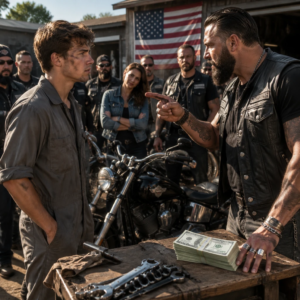
Ray reached into his vest and set the brown leather wallet on the table.
“This one.”
Price opened it. He checked the identification card, then counted the money.
“Four thousand dollars.”
“Correct,” Ray said.
“Where did you get it?”
“I placed it beside the newspaper box.”
Price looked at him.
“You planted it?”
“Yes.”
“Why?”
“To test whether someone would take the money.”
Cole glanced at Ray, but I could not move. The words sounded worse when spoken in front of a deputy.
Price turned to me.
“And you found it?”
“Yes.”
“You opened it?”
“Yes.”
“You saw the cash?”
“Yes.”
“You knew it belonged to Mr. Callahan?”
“I saw his ID.”
“And you returned it?”
“Yes.”
Price wrote something in a small notebook.
“Why did you come here?”
“To give it back.”
“Did Mr. Callahan offer you money?”
“No.”
“Food?”
I looked at the empty plate.
“He bought breakfast.”
“Did he offer you work?”
Ray’s face hardened.
“He gave me a business card.”
Price looked at the card still lying on the table.
“May I see it?”
I handed it over.
He read the front, then flipped it around. His thumb stopped on the back.
I saw the message before he turned the card toward me.
HE DOESN’T KNOW WHAT HIS MOTHER LEFT HIM.
The black letters looked darker than they had a minute earlier.
Price stared at the card.
“Who wrote this?”
Ray took one step forward.
“That was not there when I gave it to him.”
I looked at Ray.
“You gave it to me.”
“Yes.”
“Then how did the message get there?”
No one answered.
Cole moved toward the card, but Alvarez blocked him.
“Don’t touch it.”
Price held the card by its edges.
“Mr. Bennett, did you write this?”
“No.”
“Did you ask anyone to write it?”
“No.”
“Did you know it was there?”
“No.”
Price looked at Ray again.
“You said you gave him the card.”
“I did.”
“When?”
“Before Hank arrived.”
“Who else touched it?”
I thought back.
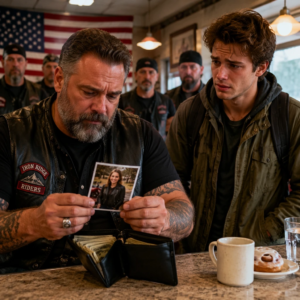
June had written the breakfast order. Ray had slid the card across the counter. I had picked it up, placed it near my plate, and later set it beside the photograph.
Hank had not touched it.
Cole had not touched it.
But the room had been busy. Riders had moved near the counter. June had carried coffee past us. Someone could have reached the table while we were looking at the photograph.
Or someone had written the message before Ray gave it to me.
Price placed the card in another evidence bag.
“I’m taking this too.”
“That message was meant for me,” I said.
“Then it may explain why your name appears in a stolen shipment record.”
“I don’t know anything about a stolen shipment.”
“You said that already.”
“Because it’s true.”
Price closed the notebook.
“Where is Derek Malloy?”
“I don’t know.”
“When did you last see him?”
“Three months ago.”
“Your employment record shows you signed for a shipment after you were fired.”
“I didn’t sign it.”
“Your signature says otherwise.”
“Someone used my badge.”
“Your badge was in your possession?”
“No. I left it in the supervisor’s office.”
“That’s convenient.”
The word struck me harder than the questions.
I looked toward Ray. He had been the first person that morning to tell me my honesty mattered. He had bought me breakfast without calling it charity. He had offered me work because I knew how to show up and tell the truth.
Now he stood silent while a deputy treated me like a convenient explanation.
I reached for my backpack.
“I’m leaving.”
Price stepped in front of the door.
“You’re not under arrest.”
“Then move.”
“You may be a material witness.”
“I found a wallet.”
“And your name is on a shipment record connected to a missing inventory case.”
“I told you I didn’t sign it.”
“Then stay and answer questions.”
“I’ve answered them.”
Price held my gaze.
“Not the important ones.”
The second deputy returned from the kitchen.
“Nothing in the office except club paperwork and repair invoices.”
Price nodded. “Search the vehicles.”
Cole turned sharply.
“You don’t have probable cause to search private motorcycles based on a warehouse record.”
“We have a warrant.”
“For the premises?”
“And associated vehicles.”
Cole looked at Ray. “They’re going to tear through every saddlebag.”
“Let them,” Ray said.
It was the first time he sounded tired.
The deputies went outside. Through the windows, I watched them move between the motorcycles while the riders stood several feet away, hands visible, faces closed.
One deputy opened the saddlebag of a blue touring bike.
The owner took a step forward.
Price raised his voice. “Stay back.”
The rider stopped.
I looked down at my hands. A dark line of grease remained beneath one fingernail from the warehouse job, though I had not worked there in months.
The clue I had spent all morning trying to understand suddenly returned with a different meaning.
The wallet had not only been a test.
Someone had placed my name inside it because they knew I would find it. They had written the diner and the exact time. They had watched from the laundromat. They had left a photograph. They had placed the blue note behind my mother’s picture.
Every message had pushed me toward Ray.
Not toward the bus station.
Toward Ray.
The question was why.
I turned to him.
“Your test was planned before you saw me.”
Ray’s eyes narrowed.
“What are you talking about?”
“You put the wallet there because you were looking for whoever would come back. But my name was already inside it.”
“I know.”
“Someone knew I would find it.”
“Or someone wanted me to think you were involved.”
“Those are not the same thing.”
“No.”
“Did you know my name before this morning?”
Ray paused.
It lasted less than a second, but I saw it.
“Yes,” he said.
My chest tightened.
“How?”
“Your former supervisor mentioned you.”
“Derek?”
“Months ago.”
“What did he say?”
“That you were reliable.”
“That’s all?”
Ray looked toward the window, where deputies were searching the motorcycles.
“Not exactly.”
I waited.
He did not continue.
“Did Derek tell you about my mother?”
“No.”
“Did he give you my name?”
“He gave me a list of employees who had access to the warehouse receiving system.”
I felt the room narrow.
“I never had access.”
“You had a badge.”
“For the time clock and loading floor.”
“Derek said the badge could open more doors than you knew.”
“Why didn’t you tell me that?”
“Because I didn’t know whether it was true.”
I laughed bitterly.
“So you put four thousand dollars in a wallet and waited to see if I was honest.”
“I needed to know whether you could be trusted.”
“You already had my name.”
“I had a name on a list.”
“And now?”
“Now I know you returned the money.”
“That doesn’t answer the question.”
Ray stepped closer.
“I don’t know who you are yet, Noah.”
The honesty should have helped. Instead, it made me feel as if the ground had moved underneath me.
Outside, a deputy shouted.
Everyone turned toward the window.
Alvarez stood beside a red motorcycle, holding a small black case in one hand. The rider who owned the bike was pale.
Cole moved toward the door.
Price blocked him again.
“What did you find?” Cole asked.
“Step away.”
“That case isn’t mine.”
“It was in the saddlebag.”
The rider shook his head. “I’ve never seen it.”
Price opened the case.
Inside were several compact hard drives, a flash drive, and a folded shipping manifest.
The diner erupted in low voices.
Ray stared at the case.
“That bike belongs to Tommy.”
Tommy looked sick. “Ray, I swear I didn’t put that there.”
Price held up the manifest.
“Pine Ridge Auto Supply,” he said. “Shipment dates, warehouse codes, and receiving signatures.”
His eyes moved to me.
“One signature is Noah Bennett.”
I could not breathe.
The paper was too far away to read, but I recognized the shape of the form. The same kind of document Cole had shown us.
Tommy shook his head.
“I didn’t know anything about that.”
Price ordered him to turn around and place his hands behind his back.
The riders outside began shouting. Cole pushed through the doorway, and Alvarez reached for her radio. Ray moved faster than either of them, stepping between the men.
“Everybody stays where they are,” he said.
His voice carried across the parking lot.
The riders froze.
Tommy looked at Ray while Price secured the cuffs.
“Boss, I didn’t do this.”
“I know,” Ray said.
But his eyes had moved to me.
I felt the old shame rise, the one I had learned to recognize in shelters and police stations. The moment when a room decided that the poorest person in it was also the easiest person to blame.
My backpack sat beside the table.
The blue envelope was gone.
I looked at the empty space where Hank had placed it.
“Where is my mother’s letter?”
Ray turned toward the table.
The evidence bag was no longer there.
Neither was the envelope.
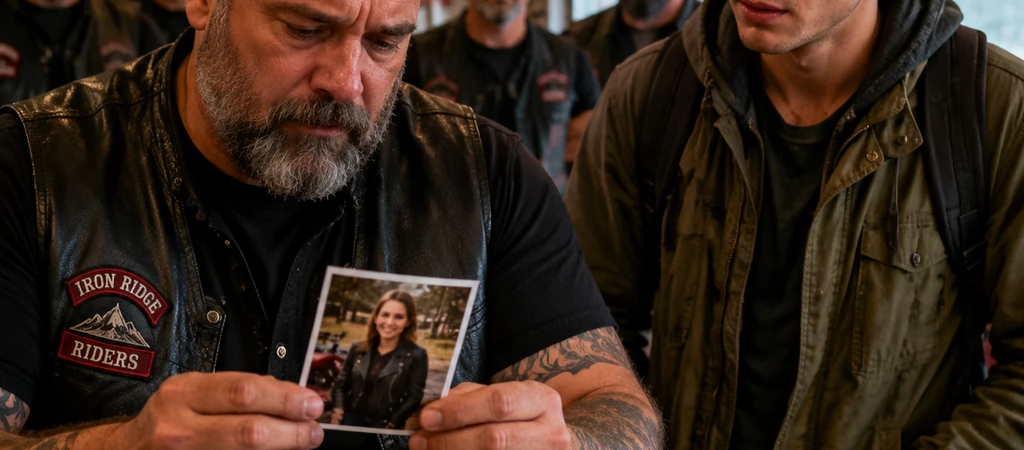
The only thing left beside the coffee mug was the plastic sleeve containing the photograph and blue note.
I looked at Hank.
“You had it.”
“I gave it to Ray.”
“Ray had it.”
Ray checked the pockets of his vest. His expression changed.
“It isn’t here.”
Price came back inside.
“What’s missing?”
“My mother’s letter,” I said.
Price looked at Ray. “You had it?”
“Yes.”
“Where is it now?”
“I don’t know.”
Alvarez scanned the room.
“Everyone stays put.”
June raised both hands. “I never touched that envelope.”
Cole looked toward the front door. “Nobody left.”
“Someone did,” I said.
The room went quiet.
I remembered the riders near the windows. The deputy entering. Hank removing his helmet. The coffee pot spilling across the counter. Ray taking the business card. Price reading the wallet.
A dozen moments when an envelope could disappear.
Then I saw the torn strip of clear tape stuck to the underside of the table.
It had not been there before.
I crouched and picked it up.
The adhesive held a faint blue fiber.
“Someone opened it,” I said.
Ray took the strip from me.
His face darkened.
“Who was sitting here?”
“Me,” I said. “Ray. Cole.”
“Hank stood beside the table,” Cole added.
Hank’s face went rigid.
“I didn’t take it.”
“You were the one who brought it,” Cole said.
“And I gave it to Ray.”
Price stepped between them.
“Nobody accuses anyone until we establish what happened.”
I looked at the front window.
The black surveillance device that had been attached to the glass was gone. Whoever placed it there had been close enough to enter the diner. Whoever took the envelope knew exactly which object mattered.
The earlier clue returned again.
The person in the gray sedan had not been watching me because of the wallet.
They had been waiting for the letter.
And now it was gone.
Price pointed at me.
“You’re coming with us for a formal statement.”
“Am I under arrest?”
“Not at this time.”
Ray stepped forward. “He’s not leaving alone.”
Price looked at him. “You’re not in charge of this investigation.”
“No.”
“Then don’t interfere.”
Ray’s eyes stayed on mine.
There was something he wanted to say, but the deputies were watching. The riders were watching. Even June had stopped pretending to wipe the counter.
I picked up my backpack.
The strap finally tore.
Everything inside dropped onto the floor.
My blanket landed first. Then the paperback. The cracked charger. The plastic bag with my birth certificate.
The photograph of my mother slid beneath the table.
I reached for it.
A small metal key fell from behind the photograph and struck the floor.
Nobody moved.
It was brass, old-fashioned, and attached to a narrow blue tag.
C-117.
I stared at it.
My mother had not left the key inside the house. She had not hidden it in a drawer. She had taped a note to the back of her photograph and made sure I carried it with me without knowing it was there.
The envelope had been meant to lead me to the locker.
The key had been meant to bring me back.
Ray crouched and picked it up.
On the reverse side of the blue tag was a second number.
Not a locker number.
A time.
10:15.
I looked at the diner clock.
It was 9:58.
Seventeen minutes.
Cole saw the time and swore under his breath.
“What happens at ten fifteen?” I asked.
Ray did not answer.
“Ray.”
He closed his hand around the key.
“Your mother was careful,” he said.
“That’s not an answer.”
“She knew someone might be watching the bus station.”
“Then why send me there?”
“Maybe she wasn’t sending you to the locker.”
“Where else would I go?”
Ray looked at the missing envelope, then at the key in his fist.
“Maybe she was sending whoever followed you.”
A sharp knock sounded against the front window.
Every head turned.
The gray sedan sat across the street.
It had not been gone.
It had been parked behind a delivery truck, hidden from the diner’s angle. Now it rolled forward into clear view. The driver’s window lowered, but the person inside remained in shadow.
A hand extended from the window and dropped something onto the sidewalk.
A blue envelope.
The car accelerated before anyone reached the door.
Cole ran outside. Ray followed. Price shouted for him to stop, then ran after them with Alvarez.
I stayed frozen beside the table.
The envelope on the sidewalk was too far away to read, but I knew the handwriting.
My mother’s handwriting.
A few seconds later, Cole came back holding it in a plastic glove. Ray followed him, breathing hard. Price was already speaking into his radio, giving the sedan’s description.
Cole placed the envelope on the table.
“This one wasn’t in the locker,” he said.
I looked at the front.
My name was written across it.
Underneath, there was no warning to Ray.
There was only one sentence.
YOU HAVE SIXTEEN MINUTES TO CHOOSE WHO TO TRUST.
Ray’s hand remained on the locker key.
Price turned toward me.
“You’re coming with us.”
Ray looked at the envelope.
“Noah,” he said quietly, “if you open that, you may lose the only chance you have to learn what your mother was protecting.”
“And if I don’t?”
“Then whoever took the first letter gets to decide what happens next.”
The diner clock clicked forward.
10:00.
I looked at the deputy waiting by the door, the envelope on the table, and Ray’s closed fist around the key.
Then I noticed a dark stain spreading across the corner of the blue paper.
It looked like ink at first.
But when Cole touched the edge of the plastic bag, his glove came away red.
Something inside the envelope had been cut.
And beneath the stain, a second line slowly became visible through the paper.
BRING THE KEY ALONE.