Part 2
Everyone in that ballroom thought they were watching the moment I fought back.
They were watching the moment I finished.
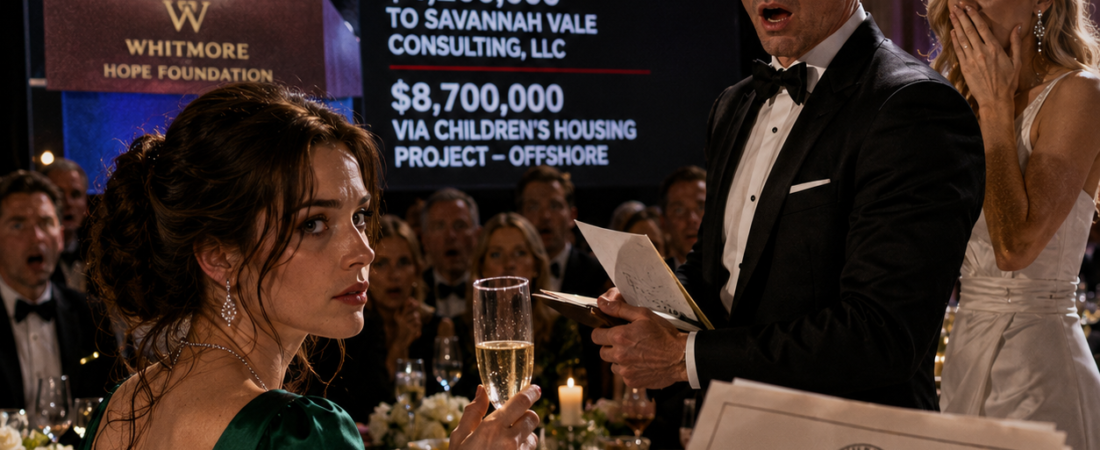
The fighting had taken six years, and none of it happened where anyone could see. That is the part the cameras never understood: by the time you watch a woman stand up calmly in a green dress while her husband’s crimes scroll across a twenty-foot screen, the war is already over. What you’re seeing is the surrender ceremony. You just can’t tell yet whose.
Let me take you back to where it started, because a marriage doesn’t end at a gala. It ends the first time you ask a simple question and get a complicated answer.
Mine was: “Where are the Harrow Street apartments?”
The Whitmore Hope Foundation had announced them four years into our marriage—forty units of transitional housing for teenagers aging out of foster care, the kind of kids who turn eighteen and get handed a garbage bag of their belongings and a bus schedule. Maxwell stood at a podium and wept about them. Donors wrote checks with three commas. There was a groundbreaking with gold-painted shovels, and I stood beside my husband in a hard hat and believed, God help me, that I had married a man who was going to catch children the world was dropping.
Then a year passed, and the building didn’t open. Then another year. And one afternoon, running an errand, I drove past the Harrow Street lot, and it was exactly what it had been at the groundbreaking: a fenced rectangle of weeds and one faded sign with Maxwell’s name on it, promising a future that had already been paid for and never built.
I asked him that night. He kissed my forehead—he always kissed my forehead when he was about to lie, I would later realize; it was the tell I never learned to read in time—and said the project had hit “permitting issues” and I shouldn’t “stress about things outside my expertise.”
My expertise. As if I hadn’t grown up in a family that had built and lost and rebuilt a fortune before Maxwell’s grandfather made his first dishonest dollar. The Whitmores had money. My family had once had money and then had honor, which the Whitmores considered a consolation prize for people too weak to keep the money. His mother called me “our little charity case” at dinner parties, smiling, and everyone laughed, and I learned to laugh too, because that is what you do when you are twenty-six and in love and have not yet understood that the laughter is how they file the edges off you.
But I could read a ledger. My grandfather taught me before he taught me to drive. And a building that has been fully funded and never built is not a permitting issue. It is a hole, and money is pouring into it, and the only question worth asking is where the money goes after it disappears.
So I stopped asking Maxwell questions out loud. That was the day the real marriage ended and the investigation began, and I want to be honest: I became a very good liar. I had to. I played the wife they’d decided I was—soft, sentimental, a little unstable, grateful to be tolerated. I let Savannah take my seat at hospital galas. I let his sister correct my table settings. I let his mother introduce me as “Maxwell’s first wife” a full year before there was any talk of a second, and I smiled, and inside I was reading everything.
Because a foundation is required to file. Every nonprofit in America has to open its books to the public, and Maxwell, arrogant, had never imagined his decorative wife would learn to read a Form 990 the way other women read a menu.
I read them. And the money told me a story Maxwell never would.
Donations for children’s housing flowed in—and then flowed out, not to contractors or lumber or land, but to “consulting services.” Program development consulting. Strategic advisory. Community outreach facilitation. Line after line of vague, expensive nothing, paid to a handful of firms. And the largest, the one that appeared again and again, growing fatter every year, was a company called Meridian Vale Strategic Partners.
Savannah Vale’s firm.
I found that out two years before the gala, sitting at my own kitchen table at 3 a.m. with the foundation’s public filings and a legal pad, and I remember the exact feeling: not heartbreak. Clarity. The affair, which I had suspected and dreaded, turned out to be the least of it. Savannah wasn’t just sleeping with my husband. She was the pipe the stolen money flowed through.
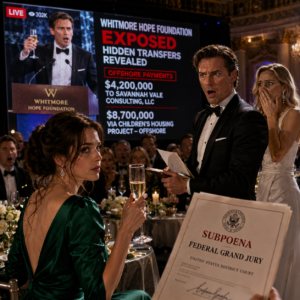
I built a spreadsheet that night. Over the next two years it became the most important document of my life: every grant, every “consulting fee,” every transfer, cross-referenced by date, tracing the path from a donor’s good intentions through Savannah’s firm, through two shell companies with names like law offices, and out to an account in a Caribbean jurisdiction that doesn’t answer American subpoenas without a fight. Eight point seven million dollars, on the housing project alone. Millions more across a dozen other “programs” that existed on letterhead and nowhere else.
I did not confront him. Confronting him would have warned him, and a warned Maxwell would have lawyered the evidence into a fog and had me declared unstable—he’d been laying that groundwork for years, every time he told a dinner table I was “going through something.” A wife who knows and says nothing is worth ten wives who scream. I learned that from the person who taught me the most about how to survive the Whitmores.
Lillian.
Maxwell’s mother was named Lillian Whitmore, and I need to be clear that I have two mothers-in-law in this story, because the Whitmores collect wives and the woman who cried into a napkin at the gala was Maxwell’s mother by his father’s second marriage—cold, ornamental, loyal to her son’s ambition. But Lillian was the first. The original. Maxwell’s grandmother, technically, the widow of the man whose money started it all, and the only Whitmore who ever looked at me like a person instead of a line item.
Lillian had watched them for sixty years. She had buried a husband who built the fortune and a son who inherited it, and she had watched her grandson Maxwell turn a family foundation—her late husband’s one attempt at decency—into a laundromat. She couldn’t prove it, at ninety-one, from a wheelchair, with her faculties sharp but her body failing. But she knew.
Six months before she died, she asked me to visit her alone, and she put an old digital voice recorder in my hand, and a small brass key, and she said the sentence I have carried like a stone in my pocket ever since.
“They will underestimate you, Eleanor. Every one of them. Let them.” Her hand closed over mine. “Underestimation is the only inheritance in this family that’s ever been worth anything. It’s the one thing they hand you for free. Take it. Use it. And when you finally move, move all at once, in front of everyone, so there’s no version of the story where it didn’t happen.”
The recorder held a conversation she’d captured in her own sitting room, on an afternoon Maxwell thought the old woman was napping. Maxwell and Savannah, discussing—in the lazy, unguarded voices of people who believe they’re alone—how to “clean the Harrow Street numbers before the next audit,” and which consulting entries were “soft enough to survive a look.” It was not everything. But it was his voice, and her voice, and the words clean the numbers, and it was the keystone my paper trail had been missing: proof that the pattern wasn’t error. It was intent.
The brass key opened a safe deposit box Lillian had kept in her own name at a bank the Whitmores didn’t use, containing the foundation’s original trust documents—the real ones, drafted by her late husband, not the amended version Maxwell circulated. I’ll come back to those, because they matter more than I understood at the time.
I spent the last two years building the case a real prosecutor could use. I did not do it alone, and I did not do it sloppily, because I had watched too many wronged women lose everything by moving in anger. I retained an attorney with no connection to the Whitmore orbit—a quiet, ferocious woman named Diane Okafor who had spent a decade in the fraud unit of the U.S. Attorney’s office before going private. I hired a forensic accountant through her, under privilege. We backed up every document to places Maxwell couldn’t reach. And Diane made the introductions that mattered: by the month of the gala, the paper trail I’d started at a kitchen table was already sitting, quietly, on a desk at the FBI’s field office, where financial crimes agents had opened a file.
The gala was not my ambush. It was my deadline. Maxwell had scheduled the livestreamed spectacle to get ahead of the divorce narrative, to brand me the villain before I could speak. Diane and I simply decided that the night he chose to tell three hundred thousand people his story would be the night the evidence told mine.
Everything was ready. Every document verified, every transfer traced, the subpoena drafted, the FBI briefed, the AV contractor Diane had legally retained standing by to display our exhibits the instant Maxwell’s own screen was handed to us by the venue’s terms.
And then, four days before the gala, my forensic accountant called me with a shake in her voice I’d never heard, and my clean, careful, six-year war nearly came apart in a single afternoon.
“Eleanor,” she said. “There’s a signature on one of the shell company transfer authorizations. The Harrow Street diversion, the big one.” A pause. “It’s yours.”