Part 4
He got as far as the top of the airstair.
I’ve thought about that image many times—Maxwell Whitmore III, in a cashmere travel coat, one foot inside the cabin of a jet bought with stolen money, turning around to find the country he’d stolen from waiting for him on the runway. He did not run. There was nowhere to run to that wasn’t also owned, in some ledger somewhere, by the crimes he was fleeing. He came down the stairs slowly, and an agent took the briefcase from his hand, and inside it were the documents he’d been most desperate to destroy.
They were not, it turned out, only about him.
That briefcase was the reason the case became something much larger than one embezzling husband. Maxwell had kept records—men like him always keep records, because the same arrogance that lets you steal from orphans convinces you you’ll never need to explain it—and those records didn’t just document his own theft. They documented the others. Which “consulting firms” belonged to which board members. Which “community outreach grants” had funded which political campaigns. Which senators had spoken at which galas in exchange for which quiet considerations. In trying to carry the evidence out of the country, Maxwell delivered a map of an entire ecosystem of laundered charity money directly into federal hands.
The indictment, when it came, was long, and it did not come all at once, and I want to be honest about that because the fantasy version of this story ends with a single dramatic collapse and the real one didn’t. Justice, when it is real, is slow and procedural and exhausting. Maxwell was charged with wire fraud, money laundering, misappropriation of charitable assets, and—because of the document I’d held back—aggravated identity theft and fabrication of evidence for the forged authorization bearing my name. That last one mattered more than all the rest to me personally, because it was the crime he’d committed specifically to destroy me, and it was the one the jury understood most viscerally: he stole from foster children, and then he tried to frame his own wife for it.
The trial took most of a year. His excellent attorneys earned their excellent fees. But the forensic report did not develop amnesia, the metadata did not change its mind, and Savannah’s cache spoke in Maxwell’s own voice. He was convicted on the major counts. The sentence was long enough that the cashmere-coated man who’d livestreamed my humiliation will be an old man before he chooses his own dinner again.
Savannah Vale faced her own reckoning, and I made sure the court understood the difference between cooperation and innocence. She testified—fully, damningly, for days—and her testimony was essential, and it also did not wash her clean. She had co-founded the laundering structure; she had profited for years; she had known exactly whose housing money paid for her firm’s glass offices. Her cooperation earned her a reduced sentence, not an absolution. She served time. Less than Maxwell, more than nothing, which is exactly what her choices had earned, and I felt neither triumph nor pity watching it, only the flat satisfaction of a ledger balancing.
The rest of the family sorted itself the way families do under subpoena. Maxwell’s mother—the ornamental one, who’d cried into the napkin—turned out to have known enough to be embarrassed and not enough to be charged; she left for Europe and does not write. His sister, who had smiled like justice at the gala, was found to have received “consulting fees” for a job that did not exist, and she entered into a quiet settlement that cost her a great deal and her name a great deal more. The board members whose firms appeared in Maxwell’s briefcase were investigated in turn, some charged, some merely ruined, the punishment falling in proportion to the crime rather than in a single satisfying avalanche.
And the foundation came to me.
The moment the court entered its finding of fraud, Lillian’s clause activated exactly as her husband had written it sixty years before. Control of the Whitmore Hope Foundation passed out of the hands of the men who’d looted it and into the successor trusteeship she had sealed in a safe deposit box and left to a daughter-in-law everyone underestimated.
I did not keep it as a monument. That was the choice that mattered, and I made it the first week. I could have run it, renamed it, installed myself at the head of the table Maxwell used to preside over. Instead I brought in independent trustees, an outside auditor chosen by lottery from a rotating pool, and a governing rule written in language even a Whitmore couldn’t misread: no single officer would ever again hold sole authority to move charitable funds, and every dollar would be traceable, by any donor, from intention to outcome. I built the foundation my husband had pretended to build. I built it to be un-lootable.
And I built Harrow Street.
The forty units of transitional housing for teenagers aging out of foster care—the building that existed for six years only as a fenced lot and a lie—opened two autumns after the gala, funded by recovered assets and restitution and, fittingly, by the forced sale of a certain private jet. Forty kids who would otherwise have gotten a garbage bag and a bus schedule got instead a room with a door that locked, and a caseworker, and a kitchen, and an address they could put on a job application.
I did not name the building after myself, and I did not leave Maxwell’s name on the sign that had faded over the weeds for six years.
I named it Lillian House.
At the opening, there was no livestream. There were no senators, because the senators were mostly busy with their own attorneys by then. There was a ribbon, and a modest crowd, and forty teenagers touching the walls of a place that was finally, actually theirs. I stood at the back, near the kitchen, the way I’d sat at the back of the ballroom near the kitchen, and I watched, and no camera looked for my face because no one had paid to see me break.
People ask me—they always ask me—whether there’s someone new. Whether the story has the ending where a better man arrives to prove I was worth keeping all along. I understand why they ask. We’re trained to believe a woman’s victory isn’t complete until someone re-selects her.
But I ran that equation the way my grandfather taught me, and it doesn’t balance. I did not survive six years of the Whitmores to make myself the prize in someone else’s story again. I have Lillian House. I have a foundation that can’t be robbed. I have my own name back—my real one, the one Maxwell tried to paste onto his crime—and it means exactly what it says when I sign it now. I am not lonely. I am, for the first time in ten years, unowned.
I took off my wedding ring the morning the verdict came in. I did not throw it into a river, because I am my grandfather’s granddaughter and I don’t waste an asset. I donated it to the foundation’s first benefit auction, where it sold to a stranger for a sum that put two more kids through their first year of community college. It was, I calculated, the single most useful thing that ring ever did.
I still have Lillian’s recorder. It sits on my desk at Lillian House, not as evidence anymore—the trial is over—but as a reminder. Sometimes a young caseworker asks about it, this scratched old device among the new computers, and I tell them it belonged to a woman who spent sixty years being underestimated by powerful men, and who turned that underestimation into the only weapon they never thought to take away from her.
They will underestimate you, she wrote. Let them.
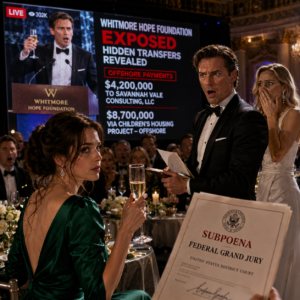
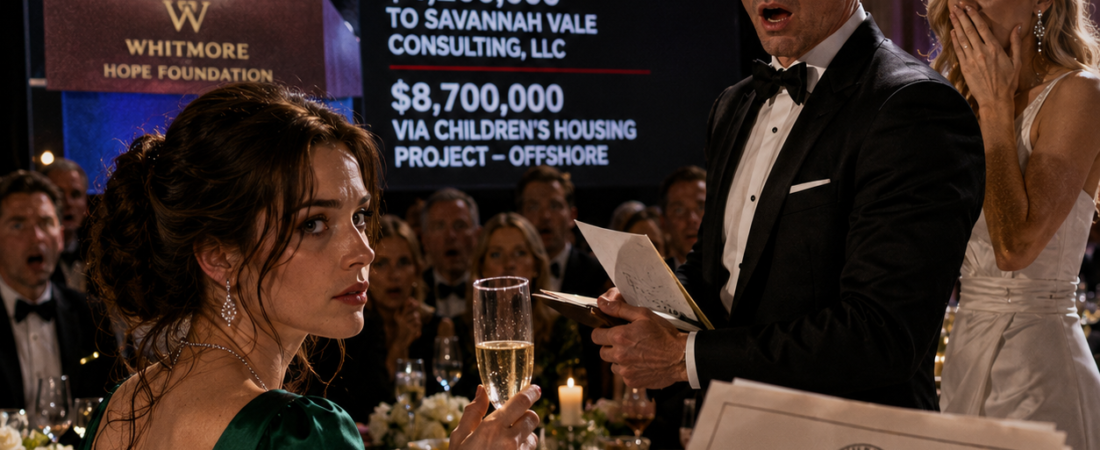
Three hundred thousand people watched my husband try to turn my life into entertainment under a chandelier the size of a small moon.
Not one of them—not him, not his mother, not the cameras, not the counter climbing toward a million—ever once considered that the quiet woman in the green dress at the table by the kitchen had already won, six years earlier, at three in the morning, with a legal pad and a dead woman’s warning and the one thing money could never buy back once it was spent.
The truth. And the patience to wait until the whole world was watching to spend it.