Part 3
I drove to Diane’s office with my hands cold on the wheel.
The document was real—that was the horror of it. A wire authorization moving $8.7 million out of the Harrow Street housing account into the first of the shell companies, dated three years earlier. And at the bottom, on the authorizing signatory line, was my signature. Not an approximation. Mine. The exact loops of my name that I’d signed ten thousand times on Christmas cards and school-auction checks and the marriage license that started all of it.
“He built me a parachute,” Maxwell said in my head, in that reasonable voice. Except it wasn’t a parachute for me. It was a trapdoor.
I understood it instantly, because I had spent six years learning to think the way he thought. If the fraud ever surfaced—and some part of Maxwell must have always known it might—he needed a story where he wasn’t the only one holding the knife. A joint signature made me a co-conspirator. It transformed the entire narrative from a husband who stole from orphans into a couple who stole from orphans and then turned on each other, which is a story juries hate and prosecutors avoid. My “clean hands,” the whole foundation of my strategy, could be poisoned by a single forged flourish of my own name.
“This is sophisticated,” Diane said, laying the document beside a genuine one. “It’s not traced by hand—look, the pressure’s too even. It’s a digital lift. Someone took your real signature off an existing document, vectorized it, and applied it. Which is actually good news.”
“How is any of this good news?”
“Because a hand-forgery is your word against the page. A digital forgery is a crime with a fingerprint.” She tapped the document. “Real signatures have variation—no two are identical, because you’re a human being with a hand that shakes differently every day. This one is identical to a signature that already exists somewhere. Find the source document, prove this is a copy of that one, and we don’t just clear you. We prove intent to frame, which is worth more to us than gold.”
We had four days.
We found it in three. My forensic accountant, working backward through every document I’d ever genuinely signed for the foundation, matched the forged signature—pixel for pixel, down to a tiny stray ink-skip in the capital E—to a consent form I’d signed at a 2019 board dinner. The exact same signature. Not similar. Identical, which a living hand cannot produce twice. Someone had scanned that consent form and pasted my name onto a fraud I’d never seen.
And the metadata on the forged authorization—the hidden data every digital file carries—showed it had been created not three years ago, as its printed date claimed, but eleven months ago, on a device registered to the foundation’s offices. Backdated. Manufactured recently, by someone anticipating exactly the reckoning that was coming.
I had my proof. But Diane made a decision that saved everything: we would not reveal the forgery at the gala. “We show the transfers,” she said. “The real crime, the eight-point-seven million. We put that on the screen and let the FBI file speak. We hold the forged-signature evidence back. Because Eleanor—the moment we expose the money, he is going to reach for the frame. He’s going to point at you. And when he does, in public, on the record, we let him commit to that lie completely. Then we prove it’s a forgery, and we don’t just win the fraud case. We catch him fabricating evidence against you, which is its own felony, and it destroys his credibility on everything else.” She almost smiled. “We let him underestimate you. We let him think the signature is his ace. And then we take it away in front of the same cameras he loves so much.”
Lillian, I thought. This is exactly what you meant.
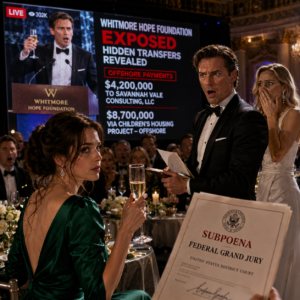
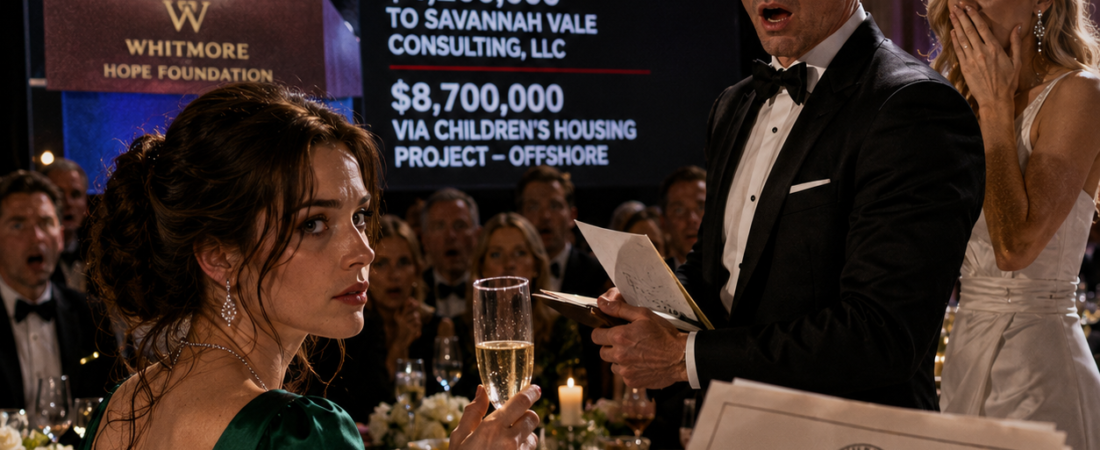
So the gala unfolded the way you already know. The screen. The transfers. Keep filming. This is the part where the FBI gets interested. I watched three hundred thousand people—and a ballroom of senators and CEOs—see the first two payments, and I watched Maxwell Whitmore’s face go from gala-tan to paper-white, and I felt Lillian’s brass key in my clutch like a heartbeat.
But a gala is not a courtroom, and the next morning, Maxwell did precisely what Diane predicted.
He surfaced the signature.
By noon, his crisis PR firm had released the document to every outlet that had covered the gala. There it was, my signature, on the largest single diversion of children’s housing money. His statement was a masterpiece of inversion: he was “devastated to reveal” that the true architect of the foundation’s financial irregularities was his estranged wife, a woman with “documented emotional instability” who had “manipulated foundation accounts” and was now “staging an elaborate public spectacle to escape accountability and destroy the man who was preparing to expose her.” His mother gave a tearful interview. His sister tweeted about “the real victim.” Savannah, dressed in mourning now instead of bridal white, told a morning show that she’d “always been uncomfortable with Eleanor’s involvement in the finances.”
The narrative split the country down the middle. Half the internet had watched me stand up in a green dress and become a folk hero. The other half now saw a scorned wife who’d embezzled from orphans and blamed her husband. For forty-eight hours, I was both the woman who exposed a monster and the monster who’d framed a good man, and I learned that the truth does not travel at the speed of a lie—it travels at the speed of evidence, which is slower, and which requires patience I nearly didn’t have.
I did not respond publicly. Diane forbade it, and Diane was right. “Let him build the lie tall,” she said. “The taller he builds it, the further it falls.”
Two things brought it down.
The first was the forensic report. Diane submitted it to the FBI and, once the criminal referral was formalized, to the court: the metadata proving the authorization was created eleven months ago and backdated, the pixel-identical match to my 2019 consent form, an independent examiner’s sworn conclusion that my signature had been digitally lifted and applied to a document I had never signed. It did not merely clear me. It proved that someone with access to the foundation’s own systems had manufactured evidence to frame me—and the device it was created on was registered to Maxwell’s office.
The second was Savannah.
She called me herself, four days after the gala, and I almost didn’t take it. When I did, her voice had lost every ounce of the handkerchief performance.
“He’s going to give you to the FBI,” she said. “You and me both. I’ve seen the strategy memo, Eleanor. His lawyers are going to argue that you and I ran the whole thing together and he was the trusting figurehead who signed what we put in front of him. He’s going to walk out of this as the deceived husband, and you and I are going to prison.” A breath. “I have everything. Every email where he directed the transfers. The real accounting. Text messages where he laughs about the Harrow Street kids. I’ll give you all of it. But I want a deal. I’m not dying in a cell so that man can marry someone younger.”
I did not trust her. I want to be very clear about that, because the easy version of this story is the one where the wife and the mistress become sisters in arms. That is not what happened, and I would not have respected either of us if it had. Savannah Vale had knowingly built the machine that stole housing from foster children. She had worn white to my public execution. Her fear was real, but her fear was not innocence.
“Send it to my attorney,” I told her. “All of it. And understand something, Savannah. I will use every document, and I will verify every one independently before I believe a syllable of it, and none of it buys you a clean exit. You don’t get to be a victim. You get to be a witness. Whether that’s worth anything to you is between you and the U.S. Attorney. It is nothing to me.”
She sent it that night. My forensic accountant spent two days authenticating it against the trail I’d already built, and it fit—every email, every text, every number slotting into the spreadsheet I’d been keeping since 3 a.m. at my own kitchen table two years before. Savannah’s cache didn’t reveal anything I hadn’t traced. It corroborated all of it, in Maxwell’s own words, which is the difference between a case and a conviction.
And then I finally understood the last thing Lillian had left me—the trust documents in the safe deposit box, the ones I’d been too busy to fully read.
I read them that week, and I sat down hard when I did.
Lillian’s husband, when he created the Whitmore Hope Foundation sixty years ago, had written it with a provision his descendants apparently never bothered to read—the same way Maxwell never read anything that assumed he might one day be the problem. The founding trust contained a clause: in the event that any officer of the foundation was found, by a court or federal authority, to have converted charitable assets to personal use, all control of the foundation would pass immediately and irrevocably out of the officers’ hands and into a successor trustee designated in a sealed instrument held by the founder’s spouse.
Lillian was the founder’s spouse. And the sealed instrument, filed with those documents, in her careful hand, named her successor trustee.
Me.
The old woman in the wheelchair had seen the whole thing coming. She couldn’t stop her grandson while she was alive—she was ninety-one and he controlled the accounts. So she’d done what her husband did: she’d built a trap into the paper, decades deep, that would only ever spring if a Whitmore proved to be exactly what she feared. If Maxwell had been honest, the clause would have slept forever and I’d never have known she doubted him.
He had not been honest. And now, from beyond the grave, Lillian Whitmore was handing me her family’s foundation—on one condition. The clause activated only upon a formal finding of fraud.
Which meant everything still came down to whether Maxwell faced justice before he could disappear.
He tried to disappear on a Tuesday.
The FBI file had become a formal investigation. The forensic report had cleared me and implicated him. Savannah’s cache was in federal hands. And Maxwell Whitmore III, watching the board of his own foundation call an emergency session and his political friends stop returning calls, did the thing cornered men with private planes always do.
He drove to the airfield where he kept a jet—purchased, my spreadsheet showed, through one of the same shell companies that had swallowed the Harrow Street money—and he loaded it with luggage and a hard drive and a briefcase of documents, and he filed a flight plan for a country that does not extradite.
What he did not know was that the jet had been named in Diane’s asset-freeze filing that same morning, and that the moment his flight plan hit the system, three federal agents were already walking across the tarmac toward the stairs.