Part 1
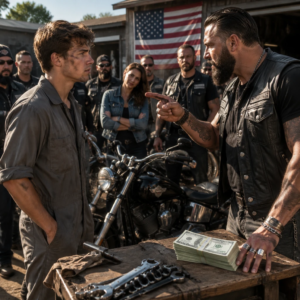
The biker counted four thousand dollars from the wallet I returned, then asked why a homeless kid had not kept it.
I had no good answer ready. The truth sounded too small to explain the way my life had fallen apart.
“It wasn’t mine,” I said.
The man sitting across from me stopped counting. One thumb rested on the last bill, a crisp hundred-dollar note pressed against the diner counter. He looked at the cash, then at my shoes, as if both were evidence in a case nobody had told me about.
His name was Ray Callahan. I learned that later.
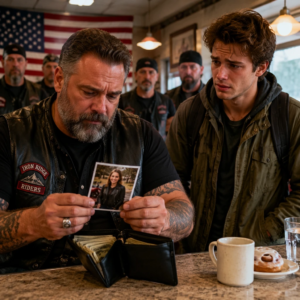
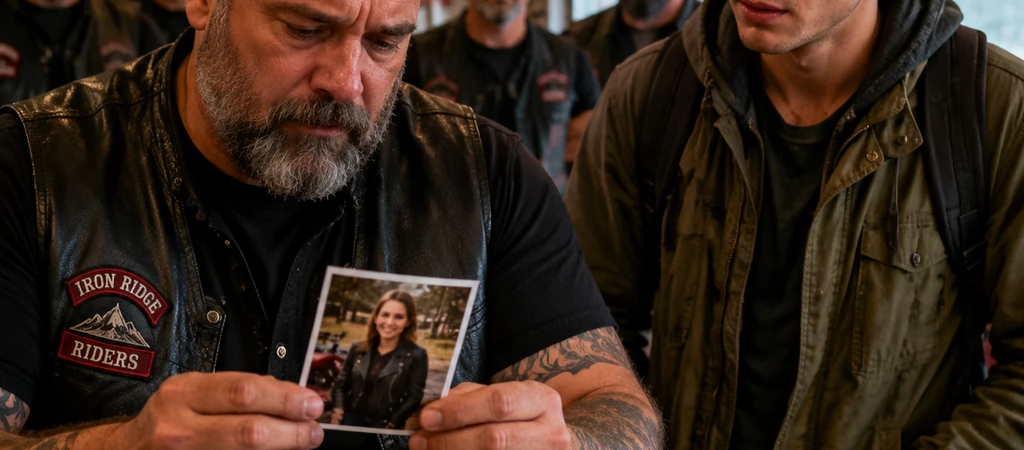
At the time, I only knew him as the broad-shouldered man in the black T-shirt and faded denim vest. A silver beard covered most of his jaw. His arms filled the sleeves of his shirt, and a small black patch near his shoulder showed the name of a motorcycle club called the Iron Valley Riders.
The patch looked heavy enough to make people step aside.
I had seen a dozen of those riders outside the diner that morning. Their motorcycles lined the curb beneath a flickering sign that read BLUE STAR CAFE. Chrome caught the pale October sun. Boots moved across the sidewalk. Low voices carried through the glass.
I almost turned around when I saw them.
Then I remembered the wallet in my hand.
It was brown leather, thick and worn at the edges. I had found it beside a red newspaper box near the bus stop. At first, I thought it was empty. Then I opened it and saw the cash.
Four thousand dollars.
For someone with a warm apartment, four thousand dollars might have been a frightening amount to lose.
For me, it was the difference between eating for several weeks and pretending hunger did not hurt.
My backpack had one working strap. My olive jacket smelled faintly of rain because I had slept in it under the awning of a closed hardware store. I had not had a real shower in five days. My phone battery was dead, and the last person I could call had stopped answering two months earlier.
Still, I walked into the diner.
The bell above the door gave one weak ring. Warm air touched my face. I smelled coffee, bacon, and toast. My stomach tightened so sharply that I had to grip the wallet with both hands.
A waitress carrying three mugs looked me over.
“Can I help you?” she asked.
“I’m looking for the owner of this.”
She glanced at the wallet, then at the riders near the counter.
“Ask the big guy in the vest.”
That was how I ended up standing in front of Ray Callahan while the whole room seemed to listen.
I placed the wallet on the counter.
“Are you Ray?”
His eyes moved over me slowly. Not cruelly. Carefully.
“Who’s asking?”
“I found this outside.”
He did not reach for it at first.
“Where?”
“By the bus stop.”
“When?”
“About ten minutes ago.”
His gaze dropped to my hands. My fingernails were dirty from sleeping outdoors. A thin cut crossed my knuckle. I had tried to wash it in a public restroom, but the paper towel dispenser had been empty.
Ray finally picked up the wallet.
He opened it and checked the identification card. Then he studied me again.
“You look like you could use what’s inside.”
The diner went quiet enough for me to hear a spoon tap against a coffee cup.
I could have lied. I could have said I never opened it. I could have handed it over and walked out before he asked questions. Instead, I stood there with my backpack hanging from one shoulder, feeling every pair of eyes on my face.
“I do,” I said.
Ray’s expression did not change.
“How much did you take?”
“Nothing.”
“That wasn’t my question.”
I swallowed.
“Nothing,” I repeated.
He pulled the bills from the wallet and spread them across the counter. The money made a soft paper sound as he counted it. One hundred. Two hundred. Five hundred. The bills kept coming.
Nobody spoke.
I stared at the red ketchup bottle beside his elbow because looking at him felt like asking to be believed.
When he finished, he tapped the stack against the counter.
“Four thousand dollars,” he said. “You returned every cent?”
“It wasn’t mine.”
Ray leaned back in his stool.
“People say that when they want credit for doing the right thing.”
“I don’t want credit.”
That answer seemed to bother him more than the money had.
A woman at the end of the counter turned in her seat. She wore a blue diner uniform and had a pencil tucked behind one ear.
Ray pointed at my backpack.
“Where are you staying?”
“Outside.”
“Outside where?”
“Wherever I can.”
“That’s not an answer.”
“It’s the one I have.”
For a moment, nobody moved.
I had become good at making people uncomfortable without meaning to. Some looked away. Some asked questions they did not want answered. A few offered advice, as if a person could sleep his way out of homelessness by making better choices for one night.
Ray did not look away.
He picked up the identification card again.
“Twenty years old,” he said.
“Yeah.”
“Parents?”
“Not around.”
“Girlfriend?”
“No.”
“Friends?”
I almost said yes. The word rose automatically, then died before it reached my mouth.
Ray noticed.
He slid the identification card back into the wallet.
“Name?”
“Noah.”
“Noah what?”
“Bennett.”
“Where’d you come from, Noah Bennett?”
“Cedar Grove.”
“That’s three miles from here.”
“I know.”
“Why are you sleeping outside if you’re from three miles away?”
Because my mother’s house had been sold. Because my stepfather said I had until sunset to leave. Because the job at the auto parts warehouse ended when the owner closed the place. Because every shelter bed in the county filled before noon.
I did not say all of that.
People rarely want the whole truth. They want a clean reason they can understand and forget.
“My housing fell through,” I said.
Ray’s fingers tightened around the wallet.
“Your housing fell through?”
“That’s what happened.”
“And you decided a bus stop was the next step?”
“I didn’t decide anything.”
The waitress with the pencil came over and set a mug of coffee in front of Ray.
“Ray, leave the kid alone.”
“I’m asking him questions.”
“You’re interrogating him over breakfast.”
“He walked in here holding four thousand dollars.”
“He walked in here returning four thousand dollars.”
Ray looked at her.
“June, you know how many people would have kept it?”
“Enough that I don’t want to hear about them before nine in the morning.”
A few riders laughed under their breath, but Ray did not.
He looked back at me.
“Did you see the name on the ID before you came in?”
“Yes.”
“Did you know who I was?”
“No.”
“Did you see the motorcycles outside?”
“Yes.”
“And you still came in?”
“I figured you’d want your wallet.”
“That simple?”
I nodded.
The truth was, it had not felt simple. I had stood beside the newspaper box for almost five minutes with the wallet open in my hands. I had imagined food first. A motel room second. A new phone charger. A pair of shoes that did not let rain in through the sole.
Then I imagined the owner searching his pockets.
That image had bothered me more than hunger.
My father used to say a person could lose everything and still keep one thing for himself. He said it during the last winter before he left. I had been eleven, and I did not understand what he meant.
Years later, I thought I did.
Ray placed the money back in the wallet and closed it.
“What did you need this morning?”
I looked at the menu above the counter. Eggs, toast, hash browns, and coffee cost $8.75. I had memorized the price because I had stood outside the diner the day before, staring through the window.
“Nothing,” I said.
June snorted.
“That’s a lie.”
“I’m fine.”
“You’re shaking.”
I tucked my hands into my jacket pockets.
“I haven’t eaten yet.”
Ray’s face changed slightly. It was not pity. I had seen pity before, and pity always made people look away too quickly.
This was something harder to name.
He took out his wallet, then stopped.
“Did you return mine because you thought I’d pay you?”
“No.”
“Then why?”
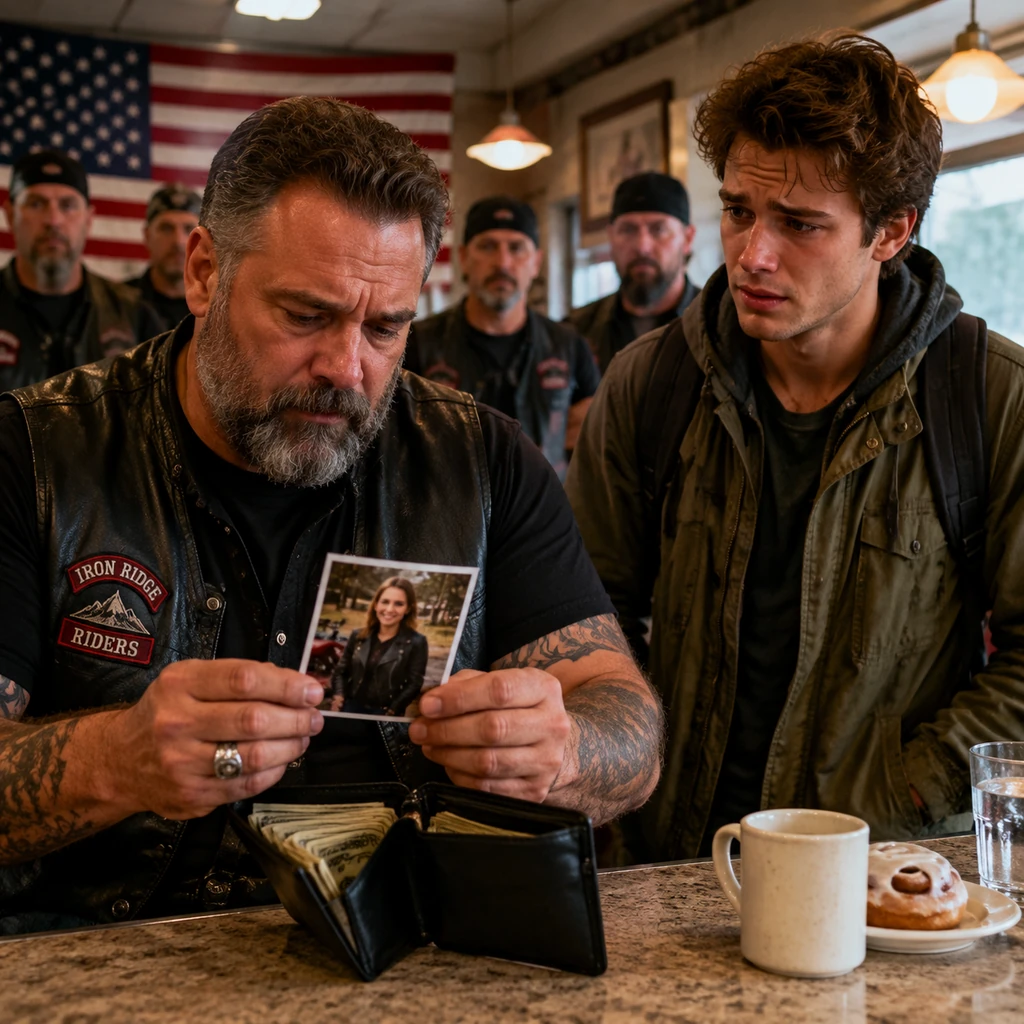
I looked at the cash between us.
“Because if I kept it, I’d know what kind of person I was.”
Ray said nothing.
The diner’s front door opened, and cold air swept across the room. Three more riders came in, bringing the smell of gasoline and wet pavement with them. One of them glanced at me, then at the wallet.
Ray lifted one hand. The man stopped asking questions before he started.
I expected Ray to hand me a few dollars. Maybe he would tell me to get cleaned up. Maybe he would say there was a shelter near the highway.
Instead, he pushed the wallet into the pocket of his vest and pointed at the stool beside him.
“Sit down.”
I stayed where I was.
“I’m not asking for anything.”
“I didn’t offer you anything.”
“I should go.”
“You should eat.”
“I can’t pay.”
“Did I ask you to?”
The question landed harder than it should have.
Ray turned toward June.
“Put eggs, bacon, toast, and coffee on my tab.”
June picked up her pencil.
“Anything else?”
Ray looked at me.
I wanted to say no. I wanted to keep the last piece of pride I had managed to carry through the door.
But my knees were weak, and the smell of bacon had become almost painful.
“Just toast,” I said.
Ray gave me a level look.
“You need more than toast.”
“I can handle toast.”
“That’s not the same as needing it.”
June wrote on her pad.
“Eggs, bacon, toast, and coffee,” she said. “The kitchen will survive your disagreement.”
I sat on the stool.
The vinyl squeaked beneath me. My backpack slid toward the floor, and the strap nearly broke. I caught it before it fell.
Ray saw the motion.
“You carry everything you own in there?”
“Most of it.”
“What’s the rest?”
“A blanket.”
“You got a place to use it?”
I looked toward the window.
Beyond the glass, the Iron Valley Riders stood beside their bikes. Their jackets were black and gray, their boots scuffed, their faces weathered by years of wind. They looked like men who had chosen one another and never had to explain why.
I had spent months moving through places where nobody knew my name. A bus station. A church basement. A laundromat open all night. The back corner of a twenty-four-hour grocery store until an employee told me to leave.
Nobody had asked where I belonged.
Ray followed my eyes.
“You don’t need to worry about them.”
“I’m not worried.”
“You are.”
“I’m just looking.”
“That’s how worry starts.”
June brought the coffee. The steam rose between us. I wrapped both hands around the mug but did not drink until she walked away.
Ray watched me take the first sip.
“Too hot?”
“No.”
“Too bitter?”
“No.”
“Then why do you look like you’re waiting for someone to take it back?”
I stared into the coffee.
“Because people usually do.”
His jaw tightened.
For the first time, I saw something beneath the stern face. Not softness. A memory, maybe. Something he kept locked down because letting it out would cost him.
He took the wallet from his vest again and held it between us.
“You could’ve walked away,” he said.
“Yes.”
“You could’ve taken enough that I wouldn’t notice.”
“Yes.”
“You could’ve turned it in somewhere and left your name.”
“I didn’t.”
“Why not?”
“Because I didn’t want a reward.”
Ray studied me as if the answer had opened a door neither of us expected.
The kitchen bell rang. My plate arrived, and for a few seconds, the world narrowed to eggs, bacon, and toast. I ate slowly at first. Then I stopped pretending I was not hungry.
Ray did not comment. He simply turned his coffee cup in his hands while I finished.
When the plate was empty, he reached into his vest and pulled out a business card. It was plain white, with a phone number and the name of a repair shop printed in blue.
“Come by tomorrow morning,” he said.
I looked at the card but did not take it.
“For what?”
“Work, maybe.”
“Doing what?”
“Whatever you can do.”
“I don’t know much.”
“Do you know how to show up?”
“Yes.”
“Do you know how to tell the truth?”
I glanced at the wallet.
“I’m trying.”
Ray slid the card closer.
“Then start there.”
I picked it up.
His hand remained on the counter beside mine. His knuckles were scarred. A thin gold ring circled one finger.
“You don’t owe me for breakfast,” he said.
“I can pay you back.”
“I didn’t say you couldn’t.”
That almost made me smile.
Then the diner door opened again.
A tall man with a shaved head stepped inside. He wore the same Iron Valley patch, but unlike the others, he did not look at me with curiosity. He looked at me with recognition.
His eyes dropped to the business card in my hand.
Then he walked straight toward Ray.
“Boss,” he said quietly, “we need to talk about the kid.”
Ray’s expression hardened.
I set the card on the counter.
The man leaned closer to him and whispered something I could not hear. Whatever it was, Ray looked at me differently when he finished.
Not like a hungry stranger.
Not like a homeless kid.
Like someone who had just become connected to a problem I knew nothing about.
Ray turned toward me.
“Go outside, Noah.”
My stomach dropped.
I pushed away from the counter. The room seemed colder than before. I reached for my backpack, but Ray caught my wrist.
His grip was firm, not painful.
“Wait.”
The man with the shaved head looked surprised.
Ray kept his eyes on mine.
“I want to ask you one more question.”
I nodded.
“Someone else saw you find that wallet,” he said. “Did they follow you here?”
I thought about the bus stop. The newspaper box. The gray sedan idling across the street. I had noticed it, but I had assumed the driver was waiting for someone.
Then I remembered the figure standing near the laundromat entrance, watching me open the wallet.
“I don’t know,” I said.
Ray released my wrist.
The man beside him folded his arms.
“Who are you really?”
The question brought back every locked door, every suspicious glance, every person who had decided my clothes told them the whole truth.
I could have lied again.
Instead, I reached for the business card.
“I’m Noah Bennett,” I said. “I found a wallet. I returned it. That’s all.”
Ray looked toward the window.
Across the street, the gray sedan was gone.
He turned back to me and lowered his voice.
“If you walk out now, you may be walking into something you don’t understand.”
I held the card between my fingers.
For months, I had been surviving by leaving before anyone could reject me. That morning, I had one chance to do the opposite.
I looked at Ray, then at the riders gathered near the door.
“I’ll stay,” I said.
Ray nodded once.
Then he pulled out a chair beside him and motioned for me to sit.
That was the moment I decided to stop running, even though I still had no idea what was waiting for me inside that room.
What happened next changed everything. Tell me what you think, leave a reaction, or share, then read the full story in the comments.